
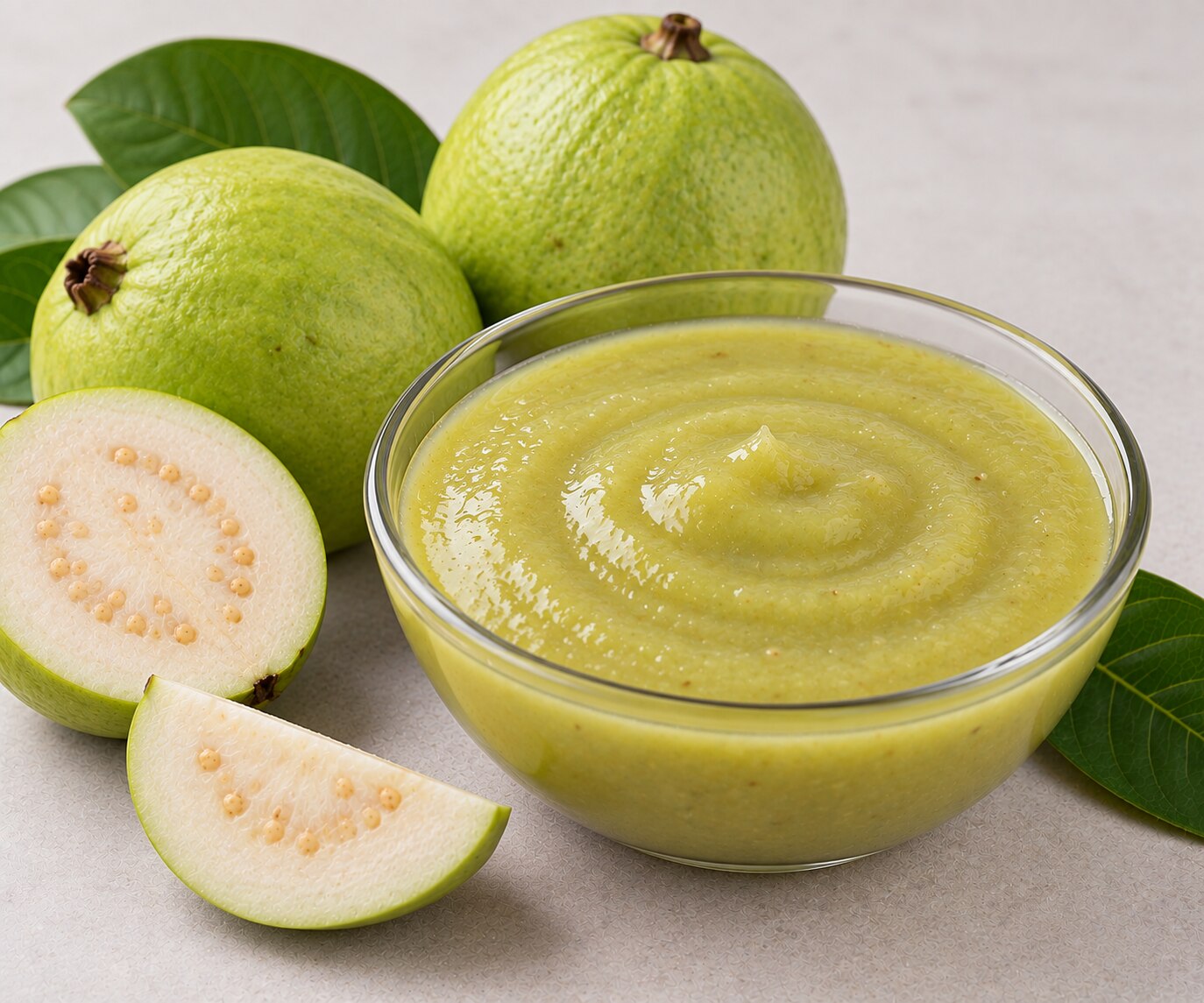
White guava puree is a suspension of pulp particles, cell-wall fragments and colloidal material, not a true solution. You can identify whether the failure is ordinary settling, air flotation, serum release or irreversible flocculation, then correct the formulation and process with targeted tests rather than adding stabiliser at random.
Key takeaways
- Check whether separation is settling, syneresis, or surface flotation.
- Control dilution, pH, enzymes, and minerals before adding stabilisers.
- Pair stabiliser selection with high-shear mixing and hydration steps.
- Validate every correction in a controlled bench trial first.
First identify what is separating
A compact layer at the bottom usually means normal pulp settling, while a clear liquid layer signals serum release, also called syneresis. A pale layer at the surface points to air flotation or low-density pulp flocs. These failures look similar at a glance but need different corrections.
- Bottom sediment that resuspends easily after gentle shaking: normal pulp settling. Large or dense insoluble particles have moved downward under gravity.
- Clear serum above or throughout the drink: serum release. The continuous phase has lost enough structure to drain away from the pulp.
- Pale foam, a floating ring, or a light top layer: air flotation. Entrained air is carrying pulp flocs upward.
- Grainy sediment, curd-like clumps, or a rubbery layer that will not redisperse: irreversible flocculation. Particles have aggregated through pectin changes, minerals, enzymes, acid or heat damage.
White guava puree is a suspension, not a solution. Its cell-wall fragments, pulp particles and colloids sit in a serum phase, so dilution can expose density and particle-size differences hidden in concentrated puree.
Run the shake test before changing the formula. If the drink becomes uniform and stays that way, investigate settling or trapped air; if clumps remain, treat it as flocculation or serum release.
This first diagnosis is the practical answer to “why white guava puree for separates in drinks and how to fix it,” and it prevents the wrong fix for white guava puree separation.
How dilution, pH, enzymes and minerals destabilise the drink
A stable concentrate can separate after dilution because the drink no longer has enough serum viscosity or pectin structure to carry white guava pulp. Adding water lowers °Brix, reduces particle-to-particle support, dilutes native pectin, and changes ionic strength; the same puree inclusion can therefore need a different stabiliser dose in a ready-to-drink formula.
| Formulation change | What destabilises the suspension | Typical result |
|---|---|---|
| Lower °Brix or puree dosage | Less continuous-phase viscosity and fewer solids hold particles up | Faster settling and serum release |
| pH shift | Pectin charge and protein interactions change; a sharp acid drop can intensify flocculation or curdling | Clumps, clear serum, or compact sediment |
| Active polygalacturonase | Depolymerises pectin and lowers serum viscosity | Cloud loss and loose settling |
| Active pectin methylesterase plus calcium | Removes methyl groups, allowing calcium bridges between pectin chains | Coarse flocs, gelled sediment, or a floating ring |
| Mineral-rich dilution water | Calcium and magnesium alter pectin hydration and aggregation | Uneven texture or irreversible separation |
Check dilution water, pH and °Brix as a matched set, not as isolated readings. A pectinase treatment that improves puree extraction can destroy beverage stability if its dosage, residence time and deactivation are not validated at final dilution.
Calcium is not a universal repair: it can strengthen low-methoxyl pectin, but with pectin methylesterase it can worsen guava puree beverage problems. Compare untreated and enzyme-treated puree in the finished formula, then hold samples through storage; a stable concentrate alone proves little.
Choose the stabiliser and mixing process together
Select the stabiliser and its mixing sequence as one decision. White guava puree separation after dilution usually needs enough low-shear viscosity to hold pulp, not maximum thickness; excessive hydrocolloid creates slime, poor pour or a spoonable drink.
| Option | Useful behaviour | Main risk and process choice |
|---|---|---|
| Pectin | Builds body and can support a clean fruit texture | Needs control of pH, sugar, calcium and heat; calcium can cause coarse flocs or a gelled layer when pectin methylesterase is active |
| CMC | Adds suspension support with relatively controlled texture | Poor dispersion leaves fisheyes; hydrate fully before acidification |
| Xanthan | Strong shear-thinning suspension with good pour behaviour | Overdose gives slimy texture; disperse in sugar before high-shear mixing |
| Guar | Rapid viscosity and body | Overuse becomes thick and gummy; hydrate under controlled agitation |
| Gellan | Creates a weak network at low use levels | Overdose produces a gel or poor pour; test salt, calcium and heat effects |
- Pre-disperse the powder in sugar or another dry carrier. Add that blend gradually into water or diluted puree under controlled high shear; dumping powder into acidic guava drink traps dry centres inside fisheyes.
- Allow the selected hydrocolloid to hydrate for the supplier-specified time and temperature before adding acid, calcium, flavour or final puree. Simultaneous addition can lock in incomplete hydration.
- Homogenise only after hydration, then compare particle size, pour, air incorporation and shelf separation across pressure and pass count. A finer dispersion cannot compensate for inadequate continuous-phase viscosity.
Match homogenisation and heat treatment to the beverage format
Use the beverage format to set homogenisation pressure, number of passes, heat load and fill temperature; the wrong combination creates guava puree beverage problems even when the puree looks stable.
| Format | Homogenisation and heat treatment | Filling and storage |
|---|---|---|
| Clear drinks | Use clarified guava fractions or a fine, narrow particle distribution; excessive shear can expose pectin and increase haze. Validate enzyme deactivation and avoid long hot holds. | Fill with minimal entrained air. Check for a clear layer and cloud loss after ambient and heat-abuse storage. |
| Nectars | Use enough pressure and passes to reduce large pulp particles without making the drink excessively fine. Apply validated pasteurisation or aseptic processing to inactivate pectin-degrading enzymes. | Fill at the process temperature that preserves viscosity and limits air pickup. Store samples at the intended temperature and under heat abuse. |
| Smoothies | Retain some particle structure; extreme homogenisation can produce a thin, serum-releasing drink. Limit post-mix holding time before heat treatment. | Fill promptly, then test refrigerated and ambient conditions if both are claimed. Sediment that compacts into a firm layer will not be fixed by shaking. |
| Juice blends | Match guava particle size to the other juices; density differences become visible during storage. Confirm the heat process does not rupture tissue or create cooked flavour. | Compare hot-fill or aseptic conditions at the actual package fill temperature. |
| Carbonated beverages | Homogenise before carbonation and remove entrained air; particles and bubbles otherwise rise together. Cool before carbonation to reduce foaming. | Fill cold, minimise headspace oxygen, and test pressure, temperature cycling and shelf life. |
| Dairy-based drinks | Validate protein compatibility after homogenisation and heating; acid or calcium changes can cause flocculation. | Fill under controlled temperature, then monitor refrigerated storage for curdling, serum release and sediment. |
Include particle-size distribution, viscosity, dissolved air and sediment height in process validation—not only pH and °Brix.
Run a controlled bench trial before changing the production batch
A passing bench trial uses the commercial dilution, package and storage conditions, not a spoonful of concentrated puree in a beaker. Run matched samples so you can separate a formulation failure from an incoming-puree failure.
1. Make three replicates of the current formula with the current puree lot. Record pH, °Brix, viscosity, puree dosage and mixing order, then photograph the drink immediately and after shaking.
2. Prepare the same formula with two or more incoming puree lots. Keep water, sugar, acid, stabiliser, homogenisation and heat treatment identical. Different separation between lots points to puree specification, particle-size distribution, enzyme activity or soluble-solids variation.
3. Prepare the current puree lot in the revised formula, changing only one factor: stabiliser level, pH, °Brix, homogenisation pass or heat treatment. A clean improvement here identifies the formulation or process variable; changing several factors hides the cause.
4. Fill each sample in the actual commercial package. Store one set at the intended temperature and another under a defined heat-abuse condition, recording serum layer, floating ring, sediment height, compactness and any curdling at fixed intervals.
5. Shake every sample once at the planned label instruction and repeat the inspection. If shaking restores uniformity, the change addresses reversible settling; if it does not, reject the formulation or lot for flocculation, gelation or serum release.
When qualifying guava puree for drink manufacturers, Zeus India Enterprise should provide the lot’s pH, °Brix, viscosity, treatment history and enzyme controls for comparison with the trial record. The winning condition is the one that survives storage, not the one that looks smooth after blending.
Related product
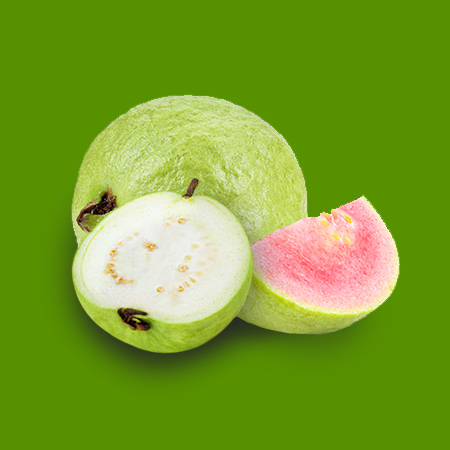 | White and Pink Guava Puree Zeus India is a trusted exporter and supplier of premium White Guava Puree and Pink Guava Puree in India, catering to the growing demands of the... View product → |
Frequently asked questions
What causes white guava puree separation in drinks?
Settling, serum release called syneresis, and surface flotation produce different layers. Dilution, pH, enzymes, minerals, and trapped air can destabilise the beverage.
How can you tell what is separating in a guava puree beverage?
A compact bottom layer usually indicates pulp settling, a clear liquid layer indicates syneresis, and a pale surface layer indicates air flotation or low-density pulp flocs.
How should you choose a stabiliser for guava puree drinks?
Choose the stabiliser together with its hydration and mixing process. A stabiliser that is suitable on paper can fail if it is dispersed poorly or added at the wrong stage.
Should homogenisation and heat treatment change by beverage format?
Yes. Match homogenisation intensity and heat treatment to the drink’s pulp level, viscosity, packaging, and intended shelf life, then confirm the result in a controlled bench trial.