
A quotation for guava puree is not a complete buying specification. Before you approve production, define the puree’s technical profile, packaging, handling conditions, commercial terms, test evidence, and export documents so the shipment can be received and used without avoidable reformulation or compliance delays.
Key takeaways
- Specify single-strength or concentrated puree, variety, application, and fruit content.
- Request viscosity, Brix, acidity, colour, texture, and sedimentation data.
- Confirm aseptic packaging, storage temperature, shelf life, and transport conditions.
- Match the quotation with Incoterms, payment terms, tolerances, and export documents.
Which technical details belong in your guava puree order?
Resolve guava puree exporters from India order details before discussing price. State whether you need single-strength or concentrated puree, the guava variety or origin, intended application, and acceptable fruit content. A beverage, nectar, sauce, filling, dessert, or dairy formulation may require different viscosity, colour, acidity, texture, and sedimentation behaviour.
- Set target ranges for Brix, pH, titratable acidity, viscosity, pulp content, sieve or mesh size, colour, flavour intensity, and texture. State your tolerance for seeds, skin, and fibre.
- Do not use Brix as a substitute for fruit content, acidity, or viscosity. Two lots with the same soluble-solids reading can perform differently because of cultivar, ripeness, insoluble solids, and processing conditions.
- Ask for the test method and acceptance range for every result: refractometer method for Brix, calibrated pH measurement, titratable-acidity method, viscosity instrument and test temperature, and sieve specification.
- Add microbiological limits, foreign-matter limits, pesticide-residue and contaminant requirements, and destination-market heavy-metal limits.
- Require the exact ingredient declaration, including sugar, acidulants, antioxidants, preservatives, and other permitted additives. “Natural,” “unsweetened,” “single-strength,” and “preservative-free” are descriptions, not complete declarations.
| Product form | Confirm before ordering | Main risk if unspecified |
|---|---|---|
| Single-strength puree | Target fruit content, Brix, viscosity, and pulp | A thin or diluted lot may fail your recipe |
| Concentrated puree | Concentration ratio, reconstitution method, Brix, acidity, and viscosity | Reconstitution can change flavour, sediment, and process performance |
What packaging and storage conditions will the shipment require?
The quoted puree format determines your freight, warehouse, and production risks. Ask whether it is aseptic, frozen, chilled, or hot-filled, then record the required storage temperature, unopened shelf life, transport-temperature evidence, and minimum remaining shelf life on arrival.
1. For an aseptic bag-in-drum or bag-in-box, confirm that the sealed pack can travel without frozen storage. Its ambient shelf life ends when opened. Agree beforehand on refrigerated temperature, maximum use period, hygienic transfer, and the pump, fittings, or other discharge equipment required after opening.
2. Treat a broken aseptic seal as a changed risk, not as unopened product. Quarantine the unit, notify the supplier, and follow the agreed disposition procedure. For frozen puree, specify the cold-chain temperature limit, temperature data-logger requirement, thawing procedure, and prohibition on refreezing.
3. Put the packaging specification into the purchase order for all bulk guava puree orders. State drum or carton dimensions, bag construction, closure type, food-contact declaration, nominal and minimum net fill, gross weight, pallet pattern, stacking limit, and compatibility with your aseptic or hygienic discharge equipment.
4. Do not treat a headline drum weight as proof of net quantity. Request the packaging specification plus photographs or drawings before booking warehouse space or transport, and state the delivery temperature and acceptance evidence required on arrival.
How can you compare white and pink puree before committing to volume?
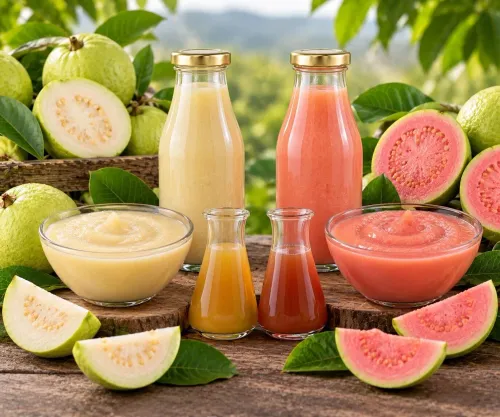
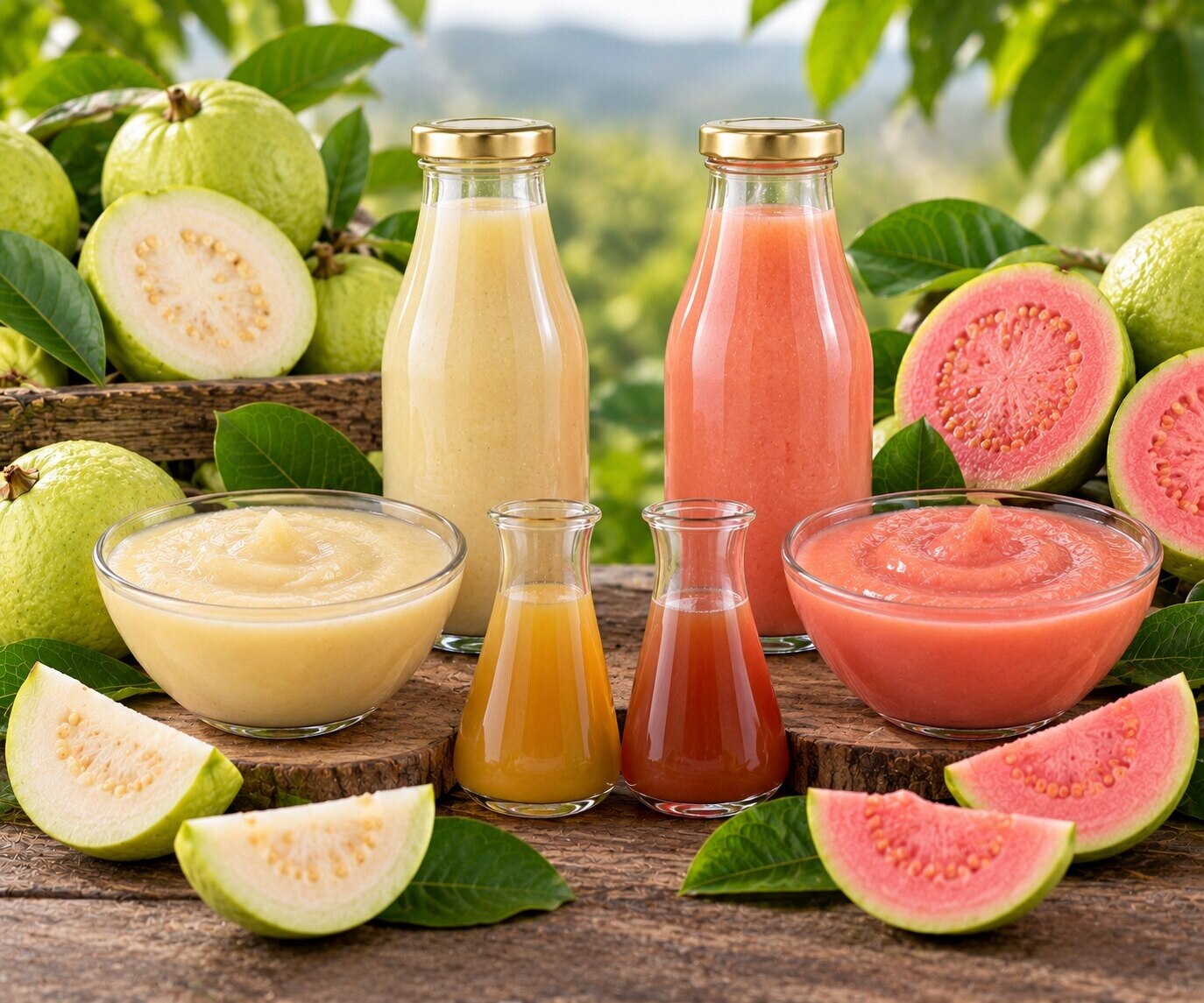
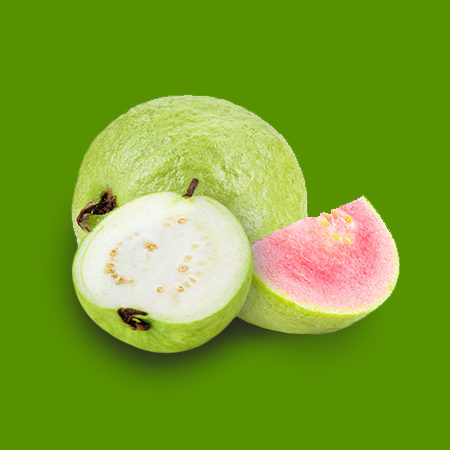
Compare white guava puree and pink guava puree in the finished recipe, not by colour name alone. White puree may suit a pale product where restrained colour impact matters; pink puree may be preferred when the formulation needs a stronger pink tone.
| Option | Colour role | Best fit |
|---|---|---|
| White guava puree | Pale appearance with limited colour impact | Light beverages, dairy products, desserts, or fillings |
| Pink guava puree | Stronger pink contribution | Products where guava colour should remain visible |
For either option, assess flavour intensity, acidity, pulp distribution, fibre, seed or skin particles, sedimentation after standing, separation after homogenisation, and colour change during heat treatment and storage. Brix alone cannot predict the finished result.
Run each sample at the planned use rate and process conditions. In beverages and nectars, check mouthfeel, sediment, suspension stability, final pH, and Brix. In sauces and fillings, test viscosity, spreadability, bake or cook stability, and colour retention.
In desserts and dairy products, assess flavour release, interaction with proteins, and any shift from the target shade. Compare the finished products with your approved benchmark, not only the supplier’s sample.
Before bulk guava puree orders, request a representative production sample, lot number, sample specification, processing date, and lot-specific certificate of analysis. Use the same evidence when comparing guava puree exporters from India. For Zeus India Enterprise, match the offered puree against the documented specification, retained sample, and intended formulation before committing to volume.
Related product
 | White and Pink Guava Puree Zeus India is a trusted exporter and supplier of premium White Guava Puree and Pink Guava Puree in India, catering to the growing demands of the... View product → |
Which commercial terms must the quotation and purchase order state?
A low unit price can become the expensive offer if the shipment arrives late, short-filled, or with too little shelf life for production. Make the quotation answer the guava puree exporters from India order details that determine landed cost and scheduling, then copy the accepted terms into the purchase order.
- State minimum order quantity, available lot size, production season, units per pallet, drums or bags per shipment, drum or carton dimensions, nominal and minimum net weight, gross weight, production lead time, dispatch window, and delivery date.
- Require the remaining shelf life promised on arrival, not only total shelf life from manufacture. Record payment terms, milestones, currency, bank charges, quotation validity, and the event that triggers production, such as cleared payment or approved artwork.
- Define inspection rights, the approved testing laboratory, acceptance criteria, claim-notification period, remedy for off-specification or damaged goods, and responsibility for disposal, replacement, or credit.
- For bulk guava puree orders, request lot traceability from finished product to production date and raw-material intake, the retained-sample period, and the recall or withdrawal procedure. Record temperature-monitoring responsibility where the agreed storage or transport limit applies.
| Incoterm and named place | Freight, insurance, inspection, and destination costs |
|---|---|
| FOB Indian port | Buyer arranges main freight, insurance, unloading, and destination charges |
| CIF destination port | Seller pays freight and insurance to the named port; confirm unloading and destination charges separately |
Name the port of loading and destination port before comparing offers. “Food grade” and “export quality” do not define measurable acceptance criteria.
What export documents should you confirm for an India shipment?
Confirm the final guava puree export documentation list with the importer and destination customs broker before production. Do not let guava puree exporters from India book the shipment until the broker has confirmed the destination requirements.
1. Collect the commercial invoice, packing list, bill of lading or air waybill, customs export filing, and exporter’s Importer Exporter Code (IEC).
2. Request the exporter’s applicable FSSAI food-business licence. Verify that the licence number, licensed activity, and product scope match guava puree. For an APEDA-scheduled agricultural or processed-food product, confirm whether APEDA registration and a Registration-Cum-Membership Certificate apply. APEDA registration does not replace the IEC, FSSAI licence, customs filing, or destination certificates.
3. Add a certificate of origin when the importer, tariff preference, or customs authority requires one. Obtain a lot-specific certificate of analysis showing the lot number, production date, and agreed physical, chemical, microbiological, and residue results.
4. Ask the broker to confirm the HS classification before production. Puree, juice, concentrate, preparation, and products containing added sugar can use different classifications, changing duty, admissibility, and certificate wording.
Do not assume that every shipment needs a phytosanitary certificate, health certificate, laboratory certificate, or importer permit. Requirements depend on destination, processing level, packaging, classification, and transport mode. Put the final document list and certificate wording in the contract.
Frequently asked questions
Which technical details belong in a guava puree order?
State whether you need single-strength or concentrated puree, the guava variety or origin, intended application, fruit content, Brix, acidity, viscosity, colour, texture, and sedimentation limits.
What packaging and storage conditions will a guava puree shipment require?
Confirm the aseptic bag or drum format, fill weight, pallet configuration, storage temperature, shelf life, lot identification, and transport conditions before shipment.
How can you compare white and pink guava puree before committing to volume?
Request representative samples and compare colour, aroma, flavour, seeds, fibre, viscosity, acidity, Brix, sedimentation, and performance in your finished application.
Which commercial terms must the quotation and purchase order state?
Specify product specification, quantity, price basis, currency, Incoterm, delivery point, lead time, payment terms, tolerances, inspection rights, claims process, and rejection conditions.
What export documents should you confirm for an India shipment?
Confirm the commercial invoice, packing list, bill of lading or airway bill, certificate of origin, certificate of analysis, health or sanitary certificate when required, and any buyer-specific certificates.