
A batch dispute cannot be settled by colour, taste, or a generic certificate alone. You need a written specification, representative samples, matched records, and a controlled investigation that separates a genuine product defect from transport, storage, sampling, or processing error.
Key takeaways
- Compare results with the agreed specification, not the word “Alphonso” alone.
- Quarantine failed drums and record seals, labels, damage and temperatures immediately.
- Use lot sampling, test methods and retain samples before rejecting the whole shipment.
- Request corrective action, traceability records and documented closure from the exporter.
What counts as a batch problem in Alphonso mango puree?
A batch problem exists when the lot fails a written specification or arrives with damaged packaging or compromised aseptic status. “Alphonso” identifies a cultivar, not a complete performance standard. Agree the formulation, limits, test methods and packaging requirements before comparing actual results from a lot-specific certificate of analysis.
| Measure | Acceptance basis | Method or control |
|---|---|---|
| °Brix | Agreed soluble-solids range | Use the same instrument, method and sample temperature; °Brix does not establish viscosity or mouthfeel. |
| pH or acidity | Specified pH or titratable-acidity limit | pH 4.6 is a safety boundary, not proof that the scheduled thermal process was adequate. |
| Viscosity | Defined range suited to the application | Name the instrument, spindle or geometry, rotational speed, sample temperature and measurement time. Mango puree is often shear-thinning. |
| Colour | Visual standard or defined L*a*b* values | State the storage age and temperature; browning can arise from maturity, oxygen, enzymes or heat. |
| Pulp and fibre | Agreed particle, pulp and fibre tolerance | Check texture and mouthfeel separately from soluble solids. |
| Safety and purity | Microbiological limits and no foreign matter | Record the actual lot result, not only a specification range. |
| Formulation | Approved permitted processing aids | Confirm each aid and its declared use. |
| Pack and asepsis | Correct format, seal integrity and aseptic-fill status | Inspect bags, drums, closures and evidence of contamination. |
Heat can reduce microbial risk while darkening puree or changing flavour and viscosity. These written limits and reproducible methods provide the basis for resolving Alphonso puree export quality issues rather than judging appearance alone.
What should you do when an incoming drum fails inspection?
Quarantine the affected drums immediately and stop production use. Do not blend suspect puree into an otherwise conforming lot; that destroys evidence and expands the possible recall scope.
1. Record the drum count, pallet numbers, and affected unit numbers. Photograph each seal, closure, dent, leak, label, and pallet condition before moving anything. Measure and record product temperature at receipt, including the time and instrument used.
2. Preserve unopened retained samples and take a documented sample from an opened drum. Keep both under controlled storage, label them with the drum and lot identifiers, and avoid testing only a top-layer sample.
3. Issue a non-conformance report stating the measured result against the agreed limit. Identify the finding precisely: °Brix, pH, acidity, viscosity, colour, flavour, microbiology, foreign matter, or packaging integrity. “Poor quality” cannot establish whether the failure concerns solids, safety, sensory performance, or a damaged aseptic package.
4. Build the investigation file with the purchase order, batch or lot number, production date, dispatch date, packing list, lot-specific certificate of analysis, specification sheet, seal numbers, transport temperature records, laboratory reports, and photographs. A generic product sheet does not prove conformity.
Request a documented corrective-action response covering containment, root cause, disposition, and preventive action. For Alphonso puree export quality issues, require the exporter to state whether the lot will be released, replaced, credited, reworked, or destroyed, with evidence supporting that decision.
How do sampling and certificate checks prove whether the whole lot failed?
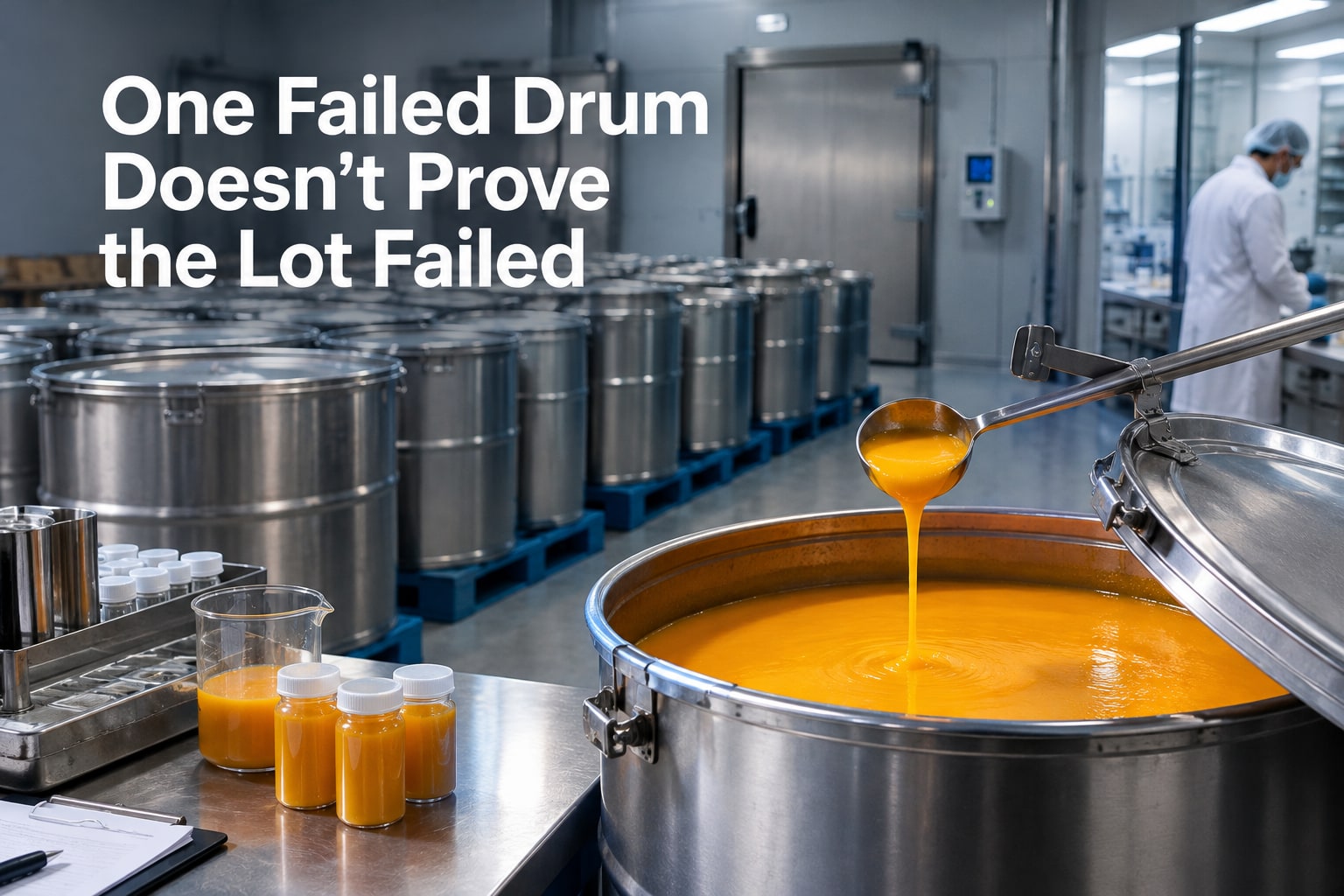
One drum, or a sample taken only from the bag’s top layer, cannot prove that an aseptic bag-in-drum lot failed. Settling, temperature variation, freezing, thawing, or incomplete homogenisation can produce a false solids or viscosity result.
Agree the sampling plan before purchase. Put these points in the specification:
- Select an exact number of drums across the load, not one convenient unit.
- Randomise selections, or stratify them by pallet and production time.
- Use aseptic sampling equipment and reseal each bag correctly.
- Equilibrate samples to the stated test temperature before analysis.
- Mix each sample fully; do not test separated liquid and pulp.
- State which laboratory result governs disposition when exporter and buyer results conflict, such as an agreed independent laboratory retest.
Compare exporter and buyer retained samples from the same lot. This is essential when investigating Alphonso mango puree consistency for processors and evaluating support from Alphonso mango puree exporters from India for batch problems.
| Evidence | What to match | What it proves |
|---|---|---|
| Lot-specific COA | Lot number, test date, laboratory, method, units, limits, actual results | Conformity of the shipped lot |
| Generic product sheet | Product description or specification range only | Does not prove batch conformity |
| Reused COA | Identical results across different lots or dates | Requires verification before acceptance |
Check °Brix, pH or acidity, colour, viscosity, microbiology, foreign matter, and aseptic status. Specify separate evidence for pesticide residues, contaminants, food-contact packaging, and destination-country import requirements; routine quality results do not cover them.
How do exporters separate a true defect from a process or storage error?
A true defect remains abnormal when the exporter’s retained sample matches the buyer’s sample and the agreed test method confirms failure. Reliable Alphonso mango puree consistency for processors starts with tracing the variation back to fruit, processing, packaging, transport, or the receiving line.
1. Review raw-fruit records for mixed maturity, underripe or overripe mangoes, fibrous or diseased fruit, uncontrolled ripening, and different harvest lots. Check whether compatible pulp lots were blended, and whether that practice met the buyer’s single-harvest requirement.
2. Compare processing records for thermal treatment, product temperature, residence time, and filling conditions. Investigate enzymatic browning before heating, oxygen exposure, and heat-driven colour or flavour changes. Commercial sterility depends on the scheduled thermal process, aseptic-zone hygiene, package-contact sterilisation, and seal integrity; it does not mean the puree contains no microorganisms.
3. Inspect the buyer’s site for incorrect dilution, inadequate mixing, wrong water or sugar addition, excessive line shear, damaged aseptic bags, drum leakage, freezing, thawing, warehouse heat, and prolonged exposure after opening. These events can change viscosity, colour, flavour, or microbiological results without proving an original batch defect.
4. Separate harvest, processing, and dispatch dates. Harvest timing affects cultivar character and maturity; processing date affects thermal history and remaining shelf life; dispatch date affects age at arrival and exposure during transport. Compare all three against the buyer’s storage records and the exporter’s retained sample.
5. Document the finding by testing the same lot with an agreed method. A failed package, altered storage condition, or mismatched sample points to handling; a matching retained sample with confirmed results points to the exported batch.
What support should an exporter provide to close the batch dispute?
A dispute closes when the exporter supplies evidence tied to the exact lot and proposes a documented disposition. Useful India Alphonso puree exporter support includes a lot-specific COA, a retained sample from the same batch, and traceability from finished drum to raw-fruit intake, processing, filling, and dispatch records.
| Record | What it should show | What it helps determine |
|---|---|---|
| Lot-specific COA | Actual Brix, pH or acidity, colour, viscosity, microbiology, foreign matter, and packaging status | Whether the shipped lot met its specification |
| Traceability file | Fruit intake date, supplier or orchard, segregation, ripeness checks, compatible-lot blending, and production lot | Whether raw-material variation caused the result |
| Process file | Scheduled thermal treatment, product temperature, residence time, aseptic-zone checks, package-contact sterilisation, and seal inspection | Whether processing or filling failed |
| Packing and dispatch file | Drum and bag format, unit count, seal numbers, loading condition, and available shipping-temperature data | Whether handling or transport damaged the lot |
Compare the buyer’s sample with the exporter’s retained sample using the same preparation, temperature, instrument, and test method. If results differ, use an independent laboratory named in the supply agreement; do not resolve the dispute by choosing the more favourable result.
The corrective-action report must state whether the lot is released, reworked, replaced, credited, or destroyed. It should name controls such as orchard approval, incoming-fruit segregation, ripeness limits, disclosed compatible-lot blending, or revised transport handling.
Zeus India Enterprise is a useful example of the supplier relationship to seek: ask whether it can produce lot-level records and manage a complaint, not merely make consistency claims.
Write storage temperature, damaged-unit quarantine, use-after-opening time, and destination-market documentation into the purchase terms.
Related product
 | Alphonso Mango Puree Zeus India is a trusted exporter and supplier of premium Alphonso Mango Puree in India, known for delivering rich taste, natural aroma, vibrant... View product → |
Frequently asked questions
What counts as a batch problem in Alphonso mango puree?
A batch problem occurs when the lot fails an agreed specification or arrives with damaged packaging or compromised aseptic status. Alphonso names the mango cultivar, not limits for Brix, pH, colour, microbiology or viscosity.
What should you do when an incoming drum fails inspection?
Quarantine the affected drum or lot, photograph the damage, record the batch number and seal condition, and preserve temperature and receiving records. Compare the result with the agreed test method before accepting or rejecting the shipment.
How do sampling and certificate checks prove whether the whole lot failed?
Use the agreed sampling plan across drums, test representative samples with the specified methods, and compare results with the lot-specific certificate of analysis. A single failed drum does not prove that every drum failed without wider evidence.
How do exporters separate a true defect from a process or storage error?
Compare production records, retain-sample results, transport temperature logs, receiving conditions, seal evidence and laboratory methods. Matching failure results in retained and incoming samples supports a product defect; differences point to sampling, handling or storage.
What support should an exporter provide to close the batch dispute?
Provide traceability records, the lot-specific certificate of analysis, test methods, retain-sample results, packaging and dispatch records, and a written corrective-action decision. Agree whether to replace, rework, credit or release the lot based on documented findings.