
Choose tomato paste by the beverage’s required tomato-solids level, flow behaviour, acidity, colour, and filling process—not by °Brix alone. By the end, you will be able to calculate the required paste quantity, compare cold-break and hot-break options, qualify technical documents, and test whether aseptic packaging fits your plant.
Key takeaways
- Set target solids, viscosity, colour, acidity, sodium, and stability first.
- Compare Brix with viscosity, colour, acidity, and separation—not alone.
- Calculate paste dosage from tomato solids before scheduling production trials.
- Request specifications, certificates, traceability records, and packaging details before repeat orders.
Start with the beverage formula, not the highest Brix
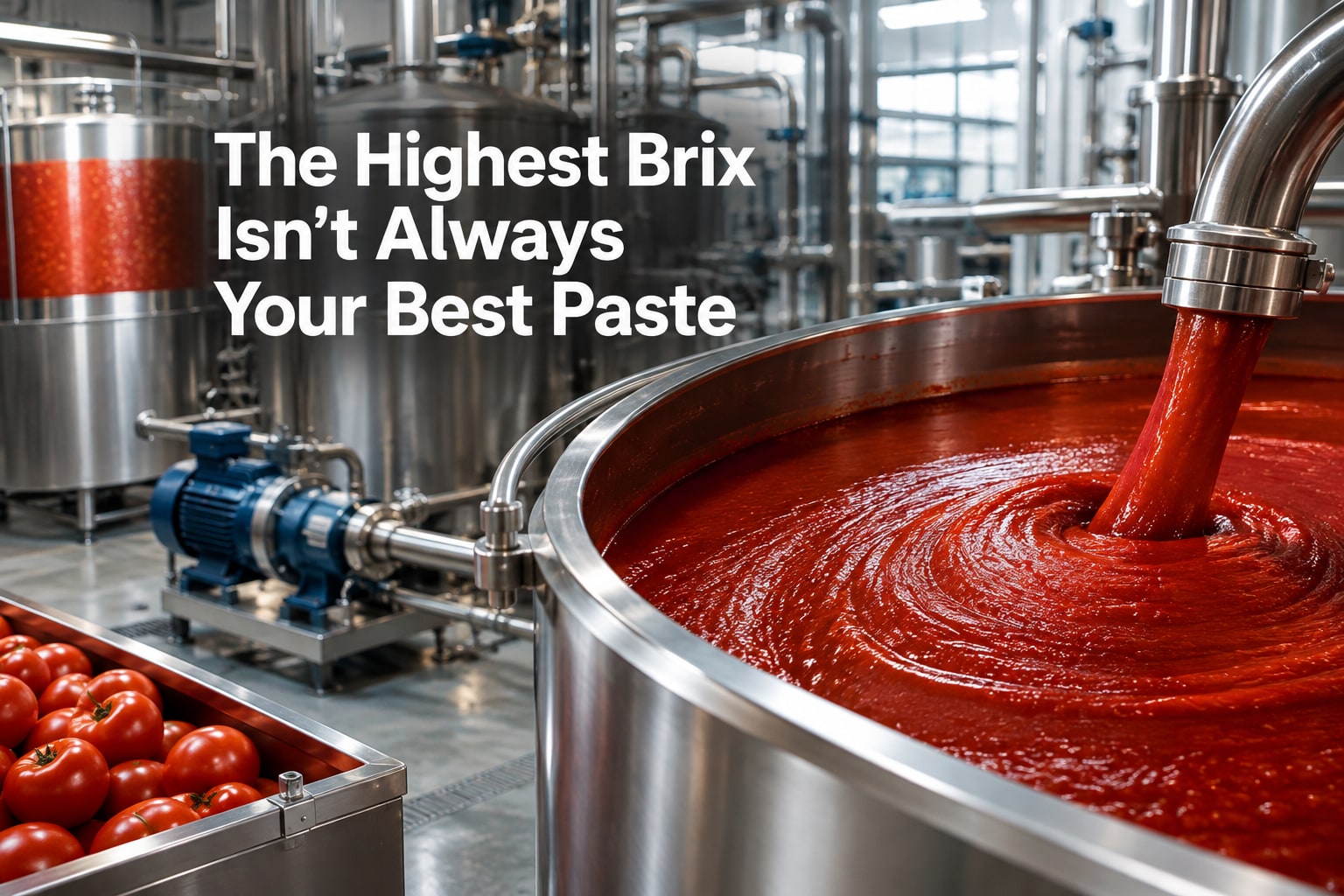
Set the finished drink’s target tomato solids, viscosity, colour, acidity, sodium, and stability before selecting paste. To decide which tomato paste for option fits commercial beverage manufacturing needs, match the ingredient to that formula—not to the highest available °Brix.
| Paste option | Advantages | Where it fits |
|---|---|---|
| 24–26 °Brix | Easier dispersion and viscosity adjustment | Fluid tomato drinks and high-volume dilution |
| 28–30 °Brix | Smaller storage and freight footprint | General-purpose beverage bases |
| 36–38 °Brix | Lowest water and handling volume | Formulas with controlled high-shear mixing |
| Cold-break | Smoother, more fluid body | Drinkable tomato beverages |
| Hot-break | Higher viscosity and stronger body | Thick savoury drinks or sauce-based formulations |
| Unsalted | Independent sodium and seasoning control | Formulas with a fixed nutrition declaration |
| Salted | Adds seasoning with the tomato input | Recipes designed around a defined salt contribution |
A higher °Brix paste reduces the kilograms you handle, but it can disperse slowly and create localised thick spots during dilution. Hot-break paste can worsen mixing, homogenisation, deaeration, and filling problems when the beverage needs a light body.
For tomato paste applications for commercial drinks, request °Brix plus a defined viscosity method, acidity or pH, pulp or serum-separation data, and Hunter or CIE colour values. Visual redness alone changes with lighting and dilution. Review colour-loss limits during storage, because fading can indicate oxidation or excessive heat exposure.
Compare Brix, viscosity, colour, acidity, and separation together
Two pastes at 28 °Brix can behave differently in the same beverage. °Brix measures soluble solids, not pourability or mouthfeel; pectin, insoluble solids, particle size, cultivar, and heat treatment determine viscosity. Compare the full set of values before choosing.
| Option | Dilution and flavour | Viscosity, colour, acidity, and separation |
|---|---|---|
| 24–26 °Brix | Requires more paste by weight and gives a lighter tomato-solids contribution; it may disperse more easily. | Often easier to pump, but verify consistency. Check CIE or Hunter redness, pH, titratable acidity, and serum separation after dilution. |
| 28–30 °Brix | Uses less paste for the same tomato-solids target and provides a fuller flavour. | A practical middle range, but viscosity still depends on processing. Check pulp uniformity, sediment, and colour loss during storage. |
| 36–38 °Brix | Minimises ingredient volume, freight, and storage space; it delivers concentrated tomato flavour. | It can be difficult to wet out and disperse, causing lumps, high mixer load, or uneven texture. Higher concentration does not guarantee lower separation. |
For tomato paste for beverage producers, specify pH and titratable acidity separately: Brix cannot predict sourness or buffering behaviour. Confirm whether the paste is salted or unsalted; salt changes sodium labelling, flavour balance, soluble-solids calculations, and the dilution formula.
Ask for a defined viscosity method and temperature, plus sieve or insoluble-solids limits. Seed and skin particles can block nozzles, increase homogeniser load, settle in the pack, and make a lightly processed drink look uneven. Compare colour after dilution, not only in the concentrate.
Calculate paste quantity and predict line behaviour
Use finished batch mass, not tank volume, for the calculation. If the formula calls for 12% paste in a 10,000 kg batch, add 1,200 kg of paste. If it specifies tomato-derived soluble solids instead, use: paste required = batch mass × target solids ÷ paste Brix.
An 8% target using 28°Brix paste requires about 2,857 kg before final water adjustment.
A higher-Brix paste reduces handling volume but increases dilution accuracy demands. Cold-break paste is a practical starting point for a drinkable base because it gives a smoother, more fluid mix; hot-break paste brings higher viscosity and can slow dispersion, increase pump load, and complicate filling.
Specify seed and skin removal, visible-speck limits, and sieve size before trials. These details affect nozzle blockage, sediment, homogenizer loading, and settling.
- Mixing: Add paste into moving water or liquid concentrate, then use high-shear mixing to break lumps. Adding paste to stagnant water creates stubborn gels and uneven Brix.
- Homogenisation: Homogenisation reduces particle size and helps limit pulp separation; it does not remove seeds, skins, or black specks. Check pressure against the equipment limit and watch for rising temperature.
- Deaeration: Remove entrained air after mixing and before filling. Air causes foam, oxidation, inaccurate fill levels, and a lighter-looking drink.
- Filling: Hot filling, retort processing, and aseptic filling each require a validated finished-product process. Aseptic tomato paste for beverage manufacturing does not make the diluted beverage commercially sterile; control its pH, thermal schedule, container seal, and hold time separately.
Choose aseptic, canned, frozen, or refrigerated ingredients for the plant
Aseptic bag-in-drum paste is the stronger plant choice when ambient storage, bulk dosing, and long production windows matter. It removes frozen or chilled warehouse dependence, but your diluted beverage still needs its own validated thermal and microbial controls.
Treat a tomato paste manufacturer near Bengaluru as a freight and continuity option, not proof of beverage suitability.
| Option | Main operational trade-off | Choose it when |
|---|---|---|
| Aseptic bag-in-drum | Ambient bulk storage; less cold-chain dependence | Production is regular, lead times are long, or stock flexibility matters |
| Canned | More opening labour and packaging waste | Batch volumes are small |
| Frozen | Freezer capacity and thawing required | Cold-chain infrastructure already exists |
| Refrigerated | Continuous chilled storage required | Paste is consumed quickly after delivery |
Aseptic wins only if the drum fits your daily throughput and transfer equipment. Confirm pumpability, bag removal, residue handling, and drum size before ordering; a large drum can create more labour than it saves.
For aseptic tomato paste for beverage manufacturing, request the validated aseptic-process record, commercial-sterility evidence, seal-integrity controls, lot traceability, storage limit, and specification. Check Brix, pH, viscosity, and cold-break or hot-break profile.
Once mixed with water, salt, sugar, or acid, the finished drink has a new microbial-risk profile; the supplier’s aseptic status does not validate your filling process.
Qualify the supplier, documents, and packaging before repeat orders
Before a repeat order, make the purchase specification and release documents contractual, not verbal. Require the supplier to match every lot to the approved range and report deviations before dispatch.
| Check | Evidence to request | Failure to accept |
|---|---|---|
| °Brix, pH, acidity, colour, viscosity, sieve or insoluble solids, salt, additives | Signed technical specification and lot-specific certificate of analysis (COA) | “Tomato paste for beverage producers” without numeric limits |
| Food safety and sterility | HACCP plan or FSSC 22000/ISO 22000 certificate, validated aseptic-process summary, and commercial-sterility record | An “aseptic” claim with no process or test evidence |
| Traceability | Lot code linking raw material, production date, test results, and recall contact | A drum marked only with a product name |
| Packaging | Aseptic bag-in-drum format, seal and leak checks, net weight, shelf-life statement, and storage temperature | Damaged outer drums, unclear bag material, or missing storage instructions |
| Shipment | Agreed lead time, minimum order, pallet pattern, export documents, and delivered-cost comparison | A low unit price that ignores freight or supply interruptions |
Treat a tomato paste manufacturer near Bengaluru as a logistics option, not proof of suitability. Compare freight distance with delivered cost, inventory cover, and the supplier’s ability to repeat the approved cold-break or hot-break specification.
Ask Zeus India Enterprise for a pre-dispatch sample, COA, aseptic-packaging details, and a retained-lot policy before approving routine supply. Then run the paste through your own dilution and finished-beverage process validation; supplier sterility does not validate the diluted product.
Related product
 | Tomato Paste Zeus India is a trusted exporter and supplier of premium Tomato Paste in India, delivering high-quality tomato-based ingredients to the global food... View product → |
Frequently asked questions
How do you choose tomato paste for commercial beverage manufacturing?
Start with the finished beverage formula. Define target tomato solids, viscosity, colour, acidity, sodium, and stability, then select paste that meets those requirements.
Is the highest Brix tomato paste the best choice for beverages?
No. Compare Brix with viscosity, colour, acidity, and separation because a higher-solids paste can still produce the wrong texture, colour, or line performance.
How do you calculate tomato paste quantity for a beverage?
Use the required tomato solids in the finished drink and the paste’s declared soluble-solids concentration to calculate dosage, then confirm the result in a production trial.
Which tomato paste format suits a beverage manufacturing plant?
Choose aseptic, canned, frozen, or refrigerated paste according to storage temperature, opening frequency, shelf-life requirements, batch size, handling equipment, and contamination controls.
What should you verify before placing repeat tomato paste orders?
Check the product specification, batch and lot traceability, certificate of analysis, microbiological results, regulatory documents, packaging integrity, and delivery conditions.