
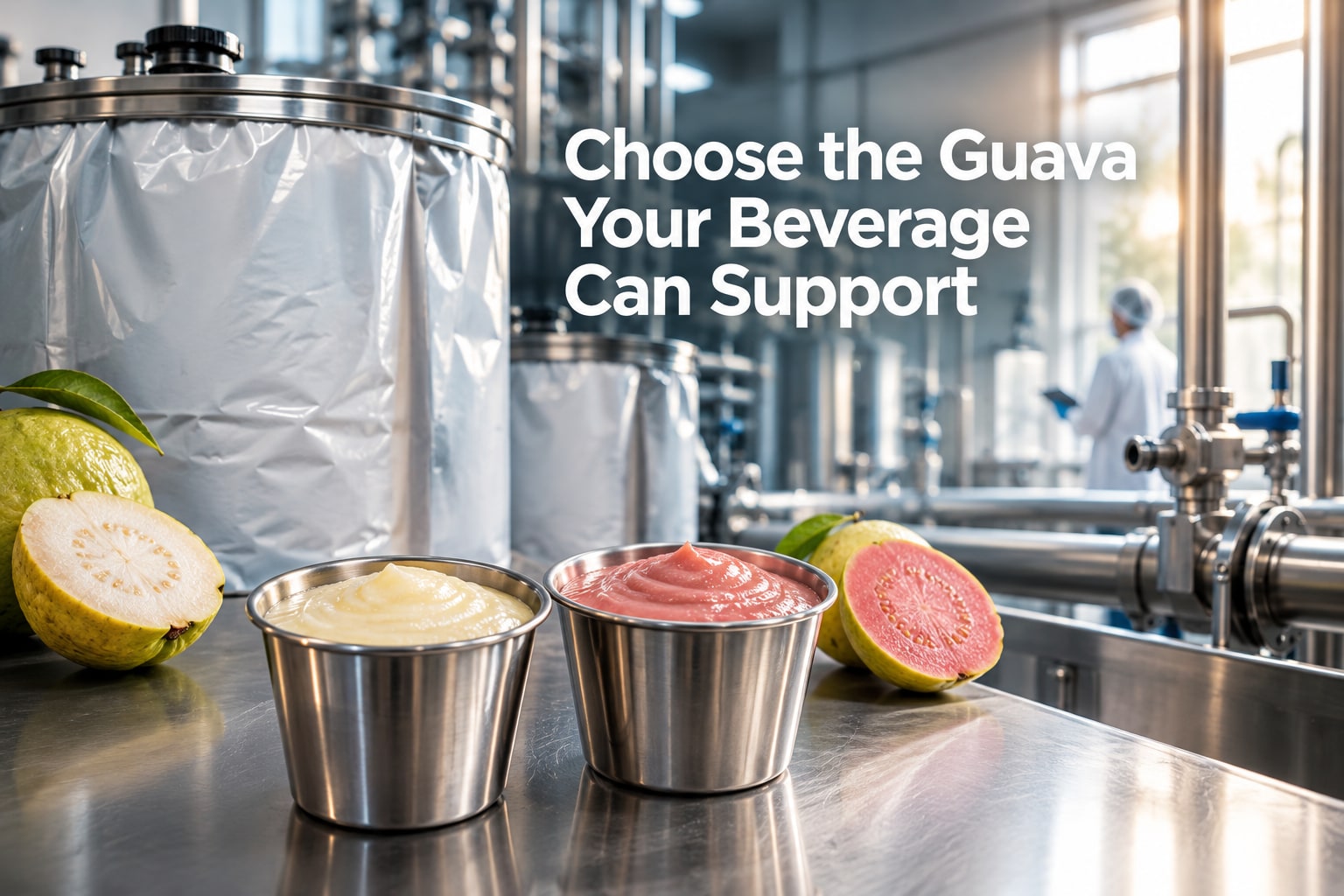
Choosing guava puree for a beverage line involves more than selecting a white or pink colour. You need to match the puree to the drink format, define measurable acceptance limits, test dilution and stability, then confirm that the pack format, documents and shipment timing fit your plant. By the end, you will have a practical checklist for comparing Indian suppliers and approving a lot.
Key takeaways
- Choose white guava for a pale drink; choose pink guava for visible colour.
- Specify Brix, pH, pulp texture, microbiology and colour before pilot production.
- Use aseptic packs for ambient storage; match frozen or chilled supply to your plant.
- Verify export documents, retained samples, lot codes and guava puree availability.
White or pink guava puree: which one fits your beverage?
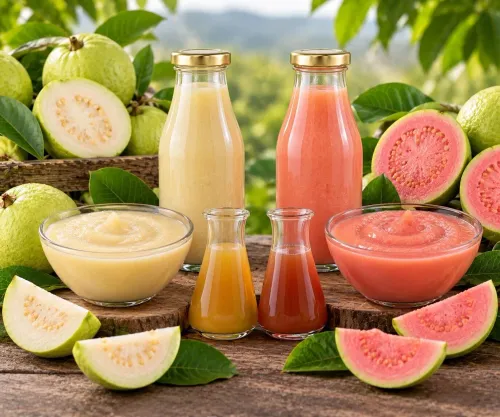
A buyer specifying white pink guava puree for beverage plants, whether white or pink, must choose the colour for the finished drink rather than the drum.
White puree usually gives a lighter base, clean guava aroma and moderate flavour, but it can still create haze, sediment and a beige tone after adding sugar, acid or other juices. Pink puree brings stronger visual identity, fuller fruit character and carotenoid-derived colour; heat, maturity and cultivar differences can change that colour between lots.
| Option | Finished-beverage effect | Formats that fit |
|---|---|---|
| White guava puree | Pale, creamy or hazy appearance; gentle aroma; visible pulp can settle | Light nectars, still juice drinks, dairy beverages, fruit preparations and cocktail mixers |
| Pink guava puree | Pink to salmon colour; more pronounced fruit impression; colour can fade or shift with heat and acidity | Pink nectars, smoothies, fermented drinks, juice drinks and strongly flavoured mixers |
White puree suits products where you want guava without dominating milk, citrus or delicate flavours. Pink puree suits smoothies and fruit-forward drinks where consumers expect colour as well as aroma. Neither choice guarantees a clear beverage: fibre, seed fragments and particle size control sedimentation.
Run both candidates at the intended dilution, then add water, sugar, acid, stabiliser and flavour in production order. Hold the trial for at least the planned shelf-life checkpoint and compare colour, separation, aroma and sediment.
A shortlist of white or pink guava puree exporters from India should provide lot-specific colour and sensory data, not only a product photograph.
Set the puree specification before running a pilot batch
Approve the puree against the finished drink, not a product photograph. Start with single-strength puree and record the fruit type, pack format, lot number and manufacturing date before making a pilot.
1. Dilute the puree with measured water to the intended fruit percentage, then add sugar, acid, stabiliser, flavour and preservative in the same order and concentrations used on the production line. Hold samples at the planned storage temperature and inspect at 24 hours, seven days and the intended shelf-life checkpoint.
2. Use these starting specification fields, then tighten each range around the pilot result:
| Parameter | White or pink guava puree specification to record |
|---|---|
| Fruit identity | White or pink type, cultivar information, single-strength status |
| Soluble solids | Brix range, measured by calibrated refractometer; 8–12°Bx is a practical pilot window |
| Acidity | pH and titratable acidity, reported as citric acid percentage |
| Body | Viscosity or flow time at a stated temperature and spindle or method |
| Particles | Sieve aperture, pulp percentage, and visible seed or peel tolerance |
| Colour | Lot-specific L*a*b* values or an approved colour standard, especially for pink puree |
| Sensory profile | Guava aroma, flavour intensity, cooked notes, bitterness and foreign odour |
| Microbiology and process | Pathogen limits, yeast and mould limits, aseptic or frozen status, and validated thermal-process record |
Reject a lot that separates, settles heavily, darkens beyond the agreed colour limit, or develops an off-aroma after dilution. A white guava puree exporter India enquiry should request these lot-specific results rather than Brix alone.
Compare aseptic, frozen, chilled and drum-packed supply
The lowest ex-works price can become the highest delivered cost once refrigeration, thawing labour and line downtime are included. Compare the preservation method, not just the container.
| Format | Storage and transport | Thawing and handling | Beverage-line effect |
|---|---|---|---|
| Aseptic | Ambient storage within the exporter’s stated temperature range; transport without frozen-chain control. Protect sterile bags from punctures and excessive heat. | No thawing. Cleanly connect the bag or decant into a sanitised feed vessel after checking seal integrity. | Fast start-up and consistent dosing, with little cold-room demand. A failed seal can expose the entire lot. |
| Frozen | Keep continuously frozen through transport and storage; record temperature excursions. | Reserve thawing space and time, then thaw under controlled refrigeration. Do not refreeze. Mix the puree after thawing because solids can settle. | Requires planning, freezer capacity and extra labour; partial-use losses rise if blocks cannot be divided. |
| Chilled | Maintain refrigerated storage and transport, with a shorter usable window than aseptic or frozen supply. | Ready to pump, but keep containers cold and minimise hold time after opening. | Convenient for frequent production, yet temperature abuse can create microbiological risk and force disposal. |
| Drum-packed | A drum describes the pack, not the preservation method. Confirm whether its bag is aseptic, frozen or non-aseptic, plus the required storage temperature. | Handling depends on that declaration; large drums need pumps, drum tippers or controlled decanting. | Efficient for bulk dosing only when your receiving equipment matches the pack. |
Ask a pink guava puree export supplier for lot-specific colour and sensory data. A catalogue photograph cannot control cultivar, maturity or heat-history variation.
Confirm pack sizes, order quantities and guava puree export availability
A catalogue listing does not confirm guava puree export availability. Before booking, obtain a written allocation for your shipment, not a general statement that production is available.
1. Ask for the current warehouse quantity by lot, crop year, pack date, remaining shelf life and storage condition. Request the next production window separately; year-round aseptic stock can coexist with seasonal raw-fruit procurement and inventory already committed to other contracts.
2. Confirm the product category and packing format in the quotation. Industrial aseptic puree, bag-in-box, frozen blocks, aseptic drums and retail-ready pulp differ in net weight, pallet configuration, minimum order quantity, handling and documentation. Record the exact number of bags, drums or cartons per shipment.
3. Set the commercial basis before comparing offers. Ask whether the price is per kilogram or per pack, and whether it is quoted Ex Works, FOB an Indian port or CIF your destination. Confirm currency, taxes, freight, insurance, pallet charges and payment milestones; a low unit price can conceal separate export or cold-chain costs.
4. Match dispatch timing to your line plan. Specify the required arrival date, port, booking cut-off, transit-time assumption and acceptable remaining shelf life on arrival. Ask the exporter to reserve the identified lots, state the loading date and provide a contingency date for production or vessel delay.
5. Put quantity tolerance and short-shipment terms in the purchase order. Also state whether replacement, credit or cancellation applies when the agreed pack count, lot identity or delivery window is missed.
Use documents, retained samples and lot controls to approve an exporter
Approve an exporter only after matching the paperwork, a sealed retained sample and the delivered lot against your beverage specification. A catalogue photograph cannot establish pink colour intensity: cultivar mix, maturity and thermal history can change the finished drink.
Ask every white or pink guava puree exporters from India candidate for:
- A lot-specific certificate of analysis showing single-strength status, Brix, pH, titratable acidity, viscosity, particle size or sieve result, colour, pulp content, seed and peel tolerance.
- The food-safety plan, allergen statement, pesticide-residue policy, traceability record, batch code format and production date.
- A packing list and product description that distinguish industrial aseptic drums or bag-in-box from frozen blocks and retail-ready pulp.
- Destination-country health, phytosanitary and certificate-of-origin documents, because an export catalogue does not prove import eligibility.
- Two sealed retained samples from the proposed lot, with storage instructions and a shelf-life record.
Use the sample in your actual formulation. A white guava puree exporter India shortlist still needs dilution testing with your water, sugar, acid, flavours and stabiliser; inspect haze, sediment, colour shift and fermentation odour after storage. Ask a pink guava puree export supplier for a measurable colour range, not “natural pink”.
Control approval as follows:
| Record | Acceptance control | Failure action |
|---|---|---|
| Supplier documents | Complete, lot-linked and destination-compliant | Hold purchase |
| Retained sample | Matches sensory and analytical limits | Reject or investigate lot |
| Incoming lot | Seal intact; Brix, pH, viscosity and colour pass limits | Quarantine and test |
Apply the same evidence standard when evaluating Zeus India Enterprise. A lot that passes Brix but leaks, ferments or settles excessively is not acceptable.
Related product
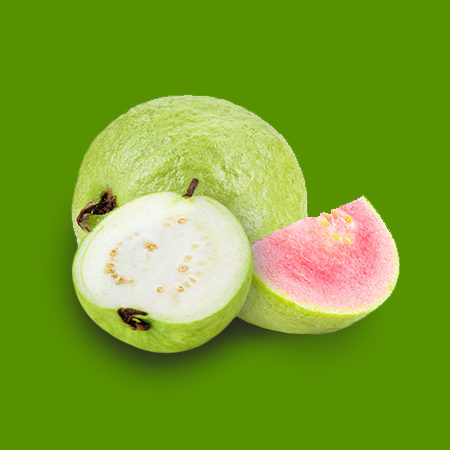 | White and Pink Guava Puree Zeus India is a trusted exporter and supplier of premium White Guava Puree and Pink Guava Puree in India, catering to the growing demands of the... View product → |
Frequently asked questions
Which guava puree suits a beverage plant: white or pink?
Choose white guava puree when you want a pale, clean appearance. Choose pink guava puree when the finished beverage needs a visible pink or rosy colour. Judge the result in the final beverage, not by the puree drum alone.
What should you specify before testing guava puree?
Set the guava variety or colour, Brix, pH, pulp texture, particle size, acidity, microbiological limits, colour target, packaging format and shelf-life requirement before running a pilot batch.
How do aseptic, frozen, chilled and drum-packed guava puree differ?
Aseptic puree supports ambient handling in sealed sterilised packs. Frozen puree requires a continuous frozen chain. Chilled puree needs controlled refrigeration and faster use. Drum-packed supply must be checked for its lining, closure, storage temperature and processing status.
How should you approve a guava puree exporter from India?
Request the exporter’s food licence copy, product specification, certificate of analysis, lot and batch details, retained sample process, packing information and export documents. Match the sample and documents to the lot supplied.