

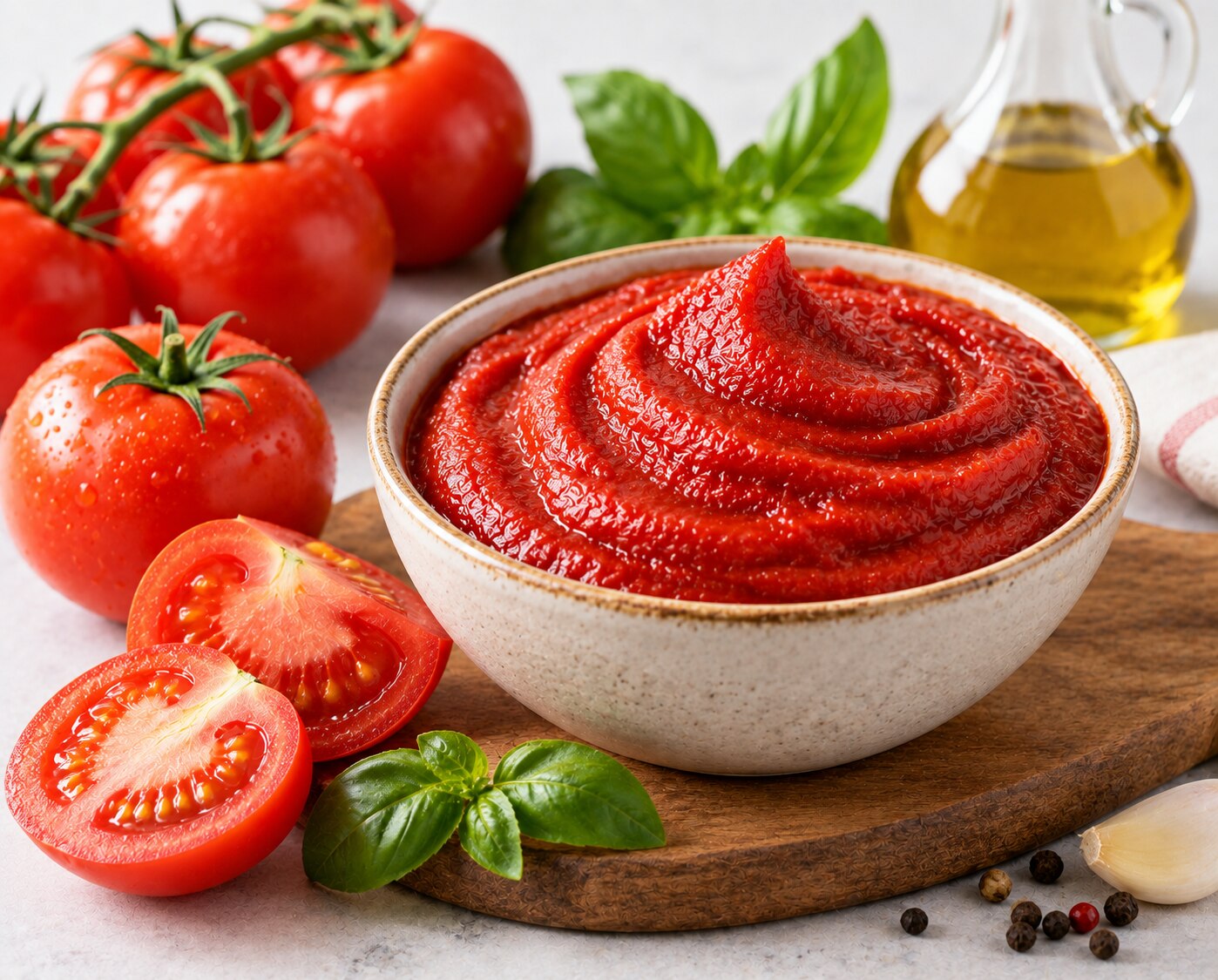
A sauce, gravy, or ready-to-eat meal can follow the same recipe and still vary when tomato raw material changes in solids, colour, acidity, and viscosity. By the end, you will know how to set a paste specification, calculate the correct dosage, release incoming lots, run a plant trial, and compare suppliers on production performance rather than marketing language.
Key takeaways
- Match paste quantity to soluble solids, not weight alone.
- Test Brix, pH, colour, viscosity and sensory quality before release.
- Record lot numbers, storage conditions and pack integrity during receiving.
- Compare suppliers using specifications, batch records, samples and supply reliability.
Which production variables does tomato paste help standardise?
Tomato paste standardises the tomato contribution to each batch: flavour, colour, acidity, soluble solids, viscosity and recipe performance. That is the core of tomato paste for consistent food production in Bengaluru, especially outside the short fresh-tomato harvest window.
| Variable | How paste supports control | Typical applications |
|---|---|---|
| Flavour | Delivers a measured tomato intensity without relying on changing fresh-tomato maturity | Sauces, gravies, soups and marinades |
| Colour | Adds a repeatable red base, subject to cultivar, processing and oxygen exposure | Ketchup, ready-to-eat meals and institutional foods |
| Acidity | Contributes acid and buffering capacity, helping reproduce the recipe’s sourness | Ketchup, sauces and prepared meals |
| Soluble solids | A stated °Brix controls tomato solids added per batch; 24 °Brix and 28 °Brix grades are not interchangeable by weight | Sauces, soups and gravies |
| Viscosity | Adds concentrated tomato body, but pulp content and serum separation still affect thickness | Ketchup, gravies and marinades |
| Recipe performance | Reduces fresh-produce sorting, trimming and seasonal variation during cooking and filling | Snack seasonings, bulk meals and catering production |
The industrial tomato paste benefits stop short of guaranteeing identical output. °Brix does not specify colour, viscosity, pH, flavour or microbial quality, so compare the certificate of analysis with a retained reference sample and trial the paste in the actual process.
Changing suppliers can shift finished-product pH and titratable acidity even at the same dosage. Check acidified products at finished equilibrium, and validate the final texture, colour, cooking loss and filling behaviour before approving the lot.
How do you calculate the right paste quantity for a recipe?
Use soluble-solids balance, not a kilogram-for-kilogram substitution. Paste dosage is estimated as:
- Set the finished batch mass and target soluble solids. For a 1,000-kilogram product at 10°Brix, the target is 100 kilograms of soluble solids.
- Divide target solids by paste °Brix: 1,000 × 10 ÷ 28 = approximately 357 kilograms of 28°Brix paste.
- Calculate water addition from the total kettle charge: subtract paste mass and every other ingredient from the planned charge. If the recipe contains only paste and water, 643 kilograms of water completes a 1,000-kilogram batch.
- Correct for finished yield. With 5% cooking loss, charge about 1,053 kilograms to finish at 1,000 kilograms, then allocate water and other ingredients within that charge.
This estimate assumes the paste supplies the only meaningful soluble solids. Sugar, starch, salt, and other ingredients change the balance; cooking loss changes concentration. A 24°Brix paste also needs more mass than a 28°Brix paste for the same solids contribution.
Run a plant trial before fixing the formula. Check finished pH and titratable acidity because tomato paste for food manufacturers contributes acid and buffering capacity, then adjust for viscosity, colour, flavour, and pumping behaviour. Brix alone cannot predict those results.
These checks protect the industrial tomato paste benefits—repeatable dosing and batch consistency—without treating a calculation as a finished specification.
What should you test before releasing a tomato paste lot?
Release tomato paste for food manufacturers only after the lot passes both document review and plant-use checks. A certificate of analysis is evidence, not a substitute for inspecting the actual drum or bag.
1. Confirm the batch number, production date, declared net weight, agreed °Brix, pH, titratable acidity, colour value or reference, viscosity result, sensory condition, and foreign-matter status. Do not treat °Brix as proof of viscosity or flavour.
2. Inspect the packaging for swelling, leaks, punctures, rust, broken seals, vacuum loss, heat damage, or sunlight exposure. For aseptic packs, retain the microbiological results and commercial-sterility or process records; quarantine damaged packs and request an investigation.
3. Check the test methods and conditions, especially viscosity temperature, spindle or instrument, speed, sample preparation, and holding time. For acidified products, measure pH on the finished equilibrium product, not from the paste certificate alone.
Then run a controlled multi-lot plant trial before approving a new grade or supplier. Use the same recipe, equipment, batch size, cooking time, and filling settings for at least two or three lots, and record cooking loss, finished yield, flavour, colour, and filling or pumping behaviour.
Note blocked lines, unstable flow, excessive foaming, or filler-weight variation.
This evidence is more useful than price alone when selecting tomato paste for consistent food production in bengaluru. A lower-cost lot that changes pump settings or forces rework is not consistent.
How should bulk paste be handled and compared with other tomato formats?
Fresh tomatoes | High washing, sorting, trimming, and cooking labour; harvest and cultivar changes alter colour, flavour, and solids. | Require chilled or rapid-use storage, tomato-processing equipment, and produce more skins, seeds, trimming, and wastewater.
Tomato puree | Less preparation than fresh tomatoes, but lower solids can increase cooking time and transport water. | Suits simpler pumping systems; sealed packs store more easily than fresh fruit, with packaging waste after use.
Tomato powder | Minimises storage volume and waste, but needs controlled rehydration to avoid lumps, uneven flavour, and dust loss. | Requires powder-handling and mixing equipment; moisture control prevents caking.
In-house paste | Gives process control but adds labour, steam or cooking capacity, cleaning, and raw-material risk. | Needs evaporators or kettles, filtration, utilities, and waste handling; seasonal supply still affects output.
Bulk tomato paste | Standardises tomato solids outside the harvest window and reduces opening and handling steps. | Requires drum handling and a hygienic pump; bulk packs reduce packaging waste and suit planned, steady consumption.
Among industrial tomato paste benefits are lower preparation labour, less seasonal disruption, and predictable dosing. Tomato paste for food manufacturers becomes the wrong choice when daily use is too low to consume a drum promptly or the plant lacks safe lifting and pumping equipment.
An unopened aseptic bag-in-drum can remain at ambient temperature only within the supplier’s stated shelf life, storage temperature, and intact commercial-sterility conditions. Inspect the drum and bag before opening, connect a clean dispensing line, and avoid piercing the liner with contaminated tools.
Do not treat the opened bag as resealable. Use hygienic transfer, refrigerate the remaining paste as instructed, record the opening time, and schedule production to consume it within the supplier’s stated period. Plan drum opening around production demand; a partially used drum creates contamination, refrigeration, and waste risk.
How can procurement choose a supplier that keeps batches consistent?
Choose a supplier whose records predict your next batch, not one offering the lowest price per kilogram. Compare at least three lots against an agreed specification for °Brix, viscosity, colour, pH, titratable acidity, sensory condition, net weight, and microbiological results.
| Check | Evidence to request | What failure costs |
|---|---|---|
| °Brix and viscosity | Lot COAs with test methods and agreed windows | Recipe changes, pump or filler recalibration |
| Colour, pH and acidity | Instrument results, test conditions, and retained samples | Different shade, flavour, or finished-product pH |
| Traceability | Lot number, production date, origin, and recall contact | Slow investigation and blocked stock |
| COA timing | COA before dispatch or with every delivery | Material reaches production before release |
| Delivery and heat protection | Delivery record, palletisation, shade, and temperature controls | Late production or heat-damaged paste |
| Packaging fit | Bag-in-drum dimensions, liner specification, seal, and handling limits | Leaks, difficult dispensing, or contamination |
| Replacement procedure | Written response time, sampling method, and credit or replacement terms | Rework remains your cost |
| Repeatability | Results from consecutive lots at the same concentration grade | Ongoing recipe and process variation |
Do not treat “premium,” “natural,” “aseptic,” “no additives,” “organic,” and “concentrate” as interchangeable quality evidence. Match each claim to an ingredient declaration, process or commercial-sterility record, organic certificate, or product specification; “concentrate” alone does not state °Brix or viscosity.
For tomato paste for consistent food production in Bengaluru, audit a bulk tomato paste supplier in Bengaluru on these documents and a multi-lot trial. Zeus India Enterprise belongs on the comparison sheet only after its COAs, packaging fit, delivery record, and replacement terms meet the same written standard.
Related product
 | Tomato Paste Zeus India is a trusted exporter and supplier of premium Tomato Paste in India, delivering high-quality tomato-based ingredients to the global food... View product → |
Frequently asked questions
Which production variables does tomato paste help standardise?
It helps standardise tomato flavour, colour, acidity, soluble solids, viscosity and recipe performance across batches.
How do you calculate the right paste quantity for a recipe?
Base the calculation on the target tomato solids and the paste’s declared soluble-solids level, then confirm the result with a pilot batch.
What should you test before releasing a tomato paste lot?
Check the certificate of analysis, batch identity, soluble solids, pH, colour, viscosity, sensory quality, packaging integrity and microbiological results required by your specification.
How should bulk paste be handled and compared with other tomato formats?
Inspect seals and lot codes, follow the supplier’s storage instructions, control exposure after opening and compare paste with puree, diced tomatoes and powder by solids, processing effort and recipe performance.
How can procurement choose a supplier that keeps batches consistent?
Require a written specification, representative samples, certificates of analysis, traceability records, change notification and evidence of reliable bulk delivery.