
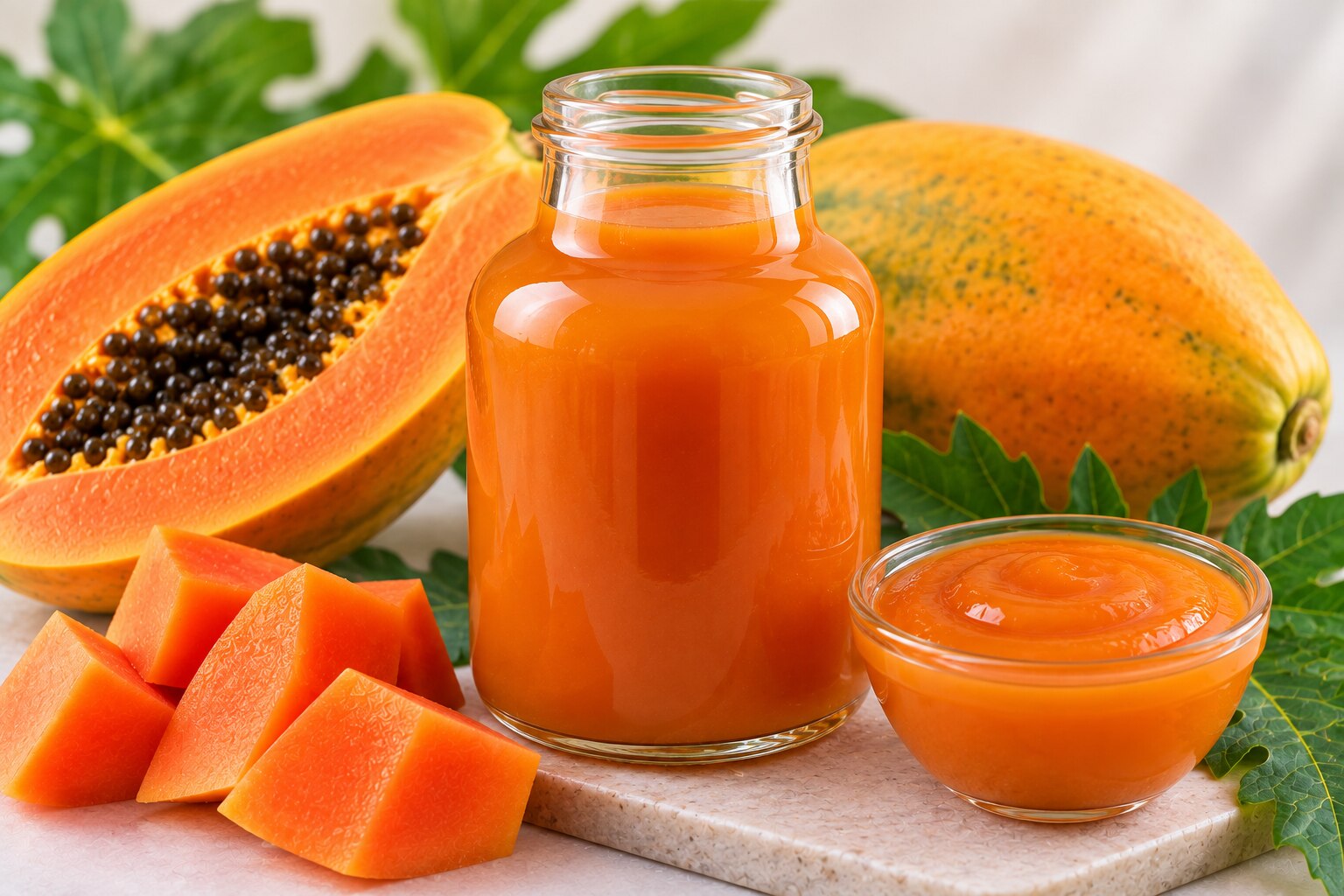
Once an aseptic pack is opened, its unopened shelf-life no longer governs handling: the product enters a refrigerated, contamination-sensitive stage. You will be able to set a defensible hold limit, portion the concentrate safely, protect it through Bengaluru temperature and power disruptions, and decide when disposal is required.
Key takeaways
- Refrigerate opened papaya concentrate at 5 °C or below immediately.
- Use sanitised tools and sealed, labelled containers for every transfer.
- Plan temperature checks and backup power for Bengaluru interruptions.
- Set opened-life limits from product evidence, not a fixed calendar rule.
Move the opened concentrate into controlled refrigeration immediately
Keep opened papaya concentrate at 5 °C or below immediately after the aseptic barrier, valve or liner is breached, unless the product specification sets a lower limit. A clean room, air-conditioning, shade or a closed drum in Bengaluru does not replace refrigeration. Unopened ambient-storage instructions no longer apply to papaya concentrate after opening.
Record the following at the time of opening and each time the product moves:
- Product name, batch or lot number, pack size and quantity opened
- Opening date and time, operator identity and the equipment used
- Refrigerator or cold-room identification and the product’s entry time
- Product temperature at placement, plus continuous data-logger readings or the site’s defined manual checks
- The approved discard date or hold-time limit from the product-specific assessment
- Any temperature excursion, transfer, partial use or disposition decision
Keep the original liner or container closed between withdrawals, and move only the quantity required for immediate production into clean, sanitised, tightly covered food-contact containers. Less headspace slows colour and flavour oxidation; it does not make warm storage safe.
Do not apply a seven-day or 30-day rule without evidence. Opened life depends on pH, Brix, preservatives, packaging, hygiene and temperature history, supported by microbiological validation. If refrigeration fails, segregate the concentrate and open a documented deviation record; do not leave it at room temperature for the next shift.
An ambient hold is acceptable only when specifically validated for that formulation and pack.
Open, transfer and portion the concentrate without contaminating it
An aseptic bag or drum stops being an ambient-stable pack as soon as its sterile barrier, liner or valve is breached. Treat the opened product as refrigerated papaya concentrate handling: prepare the work area and equipment before opening, not after product is exposed.
1. Clean and sanitise the bench, hands, gloves, transfer hose, pump, scoop and food-contact containers. Use a food-contact sanitiser at the label concentration and contact time, then allow surfaces to drain or air-dry.
2. Check the pack for leaks, swelling, damaged seams, a broken seal or a dirty outlet. Open the aseptic pack exactly as its supplier instructs; do not cut across the liner or touch the outlet with hands, clothing or an unclean tool.
3. Transfer only the quantity needed for immediate production into sanitised containers with tight-fitting lids. Keep the outlet above the receiving container without letting either surface touch.
4. Close the original liner, valve or drum promptly after dispensing. Reduce headspace where the pack design allows, but do not treat limited air exposure as a substitute for refrigeration.
5. Label every portion with the product name, original batch number, opening date and time, and operator initials. Place it at 5 °C or below, or at the stricter temperature in the product specification.
Use dedicated equipment for this product. Never return unused concentrate, rinse water or material from a production line to the opened drum; backflow can contaminate the remaining batch through the outlet or hose. High Brix slows microbial growth but does not prevent acid-tolerant yeasts and moulds.
Build a Bengaluru cold-chain plan for rooms, doors and power cuts
Keep opened concentrate at 5 °C or below, or at the lower limit in the product specification, from the moment it leaves receiving until production uses it. Papaya concentrate storage in Bengaluru needs a refrigerated room or controlled cold room; air-conditioning, a clean room, shade, and a closed production area do not replace refrigeration.
- Mark a dedicated refrigerated zone for opened containers and keep them off the floor, away from chemicals, drains, and raw materials.
- Fit a temperature logger at the warmest point, not beside the evaporator. Review the record each shift and record every opening, door alarm, or temperature excursion.
- Keep cold-room doors shut between entries; use strip curtains or a door alarm where traffic is heavy. Stage the next production batch before opening the door.
- Move opened concentrate from receiving to refrigeration immediately. Store unopened aseptic packs according to their pack instructions, but do not apply those ambient instructions after the sterile barrier or valve is breached.
During a power cut, close the room, stop non-essential entry, and activate the generator or validated backup refrigeration. Transfer containers to a qualified backup cold room only if the move is clean and traceable.
If the temperature exceeds the product limit, or refrigeration is unavailable, quarantine the material and follow the documented deviation and disposition procedure; do not leave it at Bengaluru room temperature awaiting the next shift.
A temperature log proves exposure, not product safety. Release the batch only against the approved assessment, and record the container ID, excursion duration, measured temperature, and decision.
Set the maximum opened-life from product evidence, not a fixed calendar rule
For how to store papaya concentrate after opening, set the discard date from product evidence, not an automatic seven- or 30-day rule. Treat papaya concentrate storage as refrigerated post-process control at 5 °C or below, or at the stricter specification limit; unopened aseptic shelf life does not apply after the sterile barrier is breached.
Use the shortest validated hold time supported by:
- pH, Brix and preservative system
- Container format, liner design and headspace
- Opening and transfer hygiene
- Recorded temperature history, including power interruptions
- Microbiological shelf-life or challenge-test results
Record the opening time, container identification, operator, measured product or room temperature, required pH/Brix checks and planned discard date. A temperature logger or documented checks twice daily provides evidence; a refrigerator set point alone does not.
Do not freeze the remainder unless the supplier has validated freezing for that formulation and container. Obtain the approved freezing temperature, maximum frozen duration, thawing method, post-thaw opened life and permitted number of freeze-thaw cycles. Repeated cycles are not acceptable without written validation because they can damage texture, separate solids and increase handling exposure.
If refrigeration fails, do not hold the opened concentrate at Bengaluru room temperature until the next shift. Segregate it and follow the site’s deviation and disposition procedure; use it only when an ambient hold is specifically validated.
Ask Zeus India Enterprise for the product specification, opened-life evidence, storage limit, freezing instructions and microbiological release criteria before assigning a date.
Related product
 | Papaya Concentrate Zeus India is a trusted exporter and supplier of premium Papaya Concentrate in India, delivering high-quality fruit ingredients to the global food... View product → |
Recognise spoilage and close out the batch safely
Visible mould, gas formation, a swollen container, fermentation, an off odour, or viscosity outside the approved specification requires immediate segregation. Do not scrape mould away, reheat the remainder, or return suspect papaya concentrate after opening to production.
| Condition | Decision | Immediate action |
|---|---|---|
| Visible mould, fermentation, or off odour | Dispose as nonconforming product | Seal, label “HOLD—DO NOT USE,” and follow the approved waste procedure |
| Gas, swelling, or leaking container | Segregate and investigate | Keep away from sound stock; do not open a pressurised container |
| Abnormal viscosity or colour change | Hold for quality assessment | Compare with the product specification and retain the lot identity |
| Refrigeration failure | Deviation review required | Keep isolated; discard unless a validated ambient hold applies |
Record the concentrate lot or batch number, original container number, opening date and time, quantity transferred, container identification, storage temperature records, operator, and production batch that used it. Link any disposal to a nonconformance or deviation number.
Clean the opening area and any affected shelf immediately. Remove concentrate, wash food-contact surfaces with the site-approved detergent, rinse where required, apply the specified sanitiser concentration and contact time, then allow surfaces to drain or dry according to the sanitation procedure.
Clean and sanitise pumps, utensils, lids, and reusable containers before the next papaya concentrate handling task.
Inspect nearby containers for leaks or contact contamination. Keep the remaining material closed and under 5 °C, or the stricter product limit, while quality decides its disposition.
Frequently asked questions
What temperature should papaya concentrate reach after opening?
Move it into controlled refrigeration at 5 °C or below immediately after the aseptic barrier, valve or liner is breached, unless the product specification requires a lower limit.
How do you prevent contamination when opening papaya concentrate?
Use clean, sanitised equipment, minimise exposure time, portion into sealed containers and label each container with the batch and opening details.
How should Bengaluru facilities manage papaya concentrate during power cuts?
Monitor refrigerator temperature, limit door opening, use backup power and transfer the product to validated cold storage if the temperature rises above the permitted limit.
How long does papaya concentrate last after opening?
Set the opened-life from the product specification, supplier evidence and your validated handling process rather than applying one fixed calendar rule.
How can you identify spoiled papaya concentrate?
Quarantine the batch if you see mould, gas formation, an abnormal smell, unexpected colour or texture changes, a damaged seal or an uncontrolled temperature exposure.