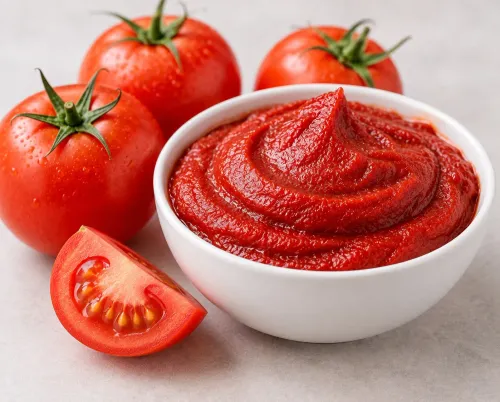


A Bengaluru food plant can cover seasonal production peaks, but fresh tomato arrivals, stored aseptic paste, domestic production and imports represent different supply risks. You will be able to test committed availability, match specifications to your recipes and build a procurement schedule that protects production before the crop window closes.
Key takeaways
- Contract aseptic paste inventory before seasonal demand rises.
- Compare Brix, acidity, colour, viscosity and pack format before buying.
- Store unopened aseptic paste in a clean, cool warehouse.
- Use forecasts, safety stock and scheduled deliveries to protect production.
Can Bengaluru supply tomato paste through a seasonal production peak?
Bengaluru can support a seasonal production peak when you contract aseptic paste inventory or scheduled production before demand rises; relying on the spot tomato market cannot provide that assurance.
A local shortage does not prove tomato paste availability in Bengaluru has failed. Fresh tomatoes face daily price and volume swings, while paste is manufactured, packed and stored separately. Supply can come from Karnataka, other Indian producing states or imports, with paste made during crop windows covering off-season demand.
| Route | Main exposure | What to verify |
|---|---|---|
| Fresh tomatoes | Spot price, local processing capacity and raw-material variability | Daily availability and conversion yield |
| Domestic aseptic paste | Crop timing, inter-state freight and held stock | Committed batch and replenishment lead time |
| Imported paste | Port transit, customs, foreign exchange and import compliance | In-country stock and import documents |
Before the processing season, convert the finished-product plan into paste tonnes. Base the calculation on:
- Each SKU’s recipe dosage
- Planned production days
- Expected yield and process losses
- Safety stock for rejected batches and freight delays
Then ask for the supplier’s committed batch quantity, production date, remaining shelf life, pack format, minimum order quantity, dispatch point and delivery lead time. A catalogue listing is not proof of stock.
Seasonal tomato paste supply is dependable when inventory or production is contracted in advance, not when the plant waits for Bengaluru’s next fresh-tomato arrival.
What does seasonal tomato paste availability actually include?
Seasonal availability can mean paste manufactured during the tomato-processing season, unopened aseptic inventory held for later dispatch, imported stock already in India, or a planned combination of these sources. A quotation does not prove that the quantity exists; ask whether it is physically allocated to your order or expected after the next production run.
- Confirm the stock location: plant, Bengaluru warehouse, another Indian warehouse, or port-held inventory.
- Record the available batch quantity, production date and remaining shelf life.
- Confirm the pack format, net weight per drum or box, and minimum order quantity.
- Identify the dispatch point, transport mode and confirmed delivery lead time.
- Ask whether the quoted quantity is reserved for you or only forecast against the next crop-season run.
- Check the supplier’s replenishment time if your forecast increases or a batch fails acceptance testing.
Reserve production or inventory before the supplier commits its crop-season allocation elsewhere. The reservation date depends on demand certainty, your shelf-life policy and replenishment time: a fixed launch needs earlier commitment than an adjustable order. Set several delivery windows instead of requesting one large arrival that your plant cannot receive or handle.
Warehouse capacity matters as much as transport. Unopened aseptic drums or boxes normally move as ambient cargo, but protect them from punctures, water ingress, excessive heat and storage beyond the agreed shelf-life window.
A bulk tomato paste supplier earns confidence through allocated stock, documented batches and dispatch capability—not simply a low price or Bengaluru sales address.
Which paste specification fits ketchup, sauces, soups and ready meals?
For tomato paste for food production, compare total soluble solids (TSS), expressed as degrees Brix, before comparing price. A common commercial range is 24–28°Brix, but the right level depends on recipe dosage, finished-product solids and process design. One kilogram at 28°Brix contains about 0.28 kg soluble solids; one kilogram at 24°Brix contains about 0.24 kg.
Compare equivalent tomato solids, not cost per kilogram.
| Application | Main specification priority | What can go wrong |
|---|---|---|
| Ketchup and pourable sauces | Controlled colour, Brix and Bostwick consistency | Thin body, uneven pour and colour variation |
| Soups and ready meals | Predictable solids, acidity and heat performance | Recipe yield and thermal-process results change |
| Snack seasonings | Concentrated flavour and manageable moisture | Clumping, excess drying load or weak flavour |
| Institutional formulations | Repeatable Brix and batch dosing | Each production batch needs a different adjustment |
Ask for a specification covering:
- Brix, pH and titratable acidity
- Salt, colour and viscosity or Bostwick flow
- Serum separation, seed and skin content
- Mould count, foreign matter and microbiological limits
A Bostwick result means little without the test temperature, test time and method; the same paste can produce different readings under different conditions. Also confirm permitted ingredients and the applicable FSSAI standard, then record any Codex-based contractual definition. Brix alone cannot predict sauce texture, acidity or heat behaviour.
A validated substitute must match those controls before seasonal production begins.
How should aseptic paste be handled during off-season production?
Stored aseptic paste can replace fresh tomatoes between crop windows when the pack is commercially sterile, intact and within its approved shelf-life. This gives seasonal tomato paste supply a buffer against local crop gaps, but unopened shelf stability ends when the bag is opened.
- Record the drum or box identity, batch number, production date and remaining shelf life before moving it into production.
- Inspect the outer container for punctures, crushed areas, leaking seams and water damage. Quarantine damaged packs.
- Store unopened packs within the supplier’s stated temperature range, protected from excessive heat, moisture and further physical damage.
- Open and transfer the paste with clean, sanitised equipment. Keep the connection, pump, hose and receiving vessel protected from recontamination.
- After opening, follow a defined refrigeration or validated short-use procedure, and record the maximum permitted use period. Do not treat an opened pack as shelf-stable.
A pH below 4.6 is an important acid-food boundary because it limits growth of Clostridium botulinum. It does not validate the process: obtain the supplier’s scheduled thermal process, commercial-sterility records, container-integrity checks and microbiological release criteria.
Match pack size to throughput. A large drum lowers handling cost per kilogram only when you can consume it within the approved post-opening period; smaller packs can reduce waste and quality risk.
What procurement plan protects a Bengaluru plant from a sudden demand increase?
Protect the plant by treating seasonal demand as a contracted stock-and-replenishment plan, not a catalogue purchase. A practical tomato paste supplier for seasonal food production in bengaluru must cover the full production window with tested material and a credible recovery plan.
1. Convert each SKU forecast into monthly paste consumption using recipe dosage, production days and expected yield. Add safety stock for forecast error, rejected batches and freight delays.
2. Approve production-line samples before the crop-season allocation. Record Brix, acidity, colour, viscosity, permitted ingredients and acceptance-testing rules. A changed specification can alter yield, taste and thermal performance.
3. Reserve the batch quantity and delivery windows. Put net weight per drum, drum count, total tonnes, minimum remaining shelf life, batch identity, production date, dispatch point and delivery lead time in the purchase record.
4. Set the reorder trigger from usable stock and lead time. Exclude damaged, quarantined or soon-to-expire drums from available inventory, then reorder before the trigger is reached.
5. Test the sudden-demand plan. Ask whether the supplier can release extra batches, split dispatches, hold stock near Bengaluru and replace rejected material without changing the validated specification.
6. Qualify two technically interchangeable sources, or approve a substitute specification before the season. The second source must pass the same sample and production-line tests, whether it operates near Bengaluru, from a domestic warehouse or through a relevant port route.
For tomato paste availability in bengaluru, verify committed stock rather than accepting a sales address as evidence. Zeus India Enterprise belongs in the comparison only after its batch, dispatch capacity, documents and technical match are verified. Accept the source when committed stock, tested quality and replenishment capacity cover the full production window.
Related product
 | Totapuri Mango Puree Zeus India is a trusted exporter and supplier of premium Totapuri Mango Puree in India, offering high-quality fruit-based ingredients for the global... View product → |
Frequently asked questions
Can Bengaluru supply tomato paste through a seasonal production peak?
Yes, if you arrange contracted inventory or scheduled production before demand rises. Spot-market buying does not guarantee volume, specification or delivery timing.
What does seasonal tomato paste availability actually include?
Check the available volume, delivery schedule, batch traceability, pack size, Brix, acidity, colour, viscosity, microbiological results and remaining shelf life.
Which paste specification fits ketchup, sauces, soups and ready meals?
Choose by application rather than product name. Compare Brix, viscosity, colour, acidity, salt content, seeds or skin particles, flavour and the required aseptic pack format.
How should aseptic paste be handled during off-season production?
Keep unopened packs in a clean, dry warehouse away from direct sunlight and temperature extremes. Inspect seals, batch codes and pack condition before use, then follow the supplier’s opening and handling instructions.
What procurement plan protects a Bengaluru plant from a sudden demand increase?
Set a demand forecast, reserve base volume, define safety stock, approve an alternate delivery window and confirm the supplier’s batch documentation before the peak begins.