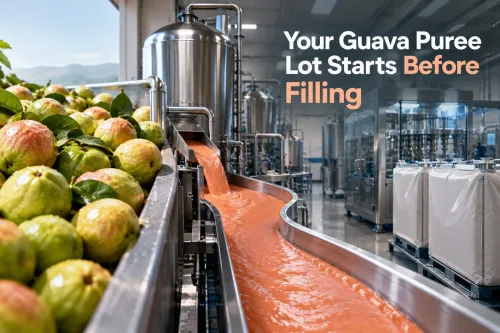

Sauce plants are only one part of the industrial market for guava puree. By matching the puree’s color, acidity, texture, documentation, and supply format to your process, you can identify whether you need an Indian exporter and what evidence to request before approving a shipment.
Key takeaways
- Choose pink puree for stronger color; choose white puree for a lighter visual profile.
- Test Brix, pH, acidity, viscosity, color, seeds, and microbiology against your recipe.
- Demand batch records, certificates of analysis, food-safety documents, and traceability details.
- Compare exporters on consistency, aseptic packaging, lead time, specifications, and landed cost.
Which businesses buy industrial guava puree from India?
Sauce, chutney, dipping-sauce, hot-sauce, marinade, beverage, dairy, bakery, confectionery, baby-food, prepared-food, and foodservice manufacturers buy guava puree when fresh fruit would create variable preparation, waste, and labor. The right buyer needs a repeatable fruit base, not merely a particular guava variety.
| Buyer | Typical application | Main purchasing priority |
|---|---|---|
| Sauce and condiment plants | Barbecue sauce, chutney, dipping sauce, hot sauce, marinades | Pumpability, spice compatibility, color stability, viscosity |
| Beverage manufacturers | Nectar, smoothie, fruit drink | Smoothness, flavor strength, low sedimentation |
| Dairy and bakery processors | Yogurt, dessert, filling, cake or pastry systems | Microbial control and compatibility with fat, protein, or starch |
| Baby-food, prepared-food, and foodservice suppliers | Purées, meals, desserts, portioned sauces | Safety controls, consistent texture, pack format, handling efficiency |
Ask whether the material is single-strength puree or concentrate. Concentrate can reduce freight cost per kilogram of fruit solids, but it requires controlled reconstitution and may cook differently from single-strength aseptic puree.
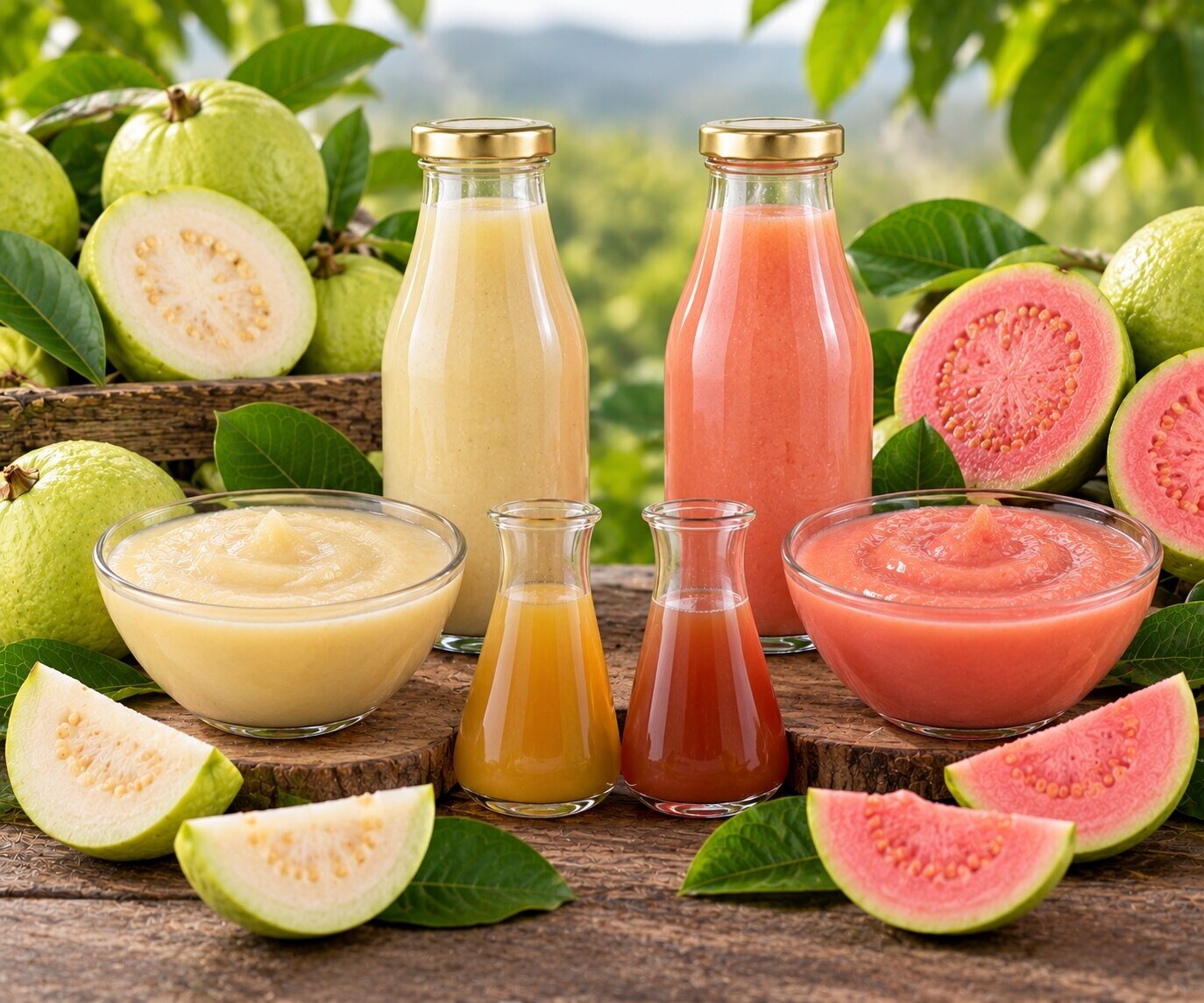
Buyers should compare soluble solids in °Brix, acidity, viscosity, seed removal, microbiological limits, color, packaging, and delivered cost. White puree usually provides a pale, neutral base; pink puree supplies stronger fruit identity and visible color. Both require a customer-specific specification covering sediment, grit, additives, and process tolerance.
Generic juice standards do not define every requirement for an industrial puree.
How should a sauce manufacturer choose white or pink guava puree?
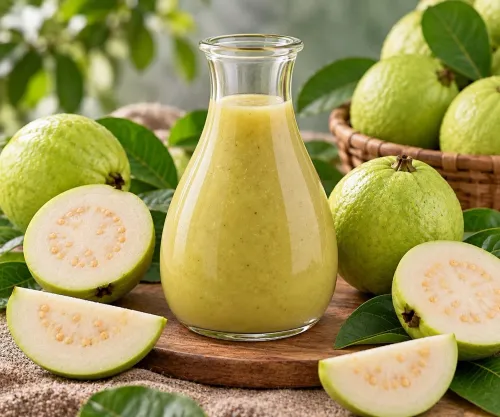
A barbecue sauce or marinade often needs guava to support tomato, chili, vinegar, salt, and spices rather than dominate them. White guava puree provides a pale, neutral base for barbecue sauce, chutney, dipping sauce, hot sauce, fruit sauce, marinades, and blended condiments; pink puree makes fruit identity and pink-to-red color more visible.
| Puree | Best fit | Main risk |
|---|---|---|
| White | Tomato, chili, spice-heavy, or colored sauces | Flavor can disappear if sweetness and aroma are too low |
| Pink | Fruit-forward sauces where natural color matters | Cultivar, maturity, oxygen, heat, light, pH, and metal exposure can shift color |
Compare aroma, sweetness, acidity, viscosity, seed-particle tolerance, and target appearance—not merely the words “white” or “pink.” Pink guava needs a retained color sample or CIELAB target, plus a maximum color change after cooking and storage.
Use white and pink guava puree exporters from india for sauce manufacturers as a search starting point, then test the puree in the actual recipe. Check whether it delivers:
- A smooth pour or spoonable texture after heating
- Stable viscosity without separation or flavor loss
- Compatibility with pectin, gums, vinegar, salt, spices, and preservatives
- Acceptable sieve or finisher performance, with no gritty seeds that block pumps or damage fillers
A puree that tastes excellent alone can thin under vinegar, tighten with pectin, or separate after hot filling. Run a bench batch at production temperature and inspect texture, color, aroma, and settling before approving it.
What technical tests prove that a guava puree fits the recipe?
A puree fits your recipe only when its measured properties survive production, not when a supplier describes the fruit as mature or premium. Ask guava puree exporters for sauce manufacturers for a lot-specific specification before comparing prices.
1. Request °Brix, pH, titratable acidity, viscosity, fruit variety, single-strength or concentrated status, added water or sugar, processing method, aseptic or frozen format, pack size, shelf life, storage temperature, microbiological limits, sieve or finisher performance, and the maximum visible-seed or grit defect.
Require lot-specific Brix and pH: those values set fruit loading, water and sweetener additions, cooking yield, and finished viscosity. A maturity statement cannot do that.
2. Run the sample through the actual sauce formula, then record color before and after heating, separation, settling, pumpability, flavor loss, and changes after adding acid, salt, spices, pectin, gums, or preservatives. Check whether the puree still pours or remains spoonable at the production temperature.
For pink puree, approve CIELAB values or a retained physical standard, then set a maximum color change after cooking and storage. A stated mesh size alone does not control hard guava seeds; inspect retained samples for grit and visible seeds that could block pumps, damage fillers, or trigger complaints.
Use pH 4.6 as the key U.S. acidified-food boundary when assessing the finished sauce. It does not replace a validated thermal process, preservative program, or shelf-life study.
Which documents and supply controls should an importer demand?
A complete approval package proves that a shipment can clear customs, enter your process, and remain traceable after delivery.
Request:
- Product specification, ingredient and allergen declaration, country-of-origin information, and process description
- Lot-specific certificate of analysis with pH, titratable acidity, °Brix, viscosity, and microbiological results
- Pesticide-residue policy or test plan, plus stated heavy-metal limits
- Packaging specification, batch or lot code, shelf life, storage conditions, and retained-lot sample policy
- Packing list, commercial invoice, certificate of origin, and phytosanitary or health documentation when the destination requires it
Before contracting white and pink guava puree exporters from India, confirm the customs classification, tariff treatment, labeling language, and permitted additives for the actual composition. Added sugar, concentration, and presentation can change the classification; an invoice description is not a binding tariff ruling.
| Format | Controls to verify | Main delivery consequence |
|---|---|---|
| Aseptic | Validated commercial sterility and packaging integrity | Less cold-chain dependence before opening; controlled handling afterward |
| Hot-filled | Fill temperature, closure integrity, and validated heat process | Ambient distribution may fit; seal failure can spoil the lot |
| Frozen | Freezer transport, storage capacity, and thawing procedure | Strong cold-chain dependence and higher handling cost |
Zeus India Enterprise can enter the approval list, but choose only after destination-market compliance, lot-specific results, intact packaging, and retained-lot evidence support the sample.
Related product
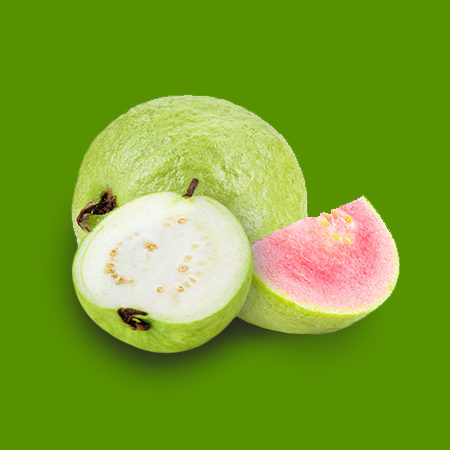 | White and Pink Guava Puree Zeus India is a trusted exporter and supplier of premium White Guava Puree and Pink Guava Puree in India, catering to the growing demands of the... View product → |
How do you compare bulk guava puree exporters beyond price?
Compare bulk guava puree exporters on total production risk, not invoice price. A cheaper lot becomes expensive when changed color or viscosity forces reformulation, rework, downtime, or rejected finished sauce.
| Supplier factor | Compare | Commercial consequence |
|---|---|---|
| Minimum order and quote | MOQ; price per kilogram or metric tonne; fruit-solids value | A concentrate may reduce freight per kilogram of fruit solids but adds reconstitution control. |
| Logistics | Pallet configuration; pack dimensions; lead time; ambient or refrigerated shipping; transit risk | Confirm your warehouse, freezer, dock, and receiving capacity can handle the shipment. |
| Continuity | Production-season planning; approved lots across crop periods | Seasonal gaps or profile changes can disrupt sauce settings and customer approvals. |
| Technical control | Retained samples; lot-to-lot Brix, pH, viscosity, and color reports | You can investigate drift instead of guessing after a batch fails. |
Ask the exporter to state whether the puree is single-strength or concentrated and whether blending, added water, sugar, acid, preservatives, or other fruit purees are used. Require written change notification before any crop, process, pack, or formulation change.
Define claims handling before purchase. Specify evidence requirements for leakage, seal failure, wrong temperature, off-spec viscosity, seed defects, and microbial nonconformance, including photos, temperature records, samples, and testing timelines.
Choose “go” only after the puree passes your production recipe, destination-market documents are complete, and the exporter demonstrates continuity across approved lots and crop periods. Otherwise, the lower quote is a no-go.
Frequently asked questions
Which businesses buy industrial guava puree from India?
Sauce, chutney, dipping-sauce, hot-sauce, marinade, beverage, dairy, bakery, confectionery, baby-food, prepared-food, and foodservice manufacturers buy industrial guava puree when they need a consistent fruit base.
How should a sauce manufacturer choose white or pink guava puree?
Choose pink guava puree when the finished sauce needs a stronger pink or red visual profile. Choose white guava puree when you want a pale base, cleaner color control, or less influence on the sauce appearance. Confirm the choice with a production-scale color and flavor trial.
What technical tests prove that a guava puree fits the recipe?
Compare the puree's Brix, pH, titratable acidity, viscosity, color, particle size, seed or grit content, and microbiological results with your recipe limits. Test a retained sample and run a pilot batch before approving the lot.
Which documents and supply controls should an importer demand?
Request a product specification, certificate of analysis, lot and batch identification, ingredient statement, allergen declaration, country-of-origin details, processing and packing dates, shelf-life statement, traceability record, food-safety certification, and export documents required for the destination market.
How do you compare bulk guava puree exporters beyond price?
Compare specification consistency, test data, aseptic pack format, minimum order quantity, lead time, production capacity, traceability, complaint handling, sample performance, shipping reliability, and total landed cost rather than the quoted price alone.