
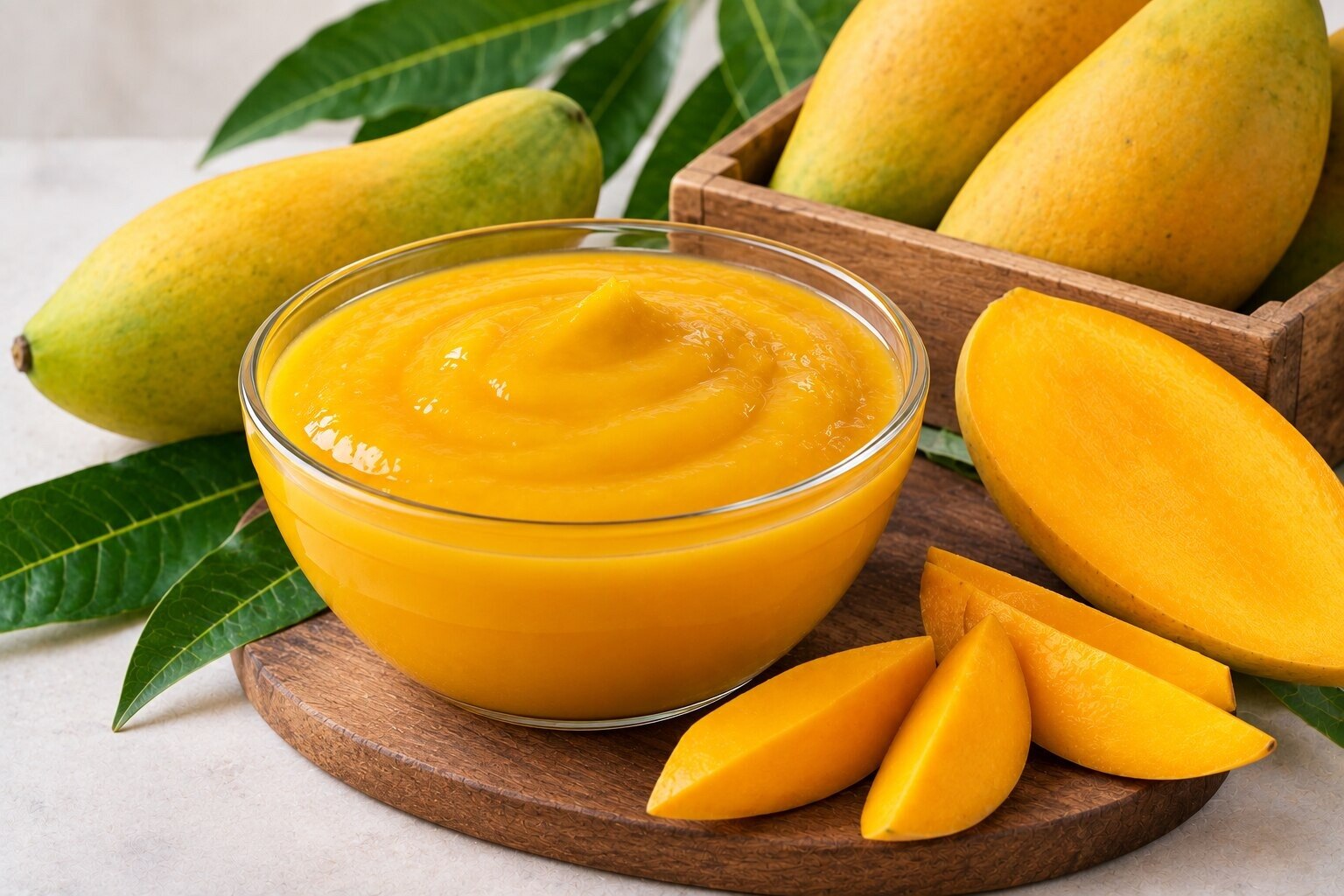
Manufacturers use Totapuri mango puree to add mango flavour, colour, acidity, soluble solids, and body to products that are mixed, heated, frozen, filled, or eaten by spoon. By defining the right puree specification, calculating the required dose, and validating handling and processing conditions, you can decide where it fits and where another mango ingredient is better.
Key takeaways
- Define Brix, pH, colour, texture, pack size, and microbiological limits before formulation.
- Use mango puree in sauces, bakery fillings, dairy products, desserts, and fruit preparations.
- Calculate puree dosage from target mango solids, not volume alone.
- Inspect seals, batch records, storage conditions, and thawing practice during trials.
Where Totapuri Mango Puree Fits Beyond Beverages
Totapuri puree works in foods where you need recognizable mango flavour, yellow-orange colour, soluble solids, and some body without handling whole fruit. These are practical totapuri mango puree uses beyond drinks:
| Product | What the puree contributes | Formulation watchpoint |
|---|---|---|
| Sauces | Fruity sweetness, colour, body, and mango aroma | Balance sugar, acid, salt, and viscosity separately |
| Chutneys | Mango character, pulp, colour, and a soft texture | Add vinegar or another acidulant for the required acidity |
| Bakery fillings | Moisture, flavour, colour, and fruit solids | Control water activity and prevent filling migration into dough |
| Ice cream and frozen desserts | Mango flavour, colour, and soluble solids | Adjust sugar and freezing-point effects before freezing |
| Fruit preparations | Mango pieces or bases gain flavour, colour, and body | Match viscosity and particle size to the yoghurt or dessert matrix |
| Snack coatings | A mango flavour layer and natural-looking colour | Dry the coating sufficiently to prevent stickiness |
| Nutrition products | Fruit flavour, colour, and some carbohydrate solids | Check fibre, acidity, and heat exposure against the product’s texture |
| Ready-to-eat foods | A sweet-tart fruit note in cereals, sauces, or meal components | Validate flavour after retorting, hot filling, or extended storage |
Use single-strength puree when the recipe is designed around its supplied soluble solids. Mango concentrate has substantially higher solids and requires reconstitution or formula adjustment. Totapuri also is not an automatic substitute for Alphonso: aroma, colour hue, fibre perception, and cooked flavour can change after processing.
Set the Puree Specification Before You Formulate
A supplier quote is incomplete if it says only “Totapuri mango puree.” Set a minimum, target, and maximum for every property that can change your formula, processing conditions, or finished-product quality.
| Property | Define before ordering | Why it matters |
|---|---|---|
| Soluble solids | °Brix range; identify single-strength puree or concentrate | Concentrate requires reconstitution or formula adjustment |
| pH and acidity | pH limit and titratable acidity method and range | Controls flavour, preservation, gel behaviour, and process validation |
| Viscosity | Test temperature, spindle or method, and acceptable range | Predicts pumping, dosing, mouthfeel, and filling performance |
| Fibre and particles | Fibre level or screen size, plus visible-particle limit | Prevents gritty texture, clogged filters, or sediment |
| Colour | Instrument method and L*, a*, b* or equivalent limits | Protects the intended yellow-orange appearance after heating |
| Flavour | Intensity, cooked-note tolerance, and off-flavour limits | Totapuri is not an automatic substitute for Alphonso |
| Additives | Permitted preservatives, acidulants, sugar, and stabilisers | Prevents an undeclared ingredient from entering your recipe |
For Totapuri puree for food manufacturing, request the supplier’s certificate of analysis, processing status, and lot-specific results rather than relying on a catalogue value. Specify whether the pack is aseptic and commercially sterile, or frozen, then define the unopened storage condition and use-by period after opening.
Run the proposed lot through your actual formula and heat process. Check the finished product for colour loss, flavour reduction, thickening, and separation; a laboratory tasting of unprocessed puree will not reveal every production failure.
Move Puree Through a Production Batch Without Losing Quality
Thaw frozen industrial Totapuri mango puree in its sealed bag at 0–5°C, unless the supplier’s validated instructions specify another condition. Do not leave it at room temperature: the outer portion can warm into a microbial-growth range while the centre remains frozen. Keep aseptic puree sealed until dosing; once opened, follow refrigerated, hygienic use-within-period controls.
Use this production sequence:
- Agitate the thawed bag gently to redistribute serum and pulp, then weigh the net puree into a covered vessel. Record the actual mass; do not estimate from the number of bags.
- Pass the puree through a sanitary screen selected during trials. A coarse screen can catch package fragments or large particles, while an unnecessarily fine screen can remove pulp and change viscosity.
- Add the puree after dissolving sugar, salts, acids, or other water-soluble ingredients. Pre-disperse stabilizers in the dry phase to prevent lumps, then use enough agitation to achieve uniformity without incorporating air.
- Apply the validated heat schedule to the complete mix when microbial control requires it. Excessive temperature or holding time can darken colour, reduce fresh mango aroma, and thicken or thin the puree unpredictably.
- Move the finished mix through a closed, sanitized line with minimal headspace and controlled pump speed. Limit recirculation and foaming, because oxygen exposure accelerates colour and flavour loss.
Check the blend for °Brix, pH, appearance, and viscosity at the specified test temperature before filling. Reconcile tank input, screen hold-up, and final batch weight so a filter loss does not quietly alter the recipe.
Calculate the Dose and Compare Mango Ingredients
Calculate puree from the finished batch target, not from the container size. For a 200 kg recipe requiring 10% mango puree, weigh 20 kg of single-strength puree and make up the remaining 180 kg with the other ingredients.
If your target is based on mango soluble solids, use: puree required = required mango solids ÷ puree soluble-solids fraction. For example, supplying 16 kg of mango solids with puree at 16°Brix requires 100 kg of puree.
This calculation applies only when the stated solids contribution comes from puree; sugar, syrup, and concentrate must be counted separately.
Confirm the supplier’s actual °Brix on the specification or certificate of analysis. Do not treat concentrate as single-strength puree: calculate its solids contribution, then add water and adjust the formula. Measure finished-product pH after dilution and blending; fruit name alone does not establish the process requirement.
| Format | Strength and character | Choose it when |
|---|---|---|
| Totapuri single-strength puree | Controlled mango flavour, colour, body | You need economical mango identity in beverages, sauces, fillings, or fruit preparations |
| Alphonso puree | More premium aroma and distinctive flavour | The product’s price and positioning depend on cultivar character |
| Mango concentrate | Higher soluble solids, less shipping volume | You can reconstitute and control water, flavour, and viscosity |
| Diced or frozen mango | Visible pieces and fresh-cut texture | The product needs inclusions rather than a smooth base |
Totapuri mango puree for food manufacturers is the better choice when consistent mango character and controlled cost matter more than premium aroma. Approve any Alphonso substitution in the finished matrix: heating can expose differences in colour, fibre perception, acidity, and cooked flavour.
Control Receiving, Storage, and the Production Trial
Release a lot only after the container, documents, and puree itself pass inspection. Confirm whether you received single-strength industrial totapuri mango puree or concentrate; the two require different formulation calculations and cannot be approved from the label alone.
- Match the lot number, production date, best-before date, pack count, net weight, and certificate of analysis to the purchase order.
- Inspect frozen packs for torn film, leakage, frost damage, partial thawing, or temperatures above your validated limit; store accepted packs at the specified frozen temperature, commonly −18°C or colder.
- Inspect aseptic bags and cartons for swollen packs, wet seams, damaged valves, broken seals, or loss of vacuum; quarantine any suspect unit instead of opening it.
- Sample according to your receiving plan and record °Brix, pH, titratable acidity, viscosity, colour, odour, and fibre or particle behaviour against the agreed specification.
- Retain a sealed reference sample and trace the lot through your batch record, especially when purchasing totapuri puree for food manufacturing from a new source or changing pack format.
Zeus India Enterprise can be included in a sourcing comparison when you need to assess lot documentation, pack integrity, and the supplier’s response to a failed incoming result—not just the quoted price.
Run the production trial with the proposed lot, not a laboratory substitute. Use your actual thawing, mixing, filtration, homogenization, pasteurization or sterilization, filling, and storage sequence, then check sedimentation, flavour loss, colour shift, excessive thickening, and microbial results before approving the lot for routine production.
Related product
 | Totapuri Mango Puree Zeus India is a trusted exporter and supplier of premium Totapuri Mango Puree in India, offering high-quality fruit-based ingredients for the global... View product → |
Frequently asked questions
Where can food manufacturers use Totapuri mango puree beyond beverages?
Use it in sauces, bakery fillings, dairy products, desserts, fruit preparations, and other foods requiring mango flavour, colour, soluble solids, or body.
Which specifications should you set before formulating with Totapuri puree?
Set the required soluble solids, pH, colour, texture, flavour profile, pack format, shelf-life conditions, and microbiological limits before choosing a supply.
How do you calculate the amount of Totapuri puree for a batch?
Calculate the dose from the puree’s soluble-solids contribution and your finished product target, then confirm the result with a pilot batch.
How should manufacturers handle Totapuri puree during receiving and production trials?
Check the container, seal, batch documents, storage condition, and product identity at receiving; control thawing, transfer, mixing, and in-process checks during the trial.