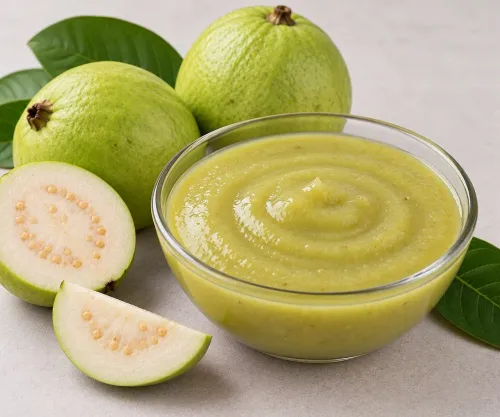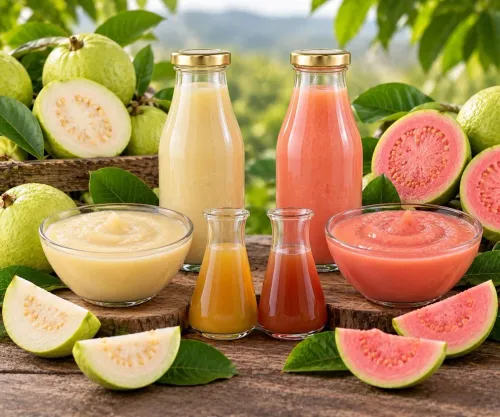

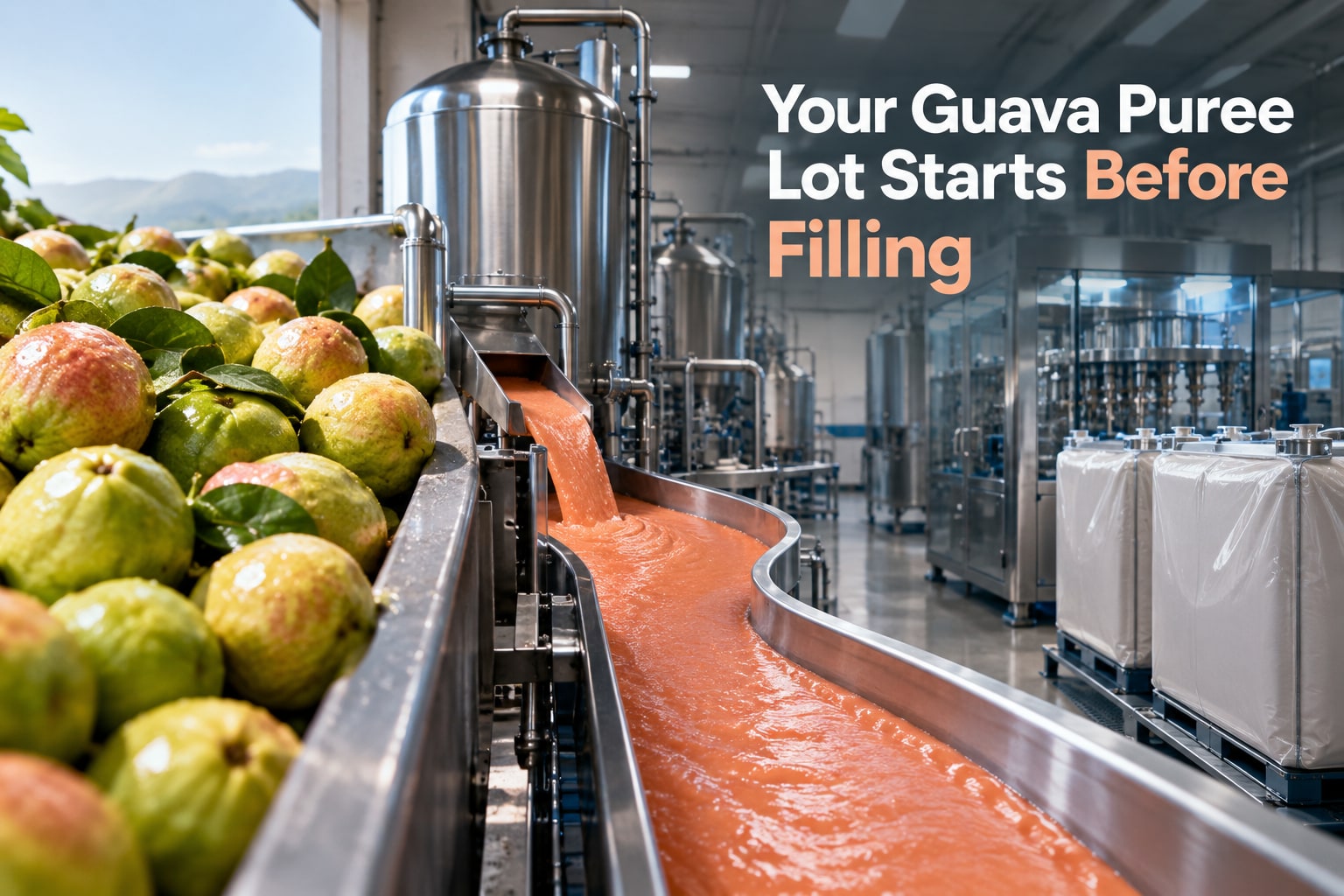
Bulk guava puree is not made by simply crushing ripe fruit and filling drums. The processor must control fruit condition, seed and fibre removal, oxygen, heat, colour, texture, and microbial safety while keeping each lot within the buyer’s specification. By the end, you will know which processing stages matter, how white and pink guavas behave differently, and what to include in a purchase specification.
Key takeaways
- Trace every guava lot from receiving through finished bulk packs.
- Set separate colour targets for white and pink guava puree.
- Request Brix, pH, viscosity, microbiology, and sensory results for each lot.
- Compare processing controls, filling methods, and traceability before ordering.
How fruit moves from receiving to a consistent guava puree
A consistent guava puree starts with lot control, not the pulper. At receiving, record the supplier, cultivar or flesh colour, harvest or delivery date, and lot number so defects and finished packs remain traceable.
1. Inspect ripeness and condition. Accept fruit with suitable firmness, aroma, and flesh development; remove bruised, mouldy, overripe, and immature guavas. Sorting cannot remove off-flavours, dark colour, or microbial load already transferred into damaged fruit.
2. Wash sound fruit in potable-water washing tanks, then sort it again on a conveyor. Trim stems, leaves, damaged tissue, and remaining defective sections before feeding the line.
3. Apply an optional short heat treatment when the process requires softer tissue, lower enzyme activity, easier pulp release, or initial microbial reduction. The processor must validate temperature and residence time for the fruit, equipment, and product; excessive heat dulls fresh flavour and pink colour.
4. Feed the prepared fruit into a pulper fitted with a perforated basket or screen. The screen removes peel fragments, seeds, and coarse material, while a finisher reduces fibrous tissue and stone cells that can create a sandy or gritty mouthfeel.
5. Set screen aperture and finisher clearance against maturity and the target texture. A wider aperture can raise yield but pass more fibre and seed particles; a tighter setting produces smoother puree but retains more pulp on the screen. Immature fruit lowers yield, while very soft fruit can increase fibre release.
A buyer searching white pink guava puree manufacturer for process should assess this complete line, not only the finished pack. Pink guava puree processing requires matched settings for each fruit lot because maturity changes yield, smoothness, and grit.
Why white and pink guavas need different colour controls
Flesh colour is a specification, not a guarantee. White guava puree may look cream, yellow, or slightly pink rather than colourless, while pink guava can lose its intended tone through oxidation, browning, or excessive heat.
| Flesh | Seed load and texture | Aroma and acidity | Main variation |
|---|---|---|---|
| White | Often lighter pulp; seed load and fibrousness vary by cultivar | Delicate aroma; acidity changes with maturity | Cream, yellow, or faint pink tones may appear |
| Cream | Usually mild colour; seeds and fibres depend on fruit condition | Soft aroma; moderate acidity | Ripeness can deepen the colour |
| Yellow | More visible colour than “white”; fibrous tissue can increase in mature fruit | Fuller aroma; acidity falls as fruit ripens | Heat can intensify dull or cooked notes |
| Pink | Pigment is sensitive to oxygen, heat, and browning; seeds and fibres still vary | Stronger aroma; acidity varies by cultivar and maturity | Pink intensity can fade during holding and storage |
A white guava puree manufacturer grades fruit by cultivar, maturity, flesh colour, seed load, fibrous texture, and condition. It controls harvest-lot differences through selective lot approval, separate processing, or blending lots to a defined colour, acidity, and texture range.
During pink guava puree processing, oxygen entrainment promotes colour loss, foaming, and oxidative flavour change. Rapid hygienic handling, deaeration, short controlled holding, validated heating, and clean stainless-steel equipment reduce risk; iron or copper contact can accelerate browning.
Ask for a colour limit or instrument reading, not an assumption about artificial colour or additives. Brix and pH alone cannot prove that pink or white appearance will remain consistent.
How deaeration, heat treatment, and filling protect the puree
After refining, the puree passes through a vacuum deaerator. The equipment removes entrained oxygen, collapses foam, and limits oxidative browning and flavour loss; it does not replace thermal sterilisation or hygienic filler design.
1. Pump deaerated puree through a product-specific heat exchanger. The scheduled process must be validated for the puree’s measured pH, Brix, formulation, fruit maturity, contamination history, and intended container and storage route. The name guava puree alone proves none of these controls.
2. Send the heated product to an aseptic filler only after sterilising the product-contact path and packaging system. Aseptic filling places commercially sterile puree into sterile bags inside drums, supporting ambient unopened storage for the validated shelf life stated on the specification.
3. Cool filled drums through the specified cooling stage, then move them with drum-handling equipment that prevents punctures, seam damage, and rough impacts. Check bag seals, drum condition, fill weight, headspace, and closure integrity; trapped air or underfilling can shorten shelf life.
4. Keep frozen-filled puree at the stated frozen temperature, commonly −18°C or colder, without treating it as aseptic material. Frozen filling depends on an unbroken cold chain, while aseptic packs depend on commercial sterility and ambient storage; their unopened shelf-life assumptions are not interchangeable.
A buyer researching guava puree production india should request the scheduled process, storage temperature, unopened shelf life, pack specification, and post-opening instruction. After opening either format, refrigerate the puree, prevent utensil contamination, reseal it, and use it within the supplier’s stated period.
Which test results define an acceptable bulk lot
Approve a lot only against a written specification naming cultivar or flesh colour, single-strength or concentrated format, target Brix, pH, titratable acidity, viscosity or consistency, colour reading, aroma, pulp and seed-particle size, insoluble solids, stone-cell tolerance, foreign matter, and microbiological results. Record the batch number and fruit-lot traceability.
Brix measures soluble solids, not structure. Two lots with equal Brix can differ in acidity, aroma, colour, viscosity, serum separation, pulp content, and gritty stone-cell residue. Set numerical acceptance limits for each property, plus defined sensory rejection criteria.
| Format | Best fit | Buyer’s warning |
|---|---|---|
| Puree | Dairy, sauces, desserts, bakery fillings, fruit-body beverages | Delivers suspended pulp and texture |
| Pulp | Desserts, fillings, sauces, formulated beverages | Confirm whether refining and seed removal match your process |
| Juice | Clearer beverages | Lacks puree’s fruit body |
| Concentrate | Lower shipping volume for beverages, sauces, dairy | Higher heat load, stronger flavour, and reconstitution changes |
| Nectar base | Ready-to-formulate beverages | May contain sweetening, water, acid, or other formulation components |
Require the certificate of analysis, process and storage records, microbial report, allergen declaration, food-contact declaration where applicable, and evidence supporting the stated shelf life. Ask an industrial guava puree supplier to identify the test method and sampling point for every result.
Reject packs with unlisted foreign matter, unexplained microbial counts, broken seals, or a batch number that cannot be traced to the fruit lot.
How to compare a processor before placing a bulk order
A capable industrial guava puree supplier can show process evidence, not only a drum price. Ask whether white and pink cultivars run separately, how guava puree production India manages seasonal fruit, stored or frozen material, cultivar mixing, and lot blending, and which screen apertures and finisher settings control seeds, fibres, and stone cells.
Ask how each harvest lot’s colour variation is approved.
- Request a representative sample with its matching specification, batch number, COA, fruit-lot traceability, microbial report, process and storage records, and post-opening instructions.
- Compare the sample and documents for Brix, pH, titratable acidity, viscosity, particle size, colour reading, aroma, microbiology, pack format, storage temperature, unopened shelf life, and handling after opening.
- Check allergen and food-contact declarations where applicable, plus evidence that aseptic or frozen handling and the selected pack were validated for the stated shelf life.
- Assess Zeus India Enterprise through documented lot traceability, batch COAs, validated preservation, and export-ready records—not the supplier label alone.
| Evidence | What it reveals | Warning sign |
|---|---|---|
| Plant capability | Separate white and pink lines or controlled changeovers | One generic colour claim |
| Texture control | Recorded screen and finisher settings | “Smooth” without particle limits |
| Colour control | Lot approval limits or instrument readings | Uncontrolled harvest blending |
| Preservation | Aseptic or frozen route with storage records | Ambient and frozen claims mixed |
Issue a purchase specification naming cultivar or flesh colour, target Brix, pH or acidity, particle limit, seed and stone-cell tolerance, preservation route, pack format, storage temperature, and acceptance limits.
Related product
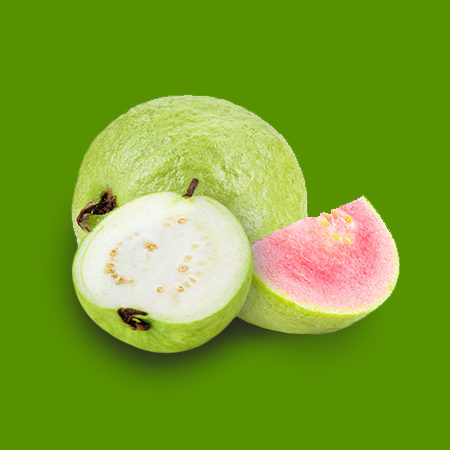 | White and Pink Guava Puree Zeus India is a trusted exporter and supplier of premium White Guava Puree and Pink Guava Puree in India, catering to the growing demands of the... View product → |
Frequently asked questions
How does guava fruit become consistent puree in bulk production?
Processors control receiving lots, sort and wash fruit, remove unsuitable material, pulp the guava, and standardise the finished puree against agreed specifications.
Why do white and pink guavas need different colour controls?
White guava puree is judged for a pale cream appearance, while pink guava puree is judged for stable pink or salmon colour. Mixing cultivars or overprocessing can shift the result.
How do deaeration, heat treatment, and filling protect guava puree?
Deaeration removes trapped oxygen, heat treatment reduces microbial risk, and hygienic filling into sealed containers limits recontamination after processing.
Which test results should define an acceptable bulk guava puree lot?
Review Brix, pH, viscosity, colour, sensory condition, foreign-material checks, and microbiological results against the written purchase specification.
How should you compare guava puree manufacturers before placing a bulk order?
Ask for process details, lot traceability records, product specifications, test reports, packaging formats, shelf-life evidence, and sample approval procedures.