
Choosing guava puree for confectionery is a formulation decision, not simply a colour preference: the puree affects set, flavour release, appearance, cooking loss and finished texture. By the end, you will be able to match white or pink guava to a confectionery format, define a usable purchase specification and compare bulk ingredients from Indian exporters without relying on vague descriptions.
Key takeaways
- Choose pink guava for colour impact, but verify shade after dilution and heating.
- Set Brix, pH, colour, texture and pack targets before ordering bulk puree.
- Add puree late in cooking when heat exposure could damage colour and aroma.
- Approve each lot against an application-ready specification, not fruit name alone.
Match white or pink guava puree to the confectionery format
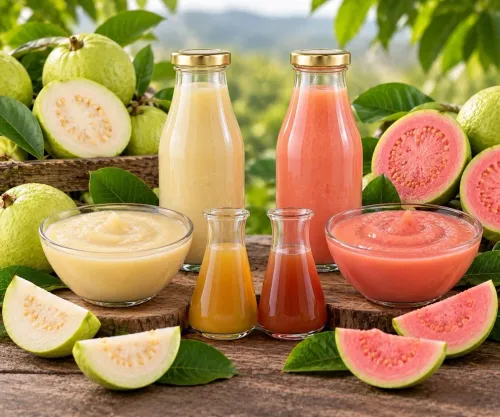
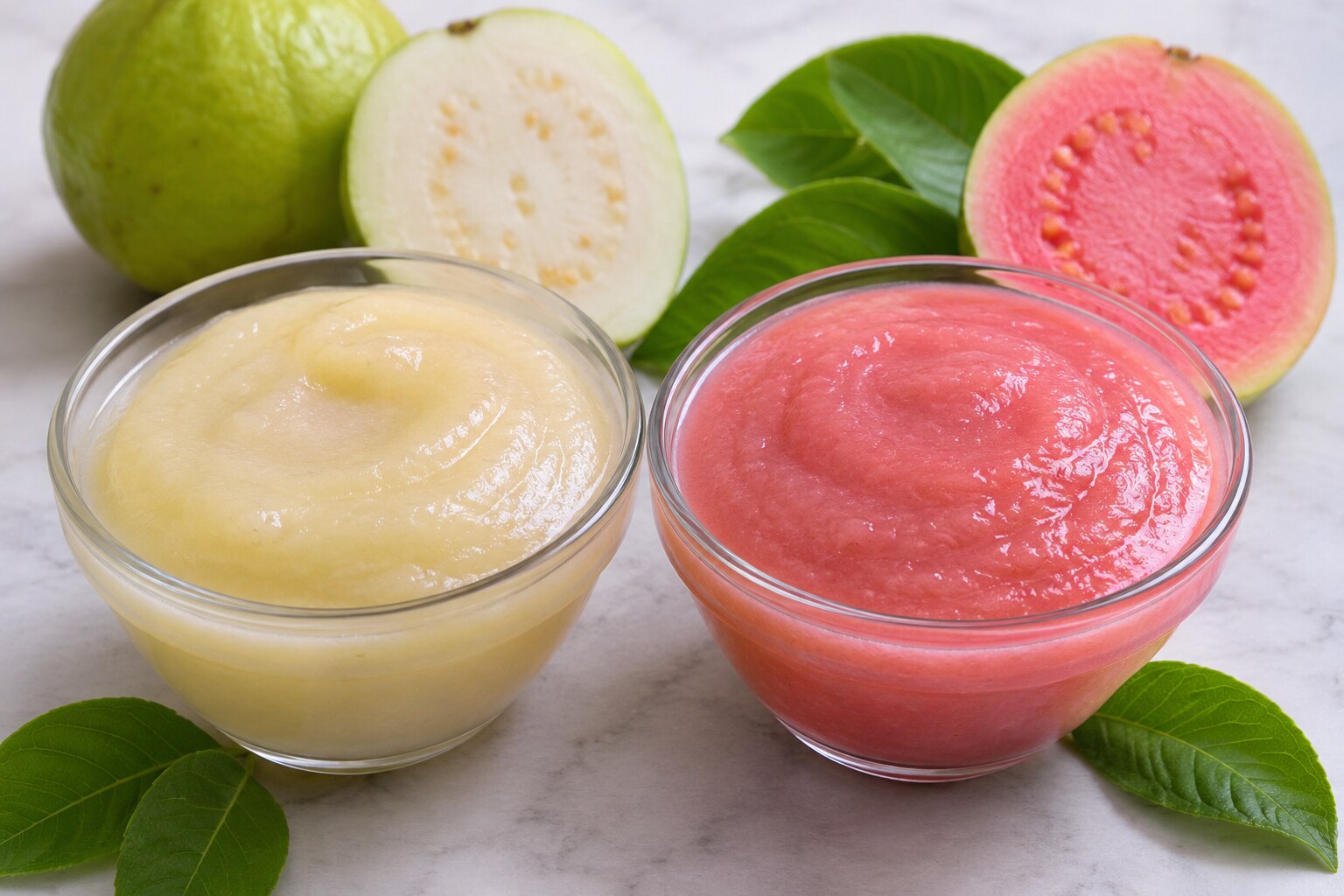
For guava puree for dessert brands, choose the puree by the finished confectionery’s colour, opacity, flavour intensity and heat exposure—not by fruit name alone. Pink guava does not guarantee a stable red shade: dilution, pH, oxygen and cooking can turn it pale or brown.
| Format | Preferred starting choice | Why and watch-out |
|---|---|---|
| Clear jelly | White guava puree | It supports a pale, cleaner appearance and lets the jelly’s clarity show through. Use a finely screened puree; seeds, grit or suspended fibre will be obvious. |
| Opaque filling | Pink guava puree | Its stronger visual identity suits fondants, marshmallow centres, caramels and bakery fillings. Confirm the finished shade after sugar, dairy or starch dilution. |
| Layered dessert | White or pink, selected for contrast | White works beneath cream, custard or fruit layers without dominating them. Pink creates a visible fruit layer, but specify its final colour after chilling. |
| Fruit chew | Pink guava puree | It gives a more recognisable fruit appearance and pronounced aroma in a dense, sugar-rich matrix. Choose white when a pale chew or less coloured coating is required. |
| Chocolate filling | White guava puree | Its lighter colour avoids muddying the chocolate and can deliver a softer, floral fruit note. Pink works when the recipe deliberately targets a chocolate-and-guava contrast. |
Ask exporters for application samples made with your sugar system and cooking profile. Buyers comparing white and pink guava puree exporters from India for confectionery applications should approve colour, viscosity, seed control and aroma in the finished format, not in the bulk puree alone.
Set the formulation targets before ordering bulk puree
Set numerical targets before requesting quotations: supplied-puree Brix, fruit percentage, pH, titratable acidity, moisture and finished-product water activity. A search for guava puree exporters india confectionery is useful only after this target sheet exists.
1. Define the fruit dose first. State white or pink guava puree as a percentage of the finished recipe, then calculate sugar and water around its actual Brix. Record whether the exporter reports Brix on single-strength puree or after adding sugar, acid, water or another fruit.
2. Set the gel system against the intended texture. Pectin needs the correct sugar concentration, pH and, for low-methoxyl grades, calcium; gelatin needs controlled cooling and loses strength under prolonged heat. Starch adds body but can mask aroma and create a pasty filling.
Trial the buyer’s exact pectin, gelatin, starch and cooking profile, not a supplier’s standard recipe.
3. Specify acidity numerically. Set a pH range and titratable acidity target because acid changes pectin set, flavour and colour; do not use “tart” as a specification. Measure pH after all ingredients are blended.
4. Control the final moisture and water activity, not puree alone. Evaporation raises Brix while lowering moisture, but the same Brix does not guarantee the same water activity after adding gelatin, starch or humectants. Measure both on the finished confectionery and adjust sugar, puree or water through pilot batches before placing a bulk order.
Control heat, evaporation and the point of puree addition
Add guava puree after the main sugar-and-water evaporation whenever the format allows it. Early addition exposes the puree to longer heat, oxygen and steam loss, which strips fresh aroma, darkens colour and can weaken pectin through prolonged acid heating.
1. Evaporate the syrup or fruit-free base to the required solids using the shortest validated heat cycle. Vacuum evaporation or a closed, low-oxygen vessel reduces aroma loss; do not compensate for poor evaporation by extending the cook.
2. Add puree at the validated finishing temperature, then mix quickly in a covered vessel with minimal headspace. For pectin systems, confirm the addition order: some require pectin activation before puree acidity enters, while others depend on fruit solids during cooking. Changing that order can produce excessive viscosity, syneresis or a weak set.
3. Run the complete application process, not only a tank sample. Compare the finished product with an approved retained sample for aroma, texture, viscosity and colour, recording L*, a* and b* values when shade matters.
Pink guava is not a guaranteed red colourant. Cultivar, pH, oxygen, heat history and dilution with sugar, dairy or starch determine the final shade; specify the finished colour rather than ordering “pink” alone.
This control matters for guava puree for dessert brands, especially in jellies, fruit fillings and layered products where browning or aroma loss is immediately visible.
Compare aseptic puree with frozen puree, concentrate, juice, pulp and flavouring
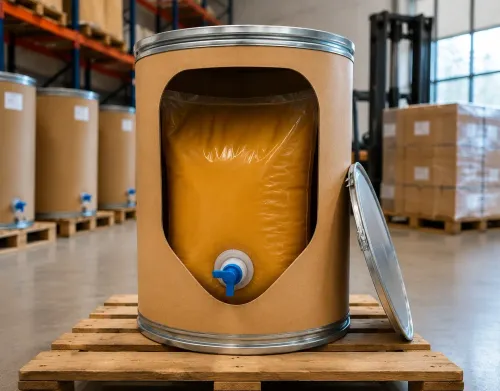
Choose aseptic single-strength puree for a shelf-stable filling line; choose frozen puree when you have freezer storage and want less processing history. Concentrate, juice, pulp and flavouring solve different formulation problems.
| Ingredient | Best fit | Confirm before buying |
|---|---|---|
| Aseptic puree | Ambient fillings, jellies and gummies | Single-strength status, Brix, pH, viscosity, aseptic pack and shelf life |
| Frozen puree | Shorter campaigns with thawing capacity | Frozen storage temperature, thaw procedure, drip loss and refreezing controls |
| Concentrate | Recipes needing intense fruit solids with added water | Concentration ratio, Brix, fruit percentage, added sugar or acid and reconstitution method |
| Juice | Clear products needing liquid flavour and low solids | Clarification, pulp content, Brix, acidity and filtration |
| Pulp | Textured fillings or inclusions | Particle size, seed and grit limits, viscosity and heat stability |
| Flavouring | Aroma correction, not fruit solids or texture | Natural or artificial status, carrier, dosage and allergen declaration |
For white and pink guava puree bulk supply, demand separate specifications: cultivar or colour reference, L*a*b* range, aroma, seed content and sensory description. Pink puree is not a guaranteed stable red; pH, oxygen, heat and dilution can change the finished shade.
Ask guava puree exporters india confectionery for the ingredient declaration, fruit percentage, country of origin, standardisation details, lot COA and package-integrity record. Confirm Brix, pH or acidity, microbiology, foreign matter, remaining shelf life and destination certificates before production. Zeus India Enterprise belongs in your comparison only after it provides those application-ready documents.
Related product
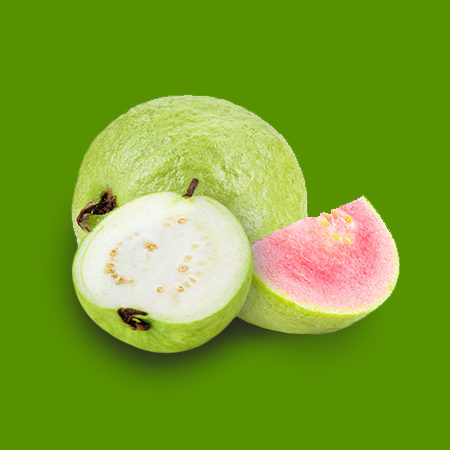 | White and Pink Guava Puree Zeus India is a trusted exporter and supplier of premium White Guava Puree and Pink Guava Puree in India, catering to the growing demands of the... View product → |
Approve the lot against an application-ready confectionery specification
Approve a lot only when its test results match the finished confectionery, not merely a generic “food grade” declaration. For white and pink guava puree bulk supply, set acceptance limits before shipment and link them to the filling, jelly, gummy, coating or dessert process.
1. Confirm lot identity, cultivar or colour designation, production date, batch number, country of origin and certificate of analysis. Treat white and pink guava as separate specifications; maturity and processing can change aroma, seed content and puree colour.
2. Test soluble solids in °Brix, pH and titratable acidity against agreed limits. A pH at or below 4.6 marks an important U.S. acidified-food boundary, but it does not replace validation of the finished product’s time-temperature process.
3. Measure colour instrumentally, using L*, a* and b* values with an approved reference sample. “Pink” does not guarantee a stable red shade: dilution, pH, oxygen and heat can shift the final colour.
4. Check viscosity or flow at a defined temperature, plus screen aperture and maximum retained-particle size. Hard seeds and stone-cell grit will be obvious in smooth fillings, jellies and coatings.
5. Release only results covering yeast and mould, total plate count, foreign matter and pathogens where the product and destination require them. Inspect aseptic bags, drums or cartons for leaks, swelling and seal damage, then verify remaining shelf life.
Ask white and pink guava puree exporters from India for confectionery applications to supply retention samples and process-authority information when the puree enters an ambient-stable system. Evaluate aroma and flavour after cooking, not only in the unopened pack.
Frequently asked questions
How do you match white or pink guava puree to a confectionery format?
Match the puree to the finished product’s colour, opacity, flavour intensity and heat exposure. White guava suits pale fillings and clear or lightly coloured formats; pink guava suits products needing stronger fruit colour, subject to dilution and heating tests.
What targets should you set before ordering bulk guava puree?
Define Brix, pH, colour, viscosity or texture, seed and fibre tolerance, flavour intensity, pack size, storage conditions and microbiological requirements before placing a bulk order.
When should guava puree be added during confectionery cooking?
Add it after high-temperature evaporation when the recipe allows, because prolonged heat can reduce fresh aroma and darken colour. Confirm the addition point through a pilot batch.
How does aseptic guava puree compare with frozen puree, concentrate, juice, pulp and flavouring?
Aseptic puree offers ready-to-use fruit solids with ambient-stable bulk handling. Frozen puree needs cold storage, concentrate needs reconstitution, juice has less body, pulp varies in texture, and flavouring supplies aroma without the full fruit profile.