
Sauce manufacturers choose Alphonso for more than mango content: its aroma, orange-yellow colour, sweetness, acidity and fruit solids shape the finished product. By the end, you will be able to compare Alphonso with Totapuri, convert a recipe, specify the right bulk format and approve an Indian supplier with measurable checks.
Key takeaways
- Define puree Brix, viscosity, pack size and preservation before requesting prices.
- Convert puree weight from fruit solids, not simply by replacing fresh mango.
- Request batch documents, laboratory results and a sauce trial before approval.
- Judge suppliers by lot consistency, delivery performance and technical support.
What Alphonso contributes to a sauce formula
Alphonso earns its place in a sauce when aroma and colour lead the sensory brief. Its characteristic fragrance, orange-yellow colour, sweetness and acidity deliver strong mango flavour, while soluble fruit solids build body; pectin and suspended fibre improve cling but can also raise viscosity and affect separation during heating.
Mango puree is not a direct texture substitute for tomato paste: their solids behave differently, so test viscosity at the intended serving temperature, not from Brix alone.
| Choice | Formula effect | Commercial fit |
|---|---|---|
| Alphonso mango puree for sauces | Stronger varietal aroma, richer flavour and vivid colour; sweetness and acidity shape the sugar-acid balance | Products sold on distinctive mango character |
| Totapuri puree | Cleaner flavour and adjustment profile with a more economical mango-solids base | Cost-controlled, high-volume formulations |
| Blend | Balances aroma, colour, solids and cost | Recipes needing controlled adjustment |
For each application, use the profile that matches the brief:
- Chutney: Alphonso adds aromatic fruit depth alongside spice, salt and acid.
- Dipping sauce: Alphonso strengthens immediate mango impact and orange-yellow appearance.
- Barbecue glaze: Totapuri or a blend may suit a high-volume glaze where sugar, spice and smoke dominate.
- Cooking sauce: Alphonso contributes flavour and cling; check fibre-related separation after heating.
- Dessert sauce: Alphonso supports richer aroma, sweetness and colour.
- Beverage syrup: Alphonso suits a pronounced mango profile, but balance its sweetness and acidity before dilution.
Bulk Alphonso mango puree is therefore the choice when consumers must recognise the fruit, not simply when a formula needs mango solids.
How to convert the recipe and add puree correctly
Calculate bulk Alphonso mango puree by solids, not by the weight of fresh fruit. Puree required = target mango-solids percentage × batch weight ÷ puree soluble-solids fraction; express both percentages as fractions, so a 10% mango-solids target in a 1,000 kg batch using 20% soluble solids requires 500 kg puree.
Fresh mango requires an edible-yield adjustment for peel and stone. Mango concentrate requires its Brix and dilution water in the calculation. For sweetened pulp, separate mango solids from added sugar before setting the formula. Do not replace another variety weight for weight; run a flavour and acidity trial first.
- Disperse sugar, salt and dry spices in the water or liquid phase. Poor dispersion leaves spice pockets and uneven sweetness.
- Hydrate stabilisers according to the supplier’s specification. Skipping hydration can produce lumps or unstable viscosity.
- Add Alphonso mango puree for sauces under agitation, then adjust acid and final solids.
- Add the puree before the validated hot-fill, pasteurisation or retort step so the whole batch receives the controlled kill treatment.
- Reserve puree for post-heat aroma only after validating the hygienic process; an unprocessed addition can recontaminate the sauce.
After heating, check scorching, pumpability, phase separation, viscosity and colour. Measure pH and titratable acidity in the finished sauce, not from the cultivar name or raw puree alone. Validate the process against the 4.6 pH acid-food boundary.
Specify the puree format before you compare supplier prices
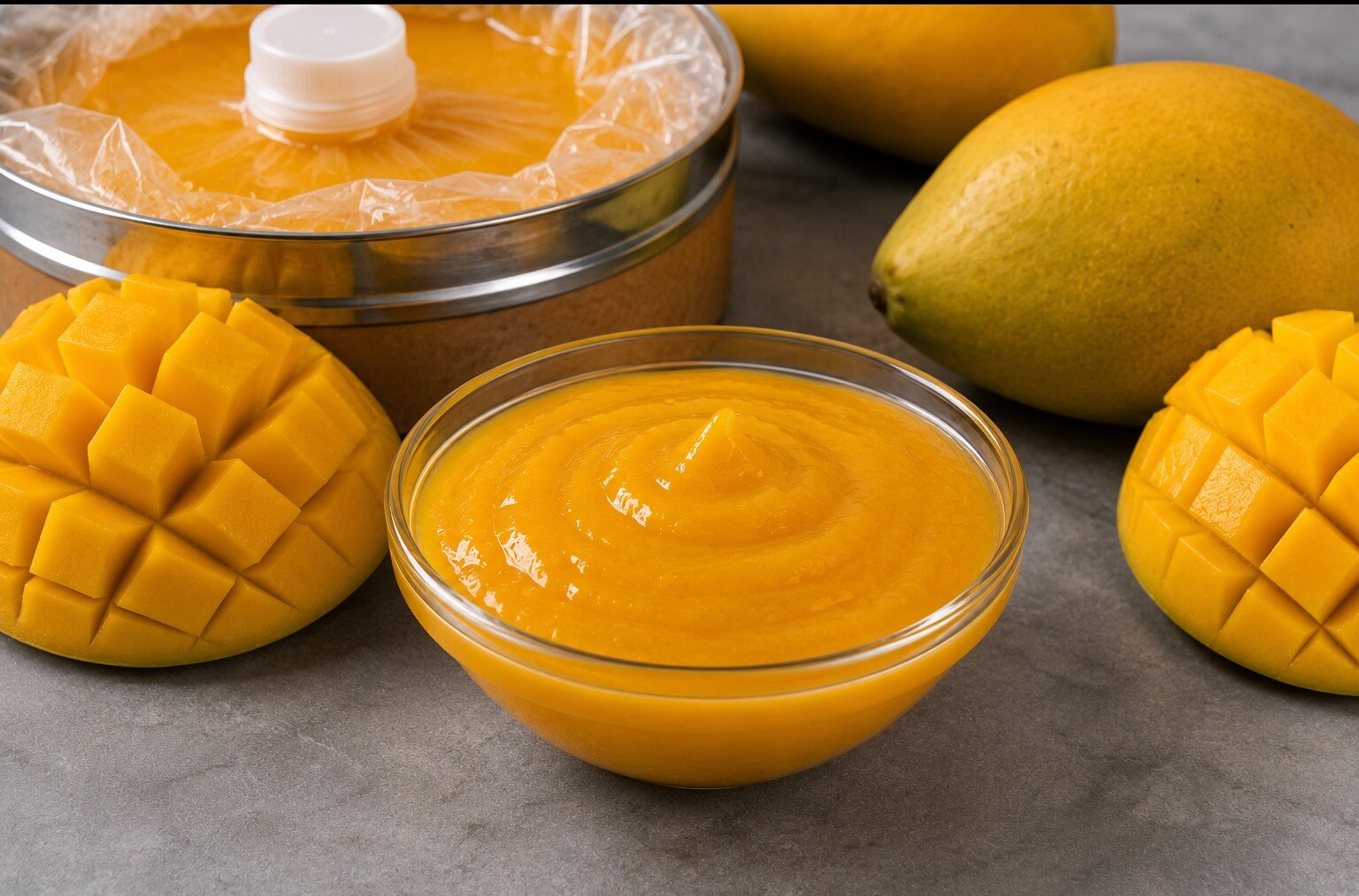
Specify the puree format before comparing prices: aseptic puree, frozen puree and sweetened pulp are not interchangeable in a sauce plant. They change cold-chain needs, thawing, sugar adjustment, opening procedures and hold times.
| Format | Operational effect | Price-comparison warning |
|---|---|---|
| Aseptic puree | Ambient storage while the sterile pack remains intact and within validated conditions | A leaking bag or damaged drum requires controlled handling, refrigeration or rapid use |
| Frozen puree | Cold storage, thawing controls and limited post-thaw hold time | Include freezer space, energy and thawing labour |
| Sweetened pulp | Added sugar changes the recipe and solids calculation | Compare mango solids, not kilograms alone |
Require alphonso mango puree suppliers from india to state:
- Brix, refractometer or other measurement method, sample basis and measurement temperature; pH; titratable acidity; viscosity method and test temperature.
- Fruit content; fibre or insoluble-solids range; sieve size; colour limits; preservation method; foreign-matter limits; microbiological limits.
- Pack format and size, net weight, storage temperature, unopened shelf life and opened-container hold time.
An opened aseptic container is not shelf-stable. Treat it hygienically and refrigerate or use it rapidly. Require the alphonso mango puree supplier india to declare Alphonso as the cultivar, identify single-cultivar or blend status, crop year and raw-fruit origin. Ratnagiri or Sindhudurg GI protection does not prove that every Indian puree came from those areas.
Compare delivered mango solids, usable strained yield, freight, storage, packaging disposal and expected losses—not drum price alone. A Codex soluble-solids reference helps compare declarations, but it does not replace your purchase specification.
Approve each lot with documents, laboratory checks and a sauce trial
Release a lot only after two gates: laboratory approval and a production-scale sauce trial. This prevents seasonal maturity shifts, dilution and enzymatic browning from reaching finished goods.
Request these documents from an Indian mango puree supplier:
- Product specification and lot-specific certificate of analysis
- Microbiological results and pesticide-residue statement
- Allergen declaration and country-of-origin document
- Lot traceability record, including cultivar, crop year and raw-fruit source
- Shelf-life data and the agreed rejection procedure
Specify maturity limits, damaged fruit, latex or skin contamination, fruit-fly and microbial defects, foreign material, and whether the product is single-cultivar or blended. “Ripe Alphonso flavour” alone is not a control.
At intake, record the batch number and verify container integrity, Brix, pH, titratable acidity, sensory profile, colour, viscosity, sieve performance and microbiological results before production release. Colour and Brix cannot authenticate Alphonso; compare the botanical or cultivar declaration with traceability records.
| Stage | Checks | Release decision |
|---|---|---|
| Laboratory release | Brix, pH, acidity, viscosity, colour, microbiology and foreign matter | Hold the lot if a result breaches the agreed specification |
| Production trial | Pumpability, heat stability, separation, colour after hot-fill or retort, and sensory performance during shelf-life testing | Approve only if the sauce remains stable and acceptable |
For export supply, retain reference samples and trend aroma, colour, sweetness, pH, Brix and viscosity by lot. This gives Alphonso mango puree suppliers from India a measurable performance record rather than a product-name claim.
Choose the supplier on delivered performance, not the product name
Score every offer against the same evidence, not its label. Record declared cultivar identity, fruit origin, single-cultivar or blending policy, Brix range, acidity, viscosity, fibre, pack format, storage requirement, documentation, traceability, lead time and production-trial results.
| Comparison point | Alphonso | Totapuri or controlled blend |
|---|---|---|
| Flavour intensity | Stronger aroma can reduce dosage and spice correction | Cleaner, lower-cost base for heavily seasoned sauces |
| Commercial use | Distinctive mango-led sauces | High-volume glazes where sugar, smoke and spice dominate |
| Main check | Cultivar and origin records | Blend ratio and repeatability |
Build delivered cost from the mango solids and flavour intensity your formula actually needs. Include freight, aseptic or frozen handling, cold storage, thawing labour, packaging losses, straining yield, and correction costs for sugar, acid, colour and viscosity.
A higher-priced Alphonso wins when its aroma lets you use less puree or reduce spice adjustment; Totapuri wins when those savings do not repay the premium.
Use the same evidence-based process with Zeus India Enterprise: request the specification, lot documents, pack and storage details, then run the puree through your intended sauce process before approving supply.
An “Alphonso mango puree supplier India” or “indian mango puree supplier” is useful only when it connects a named raw material to reproducible finished-sauce performance. Supplier claims alone do not.
Related product
 | Alphonso Mango Puree Zeus India is a trusted exporter and supplier of premium Alphonso Mango Puree in India, known for delivering rich taste, natural aroma, vibrant... View product → |
Frequently asked questions
What does Alphonso contribute to a sauce formula?
Alphonso contributes pronounced mango aroma, orange-yellow colour, sweetness, acidity, soluble fruit solids, pectin and suspended fibre. These qualities build flavour and body but can increase viscosity and affect separation during heating.
How should you convert a sauce recipe when adding mango puree?
Calculate the puree contribution from its soluble solids, then adjust water, sugar and acid instead of replacing fresh mango by weight. Add puree at the specified process stage and confirm final viscosity after heating.
What should you specify before comparing Alphonso mango puree suppliers from India?
Specify Brix, pH, viscosity target, particle or fibre profile, preservation method, aseptic or frozen format, pack size, storage temperature, shelf life and required delivery terms.
How do you approve a lot of bulk Alphonso mango puree?
Review the batch specification, certificate of analysis, traceability details and food-safety documents. Check colour, aroma, Brix, pH, viscosity and microbiology, then run the puree in your sauce process.
How should you choose an Indian mango puree supplier?
Compare delivered performance: specification consistency, lot approval results, on-time delivery, packaging condition, responsiveness, traceability and technical support—not the Alphonso name alone.