
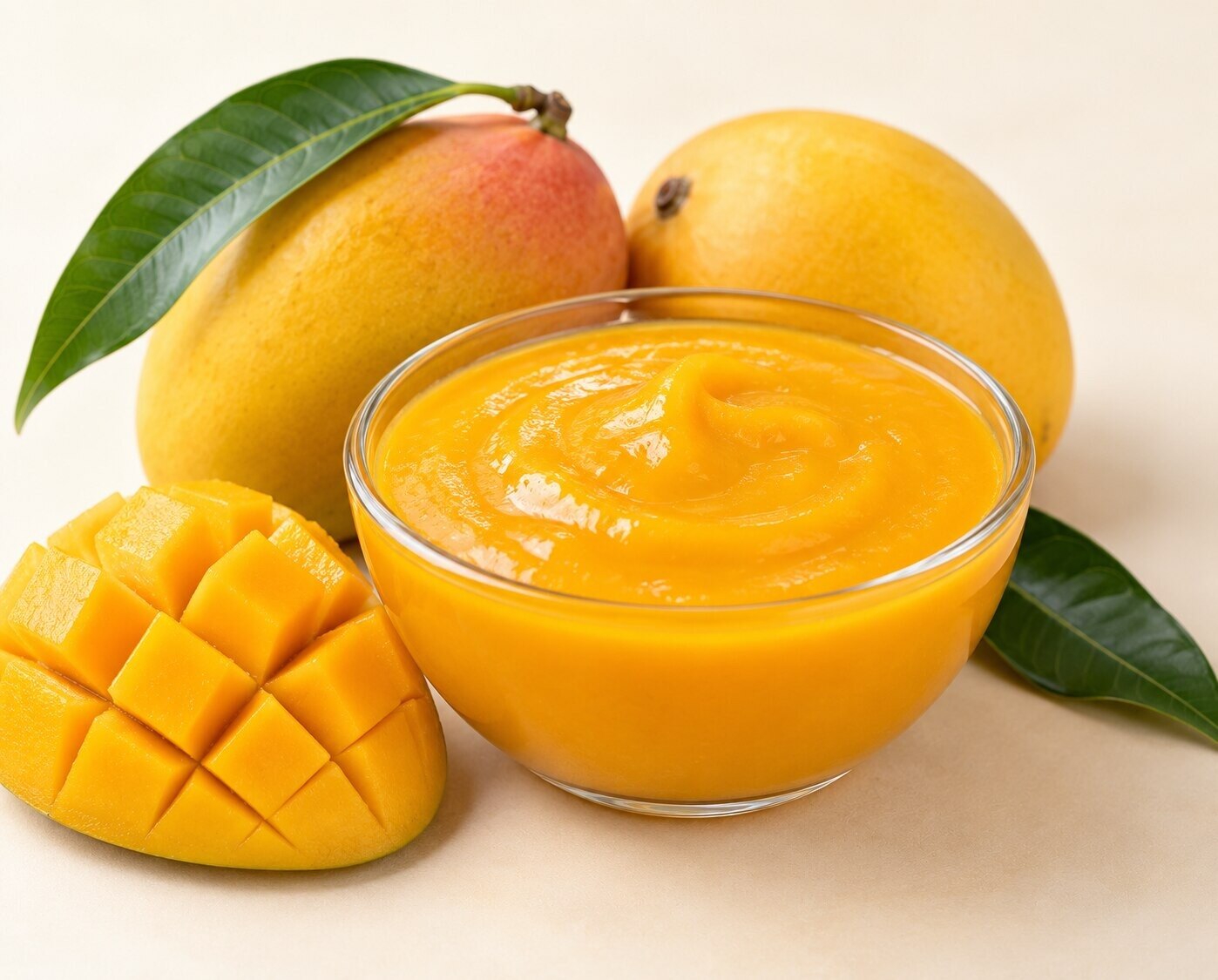
Alphonso mango puree is not simply mango juice in a larger pack: it is sieved fruit flesh whose solids, acidity, viscosity and heat history affect how it performs in a finished product. By the end, you will know how to distinguish it from pulp, nectar, concentrate and flavouring, identify the manufacturers that buy it, and specify the material for production use.
Key takeaways
- Alphonso puree contains sieved mango flesh, suspended solids, aroma compounds and natural colour.
- Choose Alphonso for premium aroma and flavour; choose Totapuri when cost and acidity matter more.
- Buyers include beverage, dairy, bakery, dessert, sauce and baby-food manufacturers.
- Compare Brix, acidity, ingredients, aseptic format, batch documents and cold-chain requirements.
What Is Alphonso Mango Puree?
What is Alphonso mango puree? It is the sieved or homogenized edible flesh of ripe Alphonso mangoes, made from cooked or uncooked fruit after removing skin, seeds and coarse material. It retains far more suspended fruit solids, natural colour, aroma compounds and fibre-related material than clarified mango juice.
- Puree: Fine, pourable fruit flesh with suspended solids and body.
- Pulp: A broader commercial term that can mean crushed mango flesh, often coarser or less uniform than puree.
- Juice: The extracted liquid, usually filtered or clarified, with much less pulp and fibre.
- Nectar: A formulated drink made from juice or puree with added water and permitted sweeteners or other ingredients.
- Concentrate: Puree or juice with part of its water removed, producing higher soluble solids and requiring recipe adjustment.
“Alphonso” identifies the mango cultivar, not a separate Codex product category. A supplier may offer single-strength puree, a sweetened fruit preparation or mango concentrate, so never substitute them without recalculating fruit content, Brix, acidity and viscosity.
The word puree alone does not define performance. Check:
- Fruit content and Brix
- pH and titratable acidity
- Viscosity at a stated temperature and test method
- Colour, particle size and sedimentation behaviour
Maturity, cultivar authenticity, pulping, heat treatment and storage can change these properties between lots. A production trial confirms whether the puree delivers the aroma, colour and mouthfeel your formula needs.
Why Choose Alphonso Over Totapuri or Mango Flavouring?
Choose Alphonso when pronounced aroma, sweet flavour, golden colour and relatively low-fibre eating quality matter more than the lowest ingredient cost. Totapuri offers a sharper profile and a different, often paler colour, making it practical for cost-sensitive products or blends where Alphonso’s distinctive character is not the main selling point.
| Ingredient | Flavour and colour | Body and formulation fit | Cost and label implication |
|---|---|---|---|
| Alphonso puree | Sweet, aromatic and golden | Provides fruit solids, body and mango colour | Higher-value choice; confirm 100% Alphonso or a cultivar blend |
| Totapuri puree | Sharper, less aromatic profile with different colour | Useful in blended beverages, sauces and economical fruit preparations | Practical for cost control; label the cultivar or blend accurately |
| Mango concentrate | More intense after water removal, but not equivalent to puree | Requires recalculation of fruit content, Brix, acidity and viscosity | A processing format, not a substitute without reformulation |
| Mango flavouring | Adds aroma without mango fruit solids | Cannot provide puree’s body, colour or fruit texture | Useful for aroma adjustment; does not support the same fruit-content claim |
Industrial Alphonso mango puree suits products where both mango flavour and fruit body must appear in the formula. Check whether “Alphonso” means 100% cultivar content. Ratnagiri and Devgad are separate Indian geographical-origin claims; a cultivar statement alone does not prove either origin, so request documented origin and applicable GI compliance.
Who Buys Alphonso Puree and What Do They Make?
Industrial buyers purchase Alphonso puree when a recipe needs both mango fruit solids and a repeatable flavour-colour profile. These are the main Alphonso mango puree uses:
- Beverage companies add it to mango drinks, nectars, smoothies and mixed fruit beverages. They use documented lots to keep flavour, colour and fruit content consistent between harvests.
- Dairy processors blend it into yoghurt, cultured products, milk drinks and dairy desserts. The puree supplies mango character while sugar, acid or stabilizers are adjusted for the finished formula.
- Ice-cream manufacturers use it for mango flavour and colour, or add it as a fruit inclusion in frozen desserts.
- Bakeries and dessert producers turn it into cake and pastry fillings, mousses, sauces, glazes and toppings.
- Confectionery makers use it in centres, fruit gums, jellies and other fruit-based sweets.
- Sauce and chutney manufacturers buy it as a measured mango component for cooking, blending and seasoning.
- Baby-food producers include it in fruit meals, pouches and blended preparations that require traceable fruit ingredients.
- Foodservice manufacturers use it in dessert sauces, beverage bases and ready-to-serve mango preparations.
- Private-label brands source it when a finished product needs a documented fruit component rather than retail mango pulp.
The buyer is purchasing consistency as much as flavour: Brix, acidity, viscosity, particle size and batch records determine whether the puree runs reliably on the production line.
How Do Manufacturers Formulate With Alphonso Puree?
A production team turns Alphonso puree into a repeatable recipe by matching its fruit solids and physical behaviour to the finished product, not by adjusting Brix alone.
Alphonso mango puree for manufacturers may be diluted with water, blended with another fruit ingredient, sweetened, acidified or stabilised; concentrate and sweetened preparations require fresh calculations for fruit content, Brix, acidity and viscosity.
Typical formulation decisions include:
- Add water to reach the target fruit concentration without making the drink thin or the flavour weak.
- Blend Alphonso with other mango or fruit ingredients to control cost, colour, aroma and seasonal variation.
- Adjust sugar after measuring puree Brix, because the same soluble-solids reading can deliver different perceived sweetness.
- Correct acidity with a permitted acidulant when pH, flavour balance or preservation demands it.
- Add a stabilizer when the product needs suspended pulp, a fuller body or resistance to sedimentation.
Run an application trial before approving a substitute lot. Particle size, pectin, viscosity, colour, sedimentation and heat history can change mouthfeel and line performance even at identical Brix.
Confirm these points against the finished-product specification:
- Brix, pH and titratable acidity
- Viscosity, including test temperature and method
- Colour, particle size and sensory limits
- Microbiological criteria and permitted tolerances
- Validated thermal process for the formulation and pack
Thermal treatment controls microorganisms and enzyme activity, but excessive heat can strip fresh Alphonso aroma, darken colour and alter body. Do not infer process adequacy from “aseptic,” “natural” or “high Brix” alone.
How Should You Buy and Compare Industrial Alphonso Puree?
Industrial Alphonso mango puree is a documented production ingredient, not interchangeable with retail mango pulp. Retail packs suit household use and may contain added sugar, preservatives or variable texture; alphonso mango puree for manufacturers must match a formula, filling line and release specification.
| Product | What it means | Buying consequence |
|---|---|---|
| Industrial puree | Sieved or homogenized fruit in aseptic bags, bag-in-box, drums or frozen packs | Check fruit content, Brix, viscosity and lot records |
| Retail pulp | Consumer-sized product with its own recipe and label | Do not assume suitability for processing or export |
| Concentrate or sweetened preparation | Water removed, or sugar and other ingredients added | Recalculate fruit content, Brix, acidity and viscosity before substitution |
Aseptic packs are commercially sterilized and filled into pre-sterilized packaging; keep unopened packs at the stated ambient conditions. Frozen packs require the specified frozen storage and controlled thawing. Aseptic does not make an opened pack shelf-stable: refrigerate it, prevent contamination, record opening time and follow the supplier’s use-by instruction.
Approve each documented lot against a specification stating:
- 100% Alphonso or an identified cultivar blend, minimum fruit content, exact Brix range, pH, acidity, viscosity method and test temperature
- Sensory limits for aroma, colour and flavour; particle or defect tolerance; permitted sugar, acid, stabilizer and preservative ingredients
- Pack format, seal requirements, storage temperature and shelf life
- Certificate of analysis, production and best-before dates, traceability to fruit lots, microbiological results, allergen and additive declarations, and process information
Zeus India Enterprise is one supplier connection to evaluate, but approve only material that matches your line trials and formula.
Related product
 | Alphonso Mango Puree Zeus India is a trusted exporter and supplier of premium Alphonso Mango Puree in India, known for delivering rich taste, natural aroma, vibrant... View product → |
Frequently asked questions
What is Alphonso mango puree?
It is the sieved or homogenized edible flesh of ripe Alphonso mangoes after removing skin, seeds and coarse material. It retains suspended fruit solids, natural colour, aroma compounds and fibre-related material.
Why choose Alphonso puree over Totapuri or mango flavouring?
Alphonso provides a more distinctive premium mango aroma and flavour. Totapuri can suit applications focused on cost, acidity or blending, while mango flavouring supplies aroma without the fruit solids and texture of puree.
Who buys Alphonso mango puree?
Beverage, dairy, bakery, dessert, confectionery, sauce and baby-food manufacturers buy it for products such as drinks, yoghurt, ice cream, fillings, sorbets and mango-based sauces.
How should manufacturers compare industrial Alphonso mango puree?
Check Brix, acidity, colour, texture, ingredient declaration, preservation method, packaging format, shelf life, batch traceability, microbiological specifications and the supplier’s certificate of analysis.