
Bengaluru buyers need to distinguish packed inventory from crop-linked production capacity before they commit to a seasonal mango puree order. By checking harvest timing, lot specifications, documents, transport responsibilities, and allocation terms, you can decide when to reserve supply and whether a seasonal exporter fits your production plan.
Key takeaways
- Reserve production before the April-to-August southern Indian processing window.
- Ask exporters for a current production schedule, batch identity, and dispatch date.
- Specify Brix, acidity, packaging, aseptic process, and microbiological limits in writing.
- Match the supplier’s documents and storage controls to your Bengaluru delivery plan.
When should Bengaluru buyers reserve Totapuri puree for the Indian harvest?
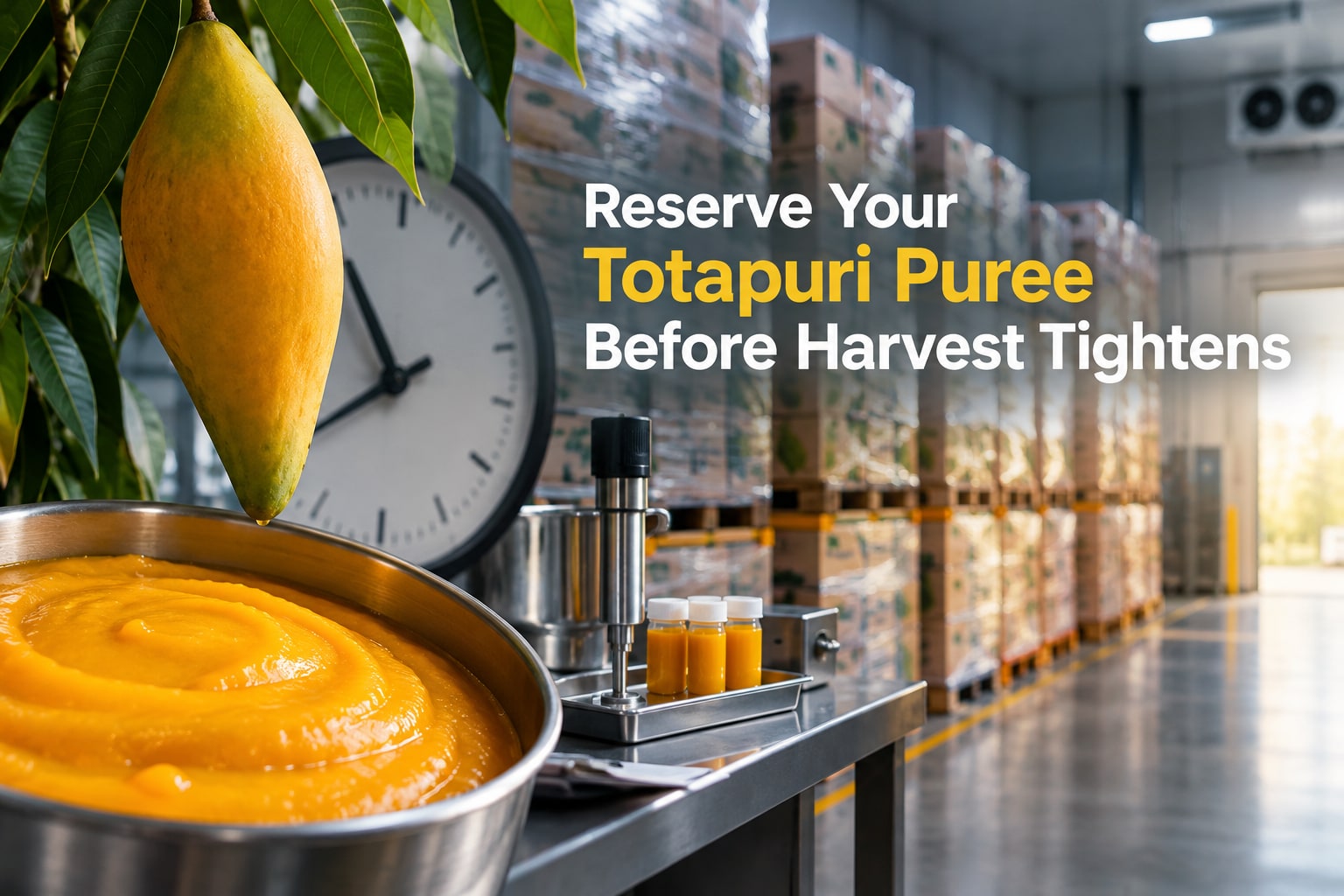
Reserve a Totapuri puree production slot before the April-to-August southern Indian processing window, rather than waiting for fruit to reach factories. Karnataka and Andhra Pradesh do not harvest on identical dates: rainfall, orchard location, and fruit maturity can move the start or finish of processing.
For Bengaluru buyers, use this working timeline:
- Enquire and request the production month, available pack format, and a current sample.
- Approve the sample before fruit allocation begins.
- Confirm your quantity forecast, destination, and required arrival date.
- Secure a written production slot for the selected harvest period.
- Complete production, quality release, and lot-specific documentation.
- Confirm aseptic packing, dispatch, and transport arrangements.
- Receive the shipment and record the batch number for traceability.
Request the slot several weeks before your required arrival date, with earlier planning for large volumes or export cargo. A statement such as “August delivery” is incomplete; “arrival in Bengaluru by 20 August” gives the supplier a date against which production, road transport, and receiving capacity can be planned.
Domestic orders need factory-to-Bengaluru road time. Export orders also need port consolidation, container booking, customs clearance, and inland delivery after arrival. A mango puree exporter seasonal orders brief should include each leg, not just the harvest month.
Buyers comparing Totapuri mango puree exporters from India for seasonal orders should ask whether the quote covers packed stock, current-season production, or only unallocated capacity.
How do you verify actual Totapuri mango puree export availability?
“Available” means allocated finished volume, not an exporter’s annual capacity. For totapuri mango puree export availability, request three separate figures, each shown in metric tonnes and pack units such as drums or cartons:
| Ready packed stock | Sealed, released inventory | Quote MT and number of packs |
|---|---|---|
| Committed stock | Inventory reserved for another buyer | Quote MT and number of packs |
| Scheduled production capacity | Fruit or processing slots not yet packed | Quote MT and planned pack count |
Aseptic puree can remain available after the April-to-August crop window, but carryover stock has less remaining shelf life and may require tighter warehouse planning than a fresh harvest lot. Harvest contracting offers fresher production and allocation priority, but adds waiting time and crop-scheduling risk.
Ask for these details before treating a quantity as firm:
- Production month and batch number
- Shelf-life statement and remaining shelf life at dispatch
- Required storage temperature and conditions
- Nominal fill weight per aseptic bag or drum
- Drum dimensions, pallet pattern, and total packs per pallet
- Confirmation that the quoted volume is allocated, not merely annual capacity
Match the stock choice to your receiving plan:
| Option | Main advantage | Main risk |
|---|---|---|
| Carryover inventory | Shorter lead time | Older lot and reduced shelf life |
| Harvest contract | Fresh production and planned allocation | Waiting for crop, processing, and release |
A generic brochure or old sample cannot prove current stock. Request lot-specific confirmation before booking transport or warehouse space.
What must you specify and test before approving a seasonal lot?
Approve a seasonal lot only after fixing its commercial specification, destination, and test limits in writing. Your order should state:
- Required quantity in tonnes and pack units
- Target arrival date and destination
- Single-strength puree or concentrate
- Pack format, nominal fill, and aseptic filling requirements
- Delivery terms, including who pays freight, insurance, and customs
- Permitted additives, processing aids, or preservatives
- Minimum °Brix, titratable acidity, pH, viscosity, colour, and pulp or fibre level
- Microbiological limits and the lot-specific certificate of analysis required
Compare °Brix around the stated formulation target, not a generic “natural puree” claim. Test yellow-orange colour, acidity, pH, viscosity, fibre, cooked notes, and flavour range against a retained reference sample. Obtain supplier confirmation or independent testing before treating any figure as guaranteed; old samples do not establish current Totapuri puree export supply in Bengaluru.
| Product | Key distinction | Suitable uses |
|---|---|---|
| Totapuri puree | Single-strength, moderate solids and tangy flavour | Beverages, sauces, dairy preparations |
| Mango pulp | Broad commercial term; confirm variety, solids, and fibre | Beverages, sauces, dairy preparations |
| Mango concentrate | Higher solids, lower freight volume, requires formulation adjustment | High-solids beverages, sauces, fillings |
| Alphonso puree | Stronger aroma and distinct colour profile | Premium dairy products, beverages, confectionery fillings |
Reject Totapuri if the recipe needs a stronger aromatic profile, clarified juice, high solids, or a different colour target. Confirm destination limits for additives and microbiology before release.
Which documents and handling controls protect an aseptic puree shipment?
Before paying, request documents tied to the actual lot, not a brochure or old sample:
- Product specification sheet, lot-specific certificate of analysis, batch number, and shelf-life statement
- Commercial-sterility or validated-process statement, plus incubation or sterility-test results where applicable
- Allergen and additive declaration, including preservatives and processing aids
- Pesticide-residue and contaminant reports required by the destination country
- Packing list, commercial invoice, certificate of origin, and export or shipping documents
Check these three controls separately:
| Check | What it proves | What it does not prove |
|---|---|---|
| FSSAI licence | The food business operates under India’s food-safety framework | That this lot meets overseas rules |
| Lot COA and process records | The identified batch matches agreed specifications and commercial-sterility controls | Compliance with every destination requirement |
| Destination review | Required residues, microbiological criteria, labels, food-contact packaging, and health or phytosanitary certificates are addressed | That Indian dispatch documents are sufficient |
Require aseptic bags to remain sealed inside sound drums, with palletisation that prevents crushing, punctures, and shifting. Record temperature exposure during loading and transport, and specify clean, dry warehouse conditions within the supplier’s stated storage range.
Confirm the unloading equipment, then open drums without cutting the inner bag; use the puree promptly after opening under a written refrigerated-use instruction.
Keep batch, pallet, drum, and delivery records linked to production dates. Ask for the recall procedure and written replacement terms covering leaking, dented, punctured, or temperature-damaged packaging. Availability after harvest depends on intact stock, remaining shelf life, and storage history—not merely sterilisation.
How should you choose between a seasonal exporter and a year-round stock supplier?
Choose a seasonal exporter when you need a defined harvest lot, a specific °Brix or colour range, and enough volume to justify production scheduling. Choose a year-round stock supplier when your minimum order quantity is smaller and rapid replenishment matters more than matching one harvest profile.
| Option | Strength | Risk to check |
|---|---|---|
| Seasonal exporter | Planned production, repeat-lot control, lower allocation uncertainty after confirmation | Higher MOQ and limited emergency replenishment |
| Year-round stock supplier | Faster response and smaller release quantities | Carryover age, mixed lots, and weaker repeat-sample consistency |
Ask both suppliers for ready stock, committed stock, and scheduled capacity in metric tonnes and pack units. Require a production month, batch number, shelf-life statement, retained sample, lot-specific COA, product specification, allergen and additive declaration, packing list, certificate of origin, and destination-required residue or contaminant reports.
Approve a current sample against measurable colour, acidity, viscosity, flavour, and microbiological limits; an old sample proves nothing about today’s lot.
For Bengaluru, require factory-origin dispatch by road and confirm who pays and manages local delivery. Export cargo may move by road to a seaport for consolidation; clarify container booking, export documents, customs clearance, and inland delivery responsibility.
Zeus India Enterprise is one supplier to evaluate by these records, response times, allocation confirmation, and fulfilled-order evidence—not by “premium” or “trusted” claims.
Avoid these errors:
- Waiting until harvest ends to request a production slot
- Ignoring road, port, customs, and inland transit time
- Approving an old sample
- Leaving damaged-pack replacement undefined
- Confusing annual capacity with confirmed allocation
Related product
 | Totapuri Mango Puree Zeus India is a trusted exporter and supplier of premium Totapuri Mango Puree in India, offering high-quality fruit-based ingredients for the global... View product → |
Frequently asked questions
When should Bengaluru buyers reserve Totapuri mango puree for the Indian harvest?
Reserve a production slot before the April-to-August southern Indian processing window. Karnataka and Andhra Pradesh can start and finish at different times because rainfall, orchard location, and fruit maturity vary.
How can you verify actual Totapuri mango puree export availability?
Request the exporter’s current production schedule, available batch quantity, packing date, best-before date, warehouse location, and planned dispatch date. Ask for a batch number or lot reference rather than relying on a general catalogue listing.
What should you specify and test before approving a seasonal lot?
Put the mango variety, puree form, target Brix, acidity or pH, packaging format, net weight, aseptic process, and microbiological limits into the purchase specification. Test a representative sample for flavour, colour, consistency, Brix, pH, foreign matter, and microbiological compliance before release.
Which documents and handling controls protect an aseptic puree shipment?
Check the commercial invoice, packing list, certificate of analysis, certificate of origin, batch traceability record, health or phytosanitary document when required, and transport details. Confirm intact aseptic seals, lot identification, storage instructions, container cleanliness, and temperature exposure records before accepting delivery.
How should you choose between a seasonal exporter and a year-round stock supplier?
Choose a seasonal exporter when harvest-linked flavour, fresh production, and planned bulk volumes matter. Choose year-round stock when you need smaller repeat releases or fixed delivery timing, then compare batch age, storage history, specification consistency, minimum order quantity, and replenishment lead time.