
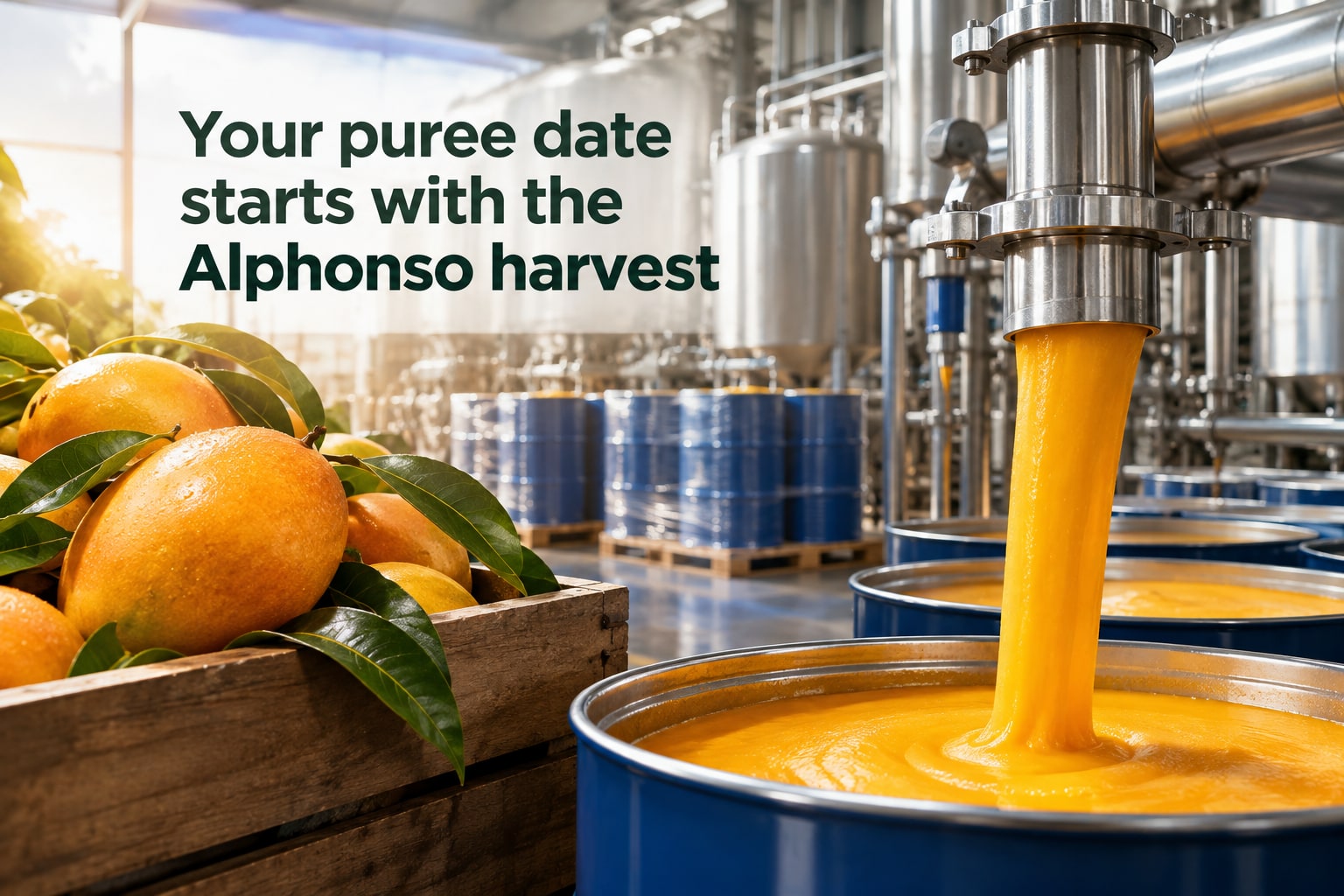
Alphonso fruit is available for processing within a limited harvest window, so a Bengaluru production plan can fail before the first batch is scheduled if puree is not reserved early. You will be able to compare harvest-season and aseptic inventory options, calculate a practical reservation quantity, test manufacturer availability, and approve a supplier using lot-level evidence.
Key takeaways
- Book production before the March-to-June Alphonso harvest window.
- Confirm the manufacturer’s available processing slot before committing volume.
- Compare fresh-season processing with aseptic inventory for your production schedule.
- Approve samples, lot records, and release criteria before shipment.
Plan Around the Alphonso Harvest, Not the Date You Need Puree
Book the seasonal run before the Alphonso crop reaches the market, not when your Bengaluru production line is ready. Commercial availability is concentrated roughly between March and June, with dates shifting by growing region and weather. Once fruit arrives, table-fruit, pulp, and export buyers compete for the same lots.
Treat the next harvest as a capacity reservation. Ask the manufacturer for these dates and limits in writing:
- Raw-fruit intake opening and closing dates for the coming season
- The uncommitted production week available for your order
- The deadline for confirming your allocation
- The minimum batch size and contracted minimum quantity
- The expected finished-goods packing date
- Current aseptic stock, packed-on date, and remaining shelf life
- The latest date for approving specifications, packaging, and payment terms
An Alphonso mango puree harvest supply does not automatically mean 100% Alphonso puree is available. Confirm whether the manufacturer will segregate Alphonso lots, prohibit other varieties, and record the declared growing region and lot number.
Waiting for local fruit availability can force you into a later production slot or an unsuitable substitute. Use a seasonal call-off agreement that names the production week, minimum quantity, packaging format, and permitted substitution.
If your launch date is fixed, reserve aseptic inventory as a fallback before harvest processing begins; otherwise, a delayed crop intake can stop finished-product production even when puree demand is already confirmed.
Confirm a Manufacturer’s Real Production Availability Before You Commit
A credible commitment gives you four dates: current aseptic stock, the next raw-fruit intake, the production week, and the finished-goods dispatch date to Bengaluru. Alphonso fruit is concentrated roughly between March and June, so confirm the manufacturer’s actual intake window rather than assuming fresh processing is available year-round.
Ask for these details in writing:
- Packed-on date, batch number, available quantity, remaining shelf life, and dispatch date for existing aseptic stock
- Expected Alphonso intake dates and the uncommitted processing slots during that harvest
- Minimum batch size, packaging format, price validity, payment terms, and freight responsibility
- Allocation deadline, production-week confirmation, and the latest date for changing your call-off quantity
- FSSAI licence number, manufacturing address, recent certificate of analysis, and production-lot sample
Use the schedule below to test whether the alphonso puree manufacturer availability matches your run, not merely whether the supplier has a factory.
| Supply route | Dates to confirm | Commercial proof | Main risk |
|---|---|---|---|
| Existing aseptic stock | Packed-on date and dispatch date | Confirmed lot quantity, price, shelf life, and reservation expiry | Stock can be allocated to another buyer |
| Fresh-season run | Fruit intake, production week, filling date, and dispatch date | Minimum batch, deposit, signed allocation, and substitution terms | Waiting until March–June fruit arrives can eliminate your slot |
Require the specification to state Alphonso, declared growing region, and permitted substitutions. Do not accept “mango puree” on an invoice; a valid licence proves the facility exists, not that your lot is single-variety Alphonso.
Choose Fresh-Season Processing or Aseptic Inventory and Calculate the Quantity
For seasonal Alphonso puree supply in Bengaluru, reserve your formulation requirement plus a 10–15% operating buffer. Calculate puree from the production mass, not the finished pack count: 10,000 kg of beverage at 12% puree inclusion requires 1,200 kg, so a 10% buffer brings the reservation to 1,320 kg.
Use this calculation for each product and add the quantities together:
- Required puree = finished product mass × puree inclusion rate
- Reserve quantity = required puree × 1.10 to 1.15
- Add extra only for known road delays, rejected deliveries, or a long gap between lots; excess puree ties up cash and shelf life
Book the volume before the March–June Alphonso intake period, then confirm the manufacturer’s minimum batch size, production week, packed-on date, remaining shelf life, and staggered delivery dates. Fresh-season processing is the better choice when you need a large, consistent lot, a defined harvest profile, and enough time to receive and approve it before production.
| Option | Choose it when | Main trade-off |
|---|---|---|
| Fresh-season puree | Your run aligns with harvest and flavour priority is high | Better harvest freshness, but short booking window and concentrated deliveries |
| Aseptic inventory | Production starts before harvest or demand changes | Faster availability and flexible call-offs, but less control over packed-on date and remaining shelf life |
| Split supply | You need immediate stock plus harvest volume | Lower interruption risk, but requires two specifications and careful blending control |
Do not wait for fruit to appear in Bengaluru’s market; competing demand can remove the required volume before processing begins.
Specify Alphonso Identity, Analytical Limits, and the Totapuri Alternative
Require a specification that separates varietal identity from colour, sweetness, and aroma. A search for alphonso mango puree manufacturer india does not prove that the puree contains fruit from Maharashtra or that it is single-variety.
- State “100% Alphonso mango” if other varieties are prohibited, and name the declared growing region, such as Ratnagiri, Sindhudurg, or another district.
- Require the raw-fruit intake period, farm or lot traceability, segregation records, and a statement that Totapuri, Kesar, or unspecified mangoes were not blended into the lot.
- Set numerical limits for soluble solids in °Brix, pH, titratable acidity, pulp content, colour, viscosity, added sugar, preservatives, microbiological counts, and foreign matter. Name the test method for each limit.
- Ask for a recent certificate of analysis, production-lot sample, batch code, FSSAI licence details, manufacturing address, and the agreed procedure for resolving an out-of-specification result.
- Treat “Alphonso-type” or a golden colour as inadequate evidence. Use retained samples and lot-level records because dilution and flavour adjustment can imitate the fruit.
| Product | What to verify | Procurement consequence |
|---|---|---|
| Alphonso puree | Declared variety, growing region, 100% status, sensory reference, and analytical limits | Higher authenticity control; do not accept substitution without written approval |
| Totapuri puree | Explicit Totapuri declaration, origin, sensory profile, Brix, acidity, colour, and viscosity | Suitable only after reformulating the recipe and resetting acceptance limits |
Totapuri can reduce cost or improve supply continuity, but it is not an equivalent replacement for Alphonso. Compare both against the finished product’s required aroma, colour, sweetness, acidity, and label claim.
Approve the Supplier Through Samples, Records, and a Lot-Level Release Plan
Approve the supplier only after a recent certificate of analysis (COA) and a sample drawn from an actual production lot match your specification. A polished sample alone proves little; the lot record must show the same variety, process, and controls that will apply to your seasonal programme.
Request these documents before signing:
- FSSAI licence showing the manufacturing address and product category
- COA stating Brix, pH, acidity, colour, microbiological results, and batch number
- Product specification declaring 100% Alphonso, the growing region, and whether Totapuri or other varieties are prohibited
- Production record covering raw-fruit segregation, thermal processing, aseptic filling, metal detection, and foreign-matter checks
- Traceability and mock-recall records linking farm or intake lot to finished batch
- Expected raw-fruit intake dates, batch quantities, manufacturing dates, and remaining shelf life at delivery
Ask Zeus India Enterprise, as you would any shortlisted supplier, to provide a production-lot sample rather than a laboratory blend. Compare aroma, colour, viscosity, Brix, acidity, and taste against your approved reference sample.
Put release rules in the purchase order. Hold every delivery until your team checks the seal, batch code, COA, packaging, and retained sample; reject unexplained variety or analytical drift. Schedule staggered lots with inspection time and a road-delay buffer, instead of accepting one shipment immediately before production.
A valid licence does not prove single-variety Alphonso or guarantee continuity.
Related product
 | Alphonso Mango Puree Zeus India is a trusted exporter and supplier of premium Alphonso Mango Puree in India, known for delivering rich taste, natural aroma, vibrant... View product → |
Frequently asked questions
When should you book Alphonso mango puree for Bengaluru seasonal production?
Book before the crop reaches the market. Commercial Alphonso availability is concentrated roughly between March and June, with timing varying by region and weather.
How can you confirm an Alphonso puree manufacturer’s availability?
Ask for the manufacturer’s actual production window, committed capacity, raw-fruit sourcing plan, and expected dispatch date before signing an order.
Should you choose fresh-season processing or aseptic Alphonso puree inventory?
Choose fresh-season processing when you can align production with the harvest. Choose aseptic inventory when your manufacturing date falls outside the available crop-processing window.
What should you specify when comparing Alphonso and Totapuri puree?
Specify the mango identity, analytical limits, pack format, and intended application. Treat Totapuri as an alternative only after confirming that its flavour, colour, acidity, and formulation performance meet your product requirements.
How do you approve an Alphonso mango puree manufacturer?
Review representative samples, batch and processing records, and a lot-level release plan before accepting commercial supply.