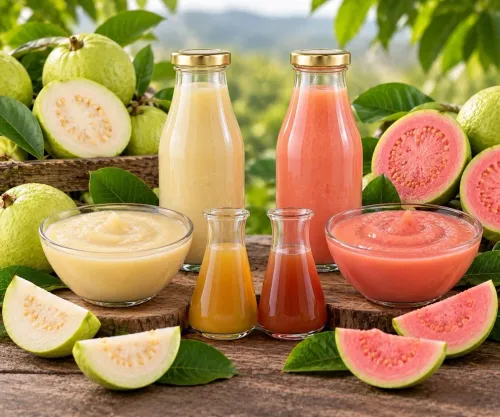

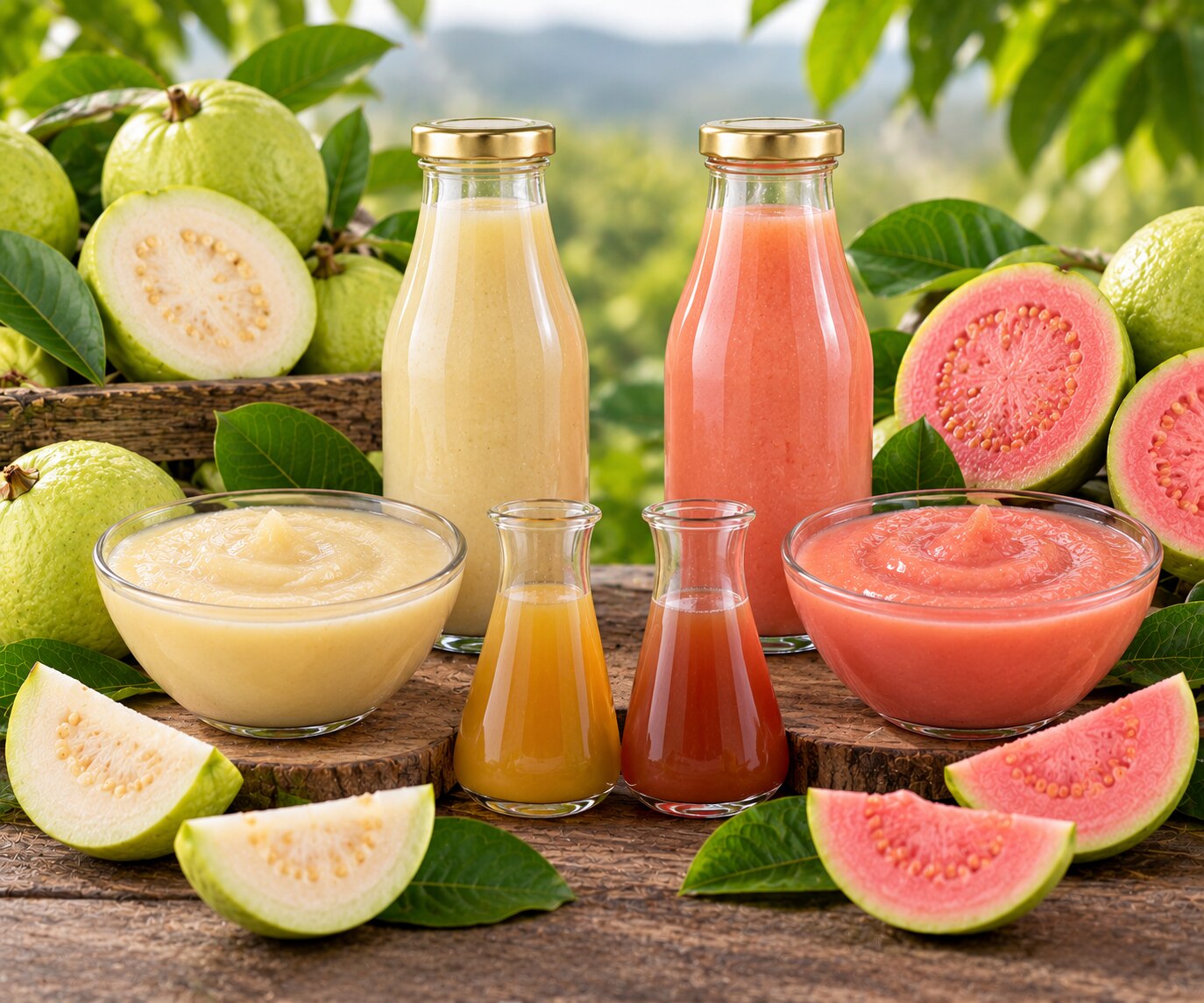
White and pink guava follow the same industrial extraction route, but cultivar, maturity, seed content, colour and oxygen exposure produce different processing risks and application results. By the end, you will be able to compare the production steps, set a receiving specification, test samples and assess whether an imported aseptic format suits your UK operation.
Key takeaways
- Inspect maturity, bruising, mould, decay and foreign material before unloading.
- Compare colour, flavour, seed load and refining requirements against your finished product.
- Request heat-treatment, aseptic-fill, lot-traceability and pesticide-control records.
- Approve a retain sample before accepting bulk guava puree in the UK.
How guava becomes puree from intake to pulping
1. At intake, inspect each lot for maturity, bruising, mould, decay and foreign material before unloading it into production. Check the lot identification, harvest or delivery records and supporting pesticide documentation.
Immature guava produces firmer, greener pulp with lower °Brix, weaker sweetness and lower recovery; overripe fruit raises microbial loading and the risk of fermentation, browning and off-odours.
2. Send accepted fruit through a fruit washer to remove soil, plant debris and surface contamination. Washing does not rescue decayed fruit, so inspect the washed fruit again on the sorting line. Remove bruised, mouldy or damaged portions during sorting and trimming, along with stems, leaves and visible foreign matter.
3. Crush the trimmed fruit and feed it into a pulper. Guava is not a seedless soft fruit: numerous hard seeds and fibrous material require mechanical separation. Sorting must happen before pulping because the machine distributes mould, decay and other defects throughout the batch instead of leaving them as removable pieces.
4. Pass the pulped mass through a finisher to separate seeds and coarse fibre, then move the puree through transfer pumps into holding tanks for the next processing stage. A buyer should expect to see, or ask about, a receiving inspection area, fruit washer, crusher, pulper, finisher, transfer pumps and holding tanks.
These controls form the guava puree production process from incoming fruit to a usable bulk puree.
Where white and pink guava require different controls
White flesh produces a pale cream, yellowish or off-white puree; pink or red flesh produces visibly coloured puree. White pink guava processing uses the same washing, sorting, pulping, refining, heat-treatment and filling line, but segregate cultivars before pulping when colour consistency matters.
| Trait | White guava puree | Pink guava puree |
|---|---|---|
| Aroma and flavour | Often lighter, with sweetness and acidity driven by cultivar and maturity | Often more pronounced fruit aroma; sweetness and acidity still require measurement |
| Texture | Can range from smooth to pulpy, depending on maturity and refining | Can have the same range; colour does not prove superior texture or quality |
| Finished appearance | Pale cream, yellowish or off-white | Pink to red and visibly coloured |
| Seed and grit control | Requires pulping and refining to remove hard seeds and fibre | Requires the same controls; colour does not indicate particle-free puree |
Pink puree needs tighter control of oxygen exposure, foaming, heat and residence time because oxidation and prolonged heating can dull colour and aroma. Deaeration or vacuum treatment removes entrained air and reduces foaming and colour damage; it does not replace pasteurisation or a validated thermal process.
Maturity changes viscosity, yield, °Brix, sweetness and colour stability, while overripe fruit increases fermentation and microbial risk. Skin colour alone is unreliable because cultivar and ripeness do not always develop together.
Require receiving and finished-product results for °Brix, pH, titratable acidity, viscosity, colour, seed or grit tolerance and microbiology. Judge colour on a standardised dilution or finished-product basis.
How refining, heat treatment and aseptic filling determine the final batch
Screen size, oxygen removal, heat exposure and filling hygiene set the puree’s mouthfeel, safety and storage performance. A finisher presses pulped guava through a perforated screen to retain hard seeds and coarse fibre.
Finer screens create smoother puree and remove more particles, but reduce recovery, increase energy use, and raise wear and blockage risk. Coarser screens improve yield while increasing the chance of perceptible seed fragments or grit, so screen size belongs in the product specification.
| Screen choice | Result |
|---|---|
| Fine | Smooth texture; lower recovery and higher blockage risk |
| Coarse | Higher yield; greater seed and fibre carryover |
The guava puree production process then uses deaeration to remove entrained air, foaming and oxidation risk. A heat exchanger raises and controls temperature before the validated thermal treatment; the scheduled process must match the puree’s pH, viscosity, particle size, package format and equipment.
A process designed for thin juice cannot automatically treat viscous guava puree safely.
Commercially processed aseptic puree is not ordinary hot-filled product: it receives a validated commercial process and enters pre-sterilised packaging under aseptic conditions. Fill the treated puree into pre-sterilised bags in drums or bag-in-box systems, control headspace, inspect seals, apply lot codes and store under the specified ambient conditions.
An opened aseptic bag loses its original barrier. Use controlled handling, clean dispensing equipment and a defined post-opening shelf life; do not return it to ambient storage as though it remained sealed.
Which guava format and colour fit your finished product
Choose puree when your product needs body, suspended fruit character and a fuller mouthfeel. Choose juice for a clearer, thinner drink; it will not provide the same texture or visible fruit presence.
| Format | What it contributes | When it fits |
|---|---|---|
| Puree | Body and suspended fruit character | Smoothies, dairy, desserts and fillings |
| Pulp | Coarser fruit material and stronger particle presence | Products where less refining is acceptable |
| Juice | Thin, clearer liquid | Clearer beverages |
| Concentrate | Lower freight volume | Formulations with controlled dilution and reconstitution |
| Nectar base | Guava plus existing water, sugar or acid components | Products designed around a prepared base |
| Sweetened preparation | Guava with added sugar | Not suitable for single-ingredient declarations or precise sugar control |
Pink puree gives beverages and desserts a stronger visual fruit cue. White puree produces a pale cream, yellowish or off-white appearance that suits pale yoghurt, bakery fillings and sauces where colour neutrality matters. White and pink guava processing uses the same core route, but segregate cultivars before pulping when colour consistency matters.
For infant and children’s products, approve either colour only after checking texture, seed particles, sweetness, acidity and the ingredient declaration. In formulation trials, check dilution, °Brix adjustment, acidity correction, stabiliser compatibility, and heat effects on aroma and colour. Test at the intended use level: puree samples measured at different °Brix values cannot be compared directly.
How to approve and receive bulk guava puree in the UK
Approve a bulk batch only when its measured specification, paperwork and physical condition agree. Use this sample checklist:
- Colour, aroma and viscosity match the approved reference.
- °Brix, pH and titratable acidity fall within the contract range.
- Seed particles and grit meet the stated tolerance.
- Microbiology meets the agreed limits.
- Bag, drum or box is clean, sealed, undamaged and correctly coded.
Match the certificate of analysis to the lot number, production date and pallet labels. Also check the single-ingredient declaration, allergen statement, country of origin, packaging declaration, HACCP-based controls, food-safety certification, validated heat-process record, traceability system and tested recall procedure.
Confirm the format before booking storage: ambient aseptic bag-in-drum or bag-in-box, or frozen puree. Record storage temperature, documented shelf life, pallet configuration, minimum order quantity, lead time and customs or border paperwork. Aseptic supply reduces refrigerated transport and warehouse demand; frozen puree needs an uninterrupted cold chain.
Concentrate saves freight volume but adds reconstitution work, while local fresh processing adds labour, equipment and variable fruit intake.
| Format | Main advantage | Main trade-off |
|---|---|---|
| Aseptic | Ambient distribution | Controlled handling after opening |
| Frozen | Flexible storage duration | Refrigerated transport and storage |
| Concentrate | Lower shipment volume | Dilution and quality-control work |
| Local fresh | Immediate processing | Labour, equipment and variable intake |
Quarantine any dented, leaking or unsealed drum. Photograph it, record the lot and contact the supplier before opening. Even a guava puree manufacturer London or guava puree bulk supply uk listing needs batch verification; apply the same checks when evaluating Zeus India Enterprise.
Related product
 | White and Pink Guava Puree Zeus India is a trusted exporter and supplier of premium White Guava Puree and Pink Guava Puree in India, catering to the growing demands of the... View product → |
Frequently asked questions
What are the main guava puree processing steps?
The process runs from lot inspection and washing through sorting, pulping, refining, heat treatment, aseptic filling and bulk dispatch. Each stage controls a different risk, including foreign material, seed fragments, microbial growth and traceability failures.
How does white guava puree differ from pink guava puree processing?
White and pink guava require the same core process, but colour, maturity, flavour and pulp characteristics affect sorting, refining and finished-product approval. Match the selected format to the colour, taste and appearance your recipe requires.
How do heat treatment and aseptic filling affect guava puree?
Heat treatment controls microbial risk, while aseptic filling protects the treated puree from recontamination during packing. Review the supplier’s time-temperature records, filling controls, lot code and container integrity before release.
What should UK buyers check when receiving bulk guava puree?
Confirm the lot code, product identity, quantity, container condition, delivery temperature requirements and accompanying quality and pesticide documentation. Compare the shipment with the approved specification and retain sample before production use.