
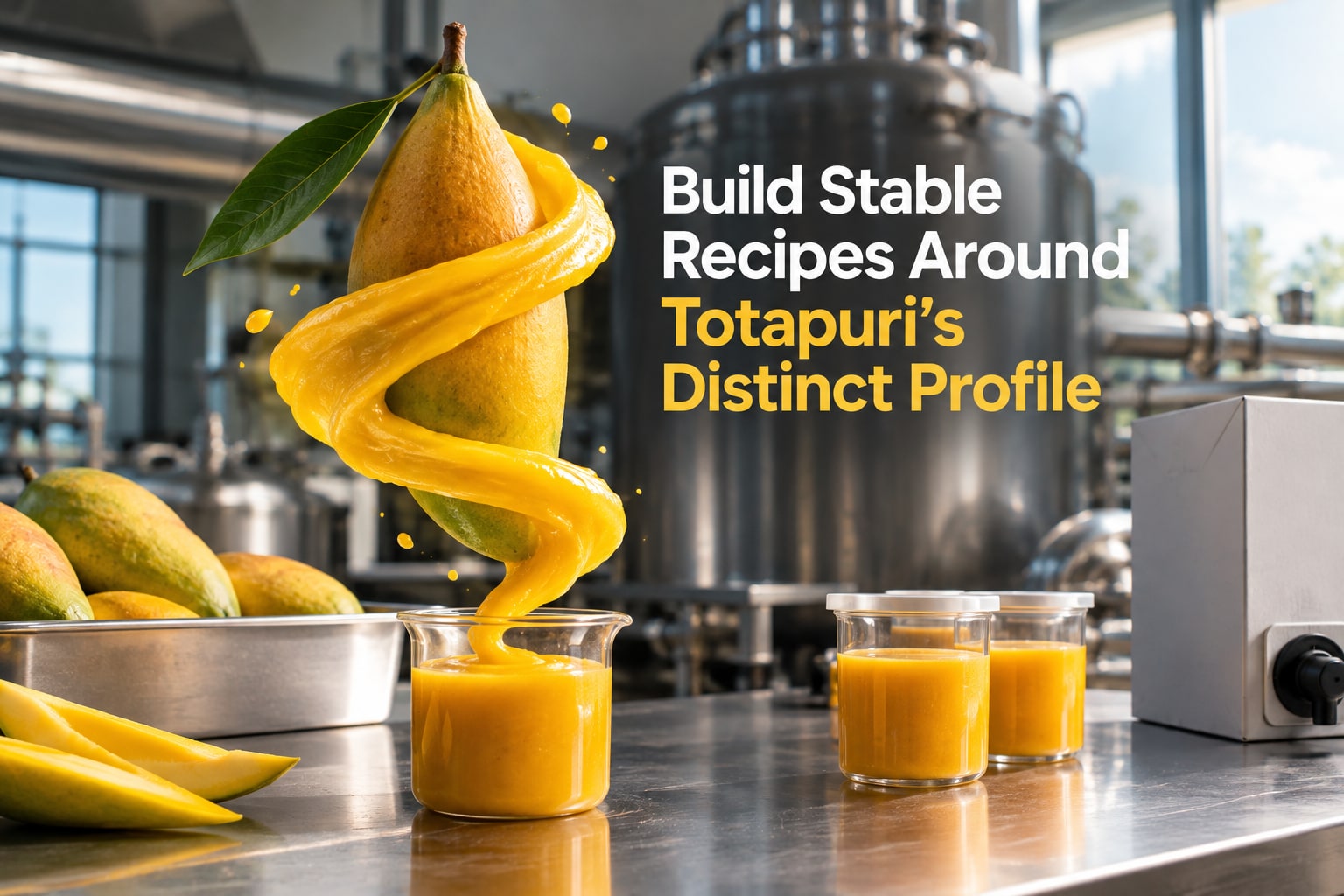
A Totapuri puree trial succeeds or fails on more than mango percentage: °Brix, acidity, fibre, viscosity, colour and processing history all change the finished recipe. By the end, you will know where to use it, how to set starting inclusion rates, what to adjust when replacing another mango ingredient, and which supply details to confirm before scheduling production in London.
Key takeaways
- Approve puree by flavour, colour, solids, acidity and process history.
- Use Totapuri as a practical mango base, not an Alphonso substitute.
- Set trial rates against dessert texture, beverage stability and target sweetness.
- Check aseptic documents, batch details and delivery timing before purchasing.
What Totapuri puree contributes to an industrial recipe
For Totapuri mango puree for London dessert manufacturers, approve the puree on flavour, colour, solids, acidity and process history—not on mango percentage alone. Totapuri, also called Bangalora, is a distinct cultivar and usually serves as a practical base rather than an Alphonso equivalent. Specify cultivar and origin; “mango puree” does not identify the sensory profile.
| Property | What to assess | What failure causes |
|---|---|---|
| Flavour | Clean mango character without fermented, cooked, bitter or atypically sour notes | Off-notes become obvious in low-sugar desserts and lightly flavoured dairy |
| Texture | Smooth body with controlled fibre and no skin or seed carryover | Graininess, blocked filling lines or an uneven mousse |
| Colour | Declared colour range and consistent appearance between batches | Dark fruit inserts, dull coulis or visible batch variation |
| Solids and acidity | Brix and pH or titratable acidity suited to the recipe | Incorrect sweetness, freezing point, set, spreadability or flavour impact |
| Process performance | Thermal process, aseptic filling conditions and oxygen exposure | Heat or oxidation strips fresh mango notes and accelerates darkening |
Before approval, request or measure:
- Brix, pH, titratable acidity, viscosity and colour specification.
- A full ingredient declaration confirming added sugar, acid, preservatives, colour, water or processing aids.
- A finished-product trial through freezing, baking, chilling or storage; an unopened-pack tasting is not enough.
- Batch-to-batch results, because a puree that tastes acceptable alone can perform poorly after processing.
Totapuri puree applications in desserts and starting trial rates
Start with 8–12% Totapuri puree in ice cream or gelato, then adjust sugar and total water after checking freezing point and scoopability. Sorbet needs more fruit impact: trial 20–30%, balancing acidity and sugar so it does not freeze hard or taste sharply sour.
For a first bench trial, use these inclusion rates by finished weight:
- Mousse, cheesecake filling and chilled set desserts: 10–18%. Check whether puree acidity weakens the set or splits a dairy system.
- Yoghurt preparations and layered chilled desserts: 8–15%. Reduce added sugar if the puree contains sugar, syrup or concentrated solids.
- Fruit sauces and coulis: 15–30%. Thin with water only after measuring viscosity; excess water dulls flavour and creates separation.
- Bakery fillings and baked fruit layers: 15–25%. Increase solids or starch when the filling spreads during baking.
- Ready-to-eat mango desserts and fruit inserts: 12–25%. Use the higher end for a defined mango layer and the lower end when dairy, chocolate or spice must remain prominent.
These Totapuri mango puree applications work best when you trial the puree after the product’s actual bake, freeze, cook or set process. Heat and oxygen can turn fresh mango notes toward cooked flavours and darken the colour, so an unopened-pack tasting is not enough.
For Totapuri puree for desserts, request Brix, acidity, added-ingredient details, declared thermal process and colour specification. Compare the finished dessert against your current puree, not just against a fresh-mango reference.
Building beverages with Totapuri puree without losing stability
Match the puree to the drink’s solids, acidity and processing conditions; do not transfer a dessert recipe unchanged. Totapuri puree that holds in ice cream can make a smoothie heavy, settle in a juice drink or destabilise milk proteins. For totapuri puree for beverages, record Brix, pH, titratable acidity, viscosity and fibre before reformulating.
| Format | Starting formulation | Main control |
|---|---|---|
| Smoothie | 15–30% puree, water or juice, sugar, acid and a stabiliser only after bench testing | Check drinking viscosity and sedimentation |
| Juice drink | 5–15% puree, then adjust water, sugar and acid | Check phase separation after pasteurisation |
| Nectar-style drink | Use at least 25% mango puree to meet the Codex mango nectar minimum; increase it for a fuller profile | Balance pulp, acidity and pourability |
| Dairy beverage | 8–15% puree with controlled acidification and a protein-compatible stabiliser | Test for curdling, serum separation and chalky mouthfeel |
| Cocktail or mocktail | 10–25% puree, diluted with the mixer and balanced with syrup and acid | Check settling, ice dilution and flavour after chilling |
Replace fresh mango by matching water and sugar separately; puree already contains both, while concentrate needs added water. Raise acidity carefully because excess acid sharpens Totapuri’s flavour and can split dairy. Homogenise before pasteurisation or hot filling, then test sedimentation, colour, viscosity and flavour through the intended shelf life.
Severe heating can flatten aroma or darken the drink.
Totapuri or Alphonso: choosing the right mango profile
Choose Totapuri when you need predictable mango solids, controlled ingredient cost and repeatable processing across large batches. Its relatively restrained aroma suits products where mango supports other flavours, while Alphonso is the stronger choice when the fruit must deliver a distinctive, fragrant identity.
| Cultivar | Cost and process profile | Best fit | Wrong fit |
|---|---|---|---|
| Totapuri | Usually a more economical base with consistent colour, acidity and viscosity when the agreed specification is met | Ice cream, sorbet, sauces, coulis, yoghurt preparations, fruit fillings and blended beverages | Low-sugar desserts or premium products relying on intense fresh-mango aroma |
| Alphonso | Higher flavour impact, but its pronounced aroma can dominate and supply specifications still require checking | Mousse, cheesecake filling, minimally flavoured dairy, premium desserts and mango-led drinks | Recipes where a bold aroma conflicts with chocolate, citrus, spices or delicate dairy notes |
Do not approve Totapuri from an unopened-pack tasting alone. Heat treatment, aseptic filling and oxygen exposure can mute fresh notes, darken colour or alter viscosity, so compare samples after the finished dessert or beverage process.
Its fibre profile is another decision point. Excess fibre, seed or skin carryover, bitterness, cooked or fermented notes become obvious in fruit inserts and lightly sweetened yoghurt, even when sugar and acid hide them in smoothies.
For totapuri mango puree applications, set acceptance limits for °Brix, pH, acidity, colour, viscosity, sieve profile and microbiology, then check every lot’s certificate of analysis. Ask whether the puree contains sugar, acid, water, preservatives or colour before calculating the recipe and label.
Aseptic supply, purchasing checks and London production planning
Price per kilogram is useful only after you know how much warehouse space, usable shelf life and labour the shipment consumes. For bulk Totapuri mango puree UK purchasing, put the following in the specification and purchase order:
- Pack format: state aseptic bag-in-box, drum or other format, net product weight, gross weight, pallet pattern and maximum pallet height.
- Storage: record the supplier’s unopened storage temperature, protection from sunlight, shelf life and minimum remaining shelf life at delivery.
- Opening: obtain the permitted opening method, hygiene controls, refrigeration requirement and use-by period after opening. Aseptic packaging stops being a protection once the bag is opened.
- Food safety: request HACCP-based process information, thermal-process or process-validation details, microbiological results, allergen status, lot traceability and recall contacts.
- Labelling: verify the ingredient name, mango percentage, Brix or acidity declaration where relevant, lot code, best-before date, country of origin and storage wording. For Great Britain, the finished-product manufacturer remains responsible for the legal label, especially when the recipe is sold as juice, nectar, fruit preparation or a flavoured drink.
- Delivery: agree transport conditions, delivery slots, pallet exchange, temperature records where specified and the documents accompanying each lot.
Totapuri mango puree for London dessert manufacturers needs production planning around opening dates, not just arrival dates. Schedule a finished-product trial after heat treatment and mixing; fresh mango notes and colour can shift with oxygen exposure.
Zeus India Enterprise is one supplier to question about lot coding, aseptic filling details and delivery shelf life before approval.
Related product
 | Totapuri Mango Puree Zeus India is a trusted exporter and supplier of premium Totapuri Mango Puree in India, offering high-quality fruit-based ingredients for the global... View product → |
Frequently asked questions
What does Totapuri puree contribute to an industrial recipe?
Totapuri contributes a distinct mango profile suitable for practical recipe bases; assess its flavour, colour, soluble solids, acidity and process history before approval.
How can manufacturers use Totapuri puree in desserts?
Use Totapuri puree in dessert formulations after bench trials that confirm flavour intensity, texture, sweetness, acidity and the required starting inclusion rate.
How can you use Totapuri puree in beverages without losing stability?
Balance puree solids, acidity, sweetness and beverage processing conditions, then test for sedimentation, phase separation and texture throughout shelf-life trials.
How should you choose between Totapuri and Alphonso puree?
Choose Totapuri for a practical, distinct mango base and Alphonso when the recipe requires its more pronounced aromatic profile; compare approved samples rather than cultivar names alone.