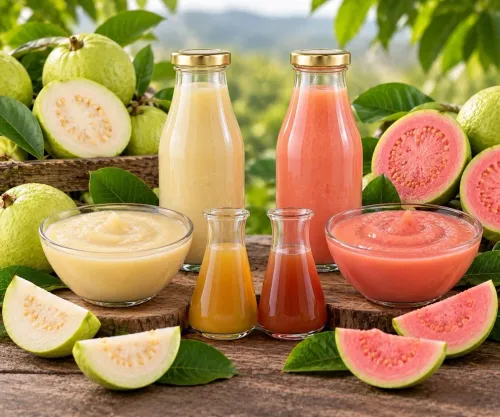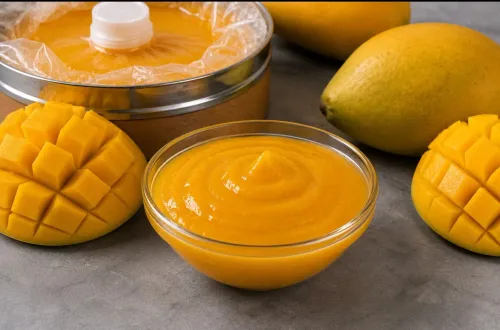

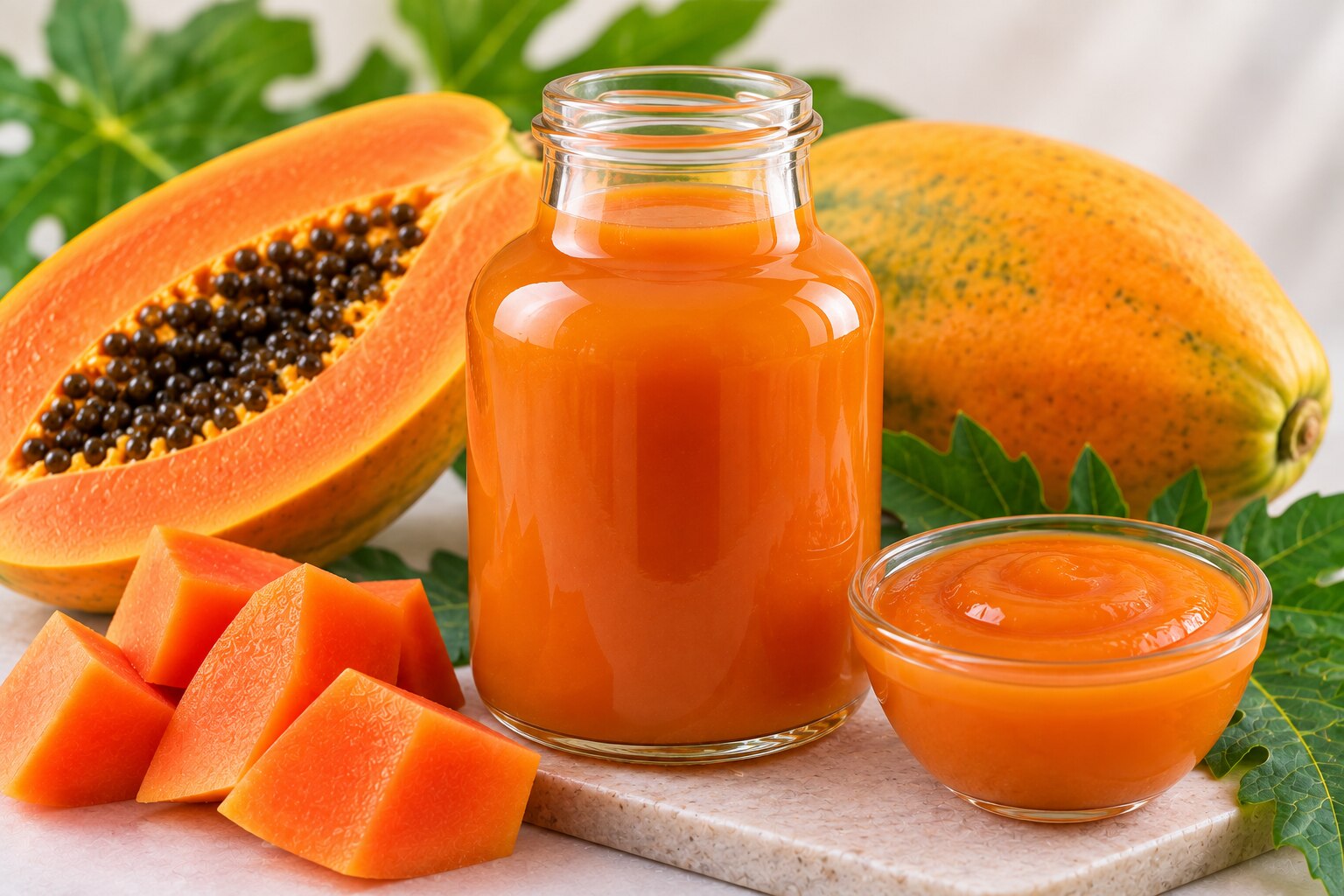
Papaya concentrate gives product developers fruit solids, tropical colour and flavour with less water to transport than puree, but its performance changes sharply between a beverage, yoghurt, sauce and baked filling. By the end, you will be able to select the right papaya format, calculate a defensible use rate, specify the checks for approval and compare delivered supplier costs rather than relying on price per kilogram.
Key takeaways
- Choose concentrate when you need controlled fruit solids in ambient recipes.
- Compare Brix, pH, colour, flavour and microbiological results before approving a supplier.
- Run pilot batches before fixing dosage, processing conditions and packaging specifications.
- Request the specification, certificate of analysis, allergen statement and traceability records.
Where papaya concentrate creates value in premium products
Papaya concentrate suits premium products that need consistent fruit solids, colour and flavour across seasonal variation: ambient beverages, fruit preparations, sauces, fillings and confectionery. Its value is highest when it standardises each batch, rather than serving only as a label ingredient.
Strong papaya concentrate applications for premium food brands London buyers assess include:
- Smoothies, nectar drinks, and cocktail or mocktail bases, where concentrated fruit character reduces transport volume.
- Yoghurt, dairy desserts, ice cream ripples, and fruit preparations, where controlled dosing supports repeatable flavour.
- Sauces, dressings, marinades, and tropical flavour blends, where papaya rounds acidity and adds colour.
- Bakery fillings, cake inclusions, jellies, and confectionery, where a consistent fruit component matters more than fresh pulp.
The best format depends on the sensory target and process tolerance.
| Option | Creates value | Limitation |
|---|---|---|
| Papaya concentrate | Standardised solids, colour and flavour with efficient bulk handling | Less pulp and fresh-fruit texture |
| Papaya puree | Fuller body, natural pulp and a more characterful profile | Greater storage volume and more viscosity variation |
| Papaya flavouring | Precise aroma at low use levels | Does not supply fruit solids, body or meaningful fruit content |
For papaya concentrate for food manufacturers, a development benchmark is about 60–65 °Brix, compared with roughly 8–12 °Brix for single-strength puree. Treat those figures as specification ranges, not universal standards; the finished product still needs sweetness, acidity and aroma balancing.
Concentrate, puree, juice or powder: which format fits the recipe?
Choose concentrate when you need papaya solids, colour and flavour without shipping the water carried by puree. It is the practical middle ground for premium drinks and fruit preparations, but heat, oxygen and storage can dull tropical notes and turn colour brown.
| Option | What it contributes | When it fits |
|---|---|---|
| Papaya concentrate | Fruit solids, colour, flavour and adjustable dilution; often around 60–65 °Brix | Beverages, sauces and fillings where transport efficiency and body matter |
| Papaya puree | More water, pulp and fresh-textured mouthfeel; roughly 8–12 °Brix for single-strength material | Smoothies, desserts and preparations needing visible fruit character |
| Papaya juice | A thinner, drink-oriented liquid with less body than puree | Clearer or lighter beverages |
| Papaya powder | Low water content and easy dry blending, but rehydration can change aroma and texture | Dry mixes, inclusions and powdered beverages |
| Flavouring | Aroma without papaya solids, colour or fruit texture | When fruit content, viscosity and particulate matter must stay low |
Use papaya concentrate for product development by testing it before and after the intended heat process, not only in cold water. A 60 °Brix concentrate contributes about 0.60 kg soluble solids per kilogram; reaching 10 °Brix takes roughly 6 kg finished product before losses and other ingredients.
It is the wrong choice when you need fresh-cut aroma, bright colour or intact pulp. Check pH and titratable acidity separately: papaya will not make a product shelf-stable. Test dairy, gelatine and protein systems for texture changes because residual papain activity can affect setting.
How to develop and scale a papaya formulation
Start with fruit solids, not litres. If the target is 6% papaya solids and the concentrate tests at 62°Brix, calculate 6 ÷ 0.62 = 9.7 kg concentrate for each 100 kg of finished product. Treat 60–65°Brix as a development benchmark, then use the supplier’s certificate result for the actual calculation.
1. Define the finished target: fruit solids, pH, sweetness, colour, viscosity and serving format. Record the intended process, pack and storage period before you make the first sample.
2. Prepare three 500 g bench samples around the calculated use rate, such as 80%, 100% and 120%. Use the actual matrix, not cold water; dairy, sauce, filling and beverage systems will change sediment, mouthfeel and flavour persistence.
3. Add ingredients in production order. Test papaya before and after heating, then adjust sugar, acid and water separately. Validate finished-product pH, because papaya concentrate does not make a low-acid formulation shelf-stable by itself.
4. Hold samples through the planned storage period and inspect colour, aroma, separation and viscosity. Test dairy, gelatine and protein recipes for setting or texture changes because papain activity can affect these systems.
5. Scale by multiplying each ingredient’s bench percentage by the pilot-batch mass, then correct for concentrate solids and water. Keep a retained sample and compare pilot results with the approved bench sample.
Papaya concentrate for product development earns approval only when it survives the real process. Papaya concentrate for food manufacturers is most useful when this repeatable calculation preserves flavour and fruit solids across larger batches.
The technical file to request before approving a UK ingredient
Do not approve the ingredient until its identity, composition, safety evidence and label treatment agree. A UK search for papaya concentrate supplier uk is not a technical approval.
| Document | Check for | Failure consequence |
|---|---|---|
| Product specification | Product category—concentrate, puree, preparation or compound—plus °Brix, pH, acidity, colour, ingredients, additives, microbiological limits and packaging | You cannot set a sound formula or ingredient declaration |
| Lot certificate of analysis | Results for soluble solids, pH, microbiology and agreed chemical tests, supplied per lot or under a written sampling plan | An off-specification delivery reaches production |
| Allergen and GMO statements | Explicit declarations, including “none intentionally added” where accurate | Your allergen matrix and customer information remain incomplete |
| Pesticide and contaminant evidence | Current compliance data for pesticide residues, heavy metals, mycotoxins and other limits relevant to the risk assessment | A compliant finished product cannot be demonstrated |
| Traceability record | Lot code, production date, origin, processor and one-step-back supplier information | A withdrawal becomes slow and untestable |
| Shelf-life and storage declaration | Unopened temperature, maximum life, freeze protection, aseptic-pack conditions and post-opening handling | Colour and tropical flavour deteriorate before use |
| Labelling statement | Correct ingredient name, fruit percentage basis, additives, origin information and permitted descriptive claims | The finished label misdescribes the product |
Ask the supplier to explain whether the reconstituted concentrate matches the relevant fruit-juice characteristics under Codex, then obtain a representative retained sample for your process trial. A generic “premium” certificate is not evidence.
Comparing suppliers, deliveries and storage in London
Compare a papaya concentrate supplier UK buyers are considering on measurable controls, not “premium” wording. Request the product specification, lot certificate of analysis or agreed sampling plan, allergen and GMO statements, pesticide and contaminant data, traceability record, processing history, packaging details, and shelf-life declaration.
Check °Brix, pH, titratable acidity, colour, viscosity, insoluble solids, microbiological limits and foreign-matter controls.
| Format | Delivery and storage question | Main risk to check |
|---|---|---|
| Aseptic bag-in-drum | Can the unopened lot remain ambient, and for how long? | Assuming aseptic means unlimited shelf life |
| Aseptic bag-in-box | Does the packaging suit your pump, warehouse and dispensing rate? | Damaging the bag or leaving product exposed after opening |
| Refrigerated format | What temperature must the carrier and your site maintain? | A warm delivery shortening usable life |
For bulk papaya concentrate London deliveries, agree the lot-specific storage temperature, maximum unopened shelf life, freezing protection and post-opening handling before placing an order. Inspect the seal, drum or box condition, lot code and temperature record at receipt; quarantine a leaking, swollen or unidentified pack.
Zeus India Enterprise is worth comparing through the same document and sample process as every other exporter, rather than accepting origin as a quality measure. Test a retained sample before and after your intended heat process: oxygen, heat and time can dull tropical aroma and turn colour brown.
Store opened concentrate according to the supplier’s written instruction and record opening date, operator and remaining quantity. Validate finished-product pH separately; papaya concentrate does not make a beverage shelf-stable by itself.
Related product
 | Papaya Concentrate Zeus India is a trusted exporter and supplier of premium Papaya Concentrate in India, delivering high-quality fruit ingredients to the global food... View product → |
Frequently asked questions
When does papaya concentrate create value in premium food products?
It creates value when a recipe needs consistent fruit solids, colour and flavour across seasonal raw-material variation. Applications include ambient beverages, fruit preparations, sauces, fillings and confectionery.
How does papaya concentrate compare with puree, juice and powder?
Concentrate suits recipes that need standardised fruit solids with less water than puree. Juice provides a more fluid fruit base, puree retains more body, and powder supports dry blends but requires controlled rehydration and dispersion.
What should you test when developing a papaya concentrate formulation?
Measure fruit solids, dosage, pH, colour, flavour, viscosity, microbiological results and performance after processing. Confirm the formulation in pilot batches before scaling production.
Which documents should you request from a UK papaya concentrate supplier?
Request the product specification, certificate of analysis, ingredient and allergen statement, nutritional information, country-of-origin details, traceability records, shelf-life information and storage instructions.
How should you compare papaya concentrate deliveries and storage in London?
Compare minimum order quantities, lead times, delivery conditions, batch documentation, packaging format, storage temperature and stock rotation. Check that your site can receive, identify and store each batch without breaking traceability.