
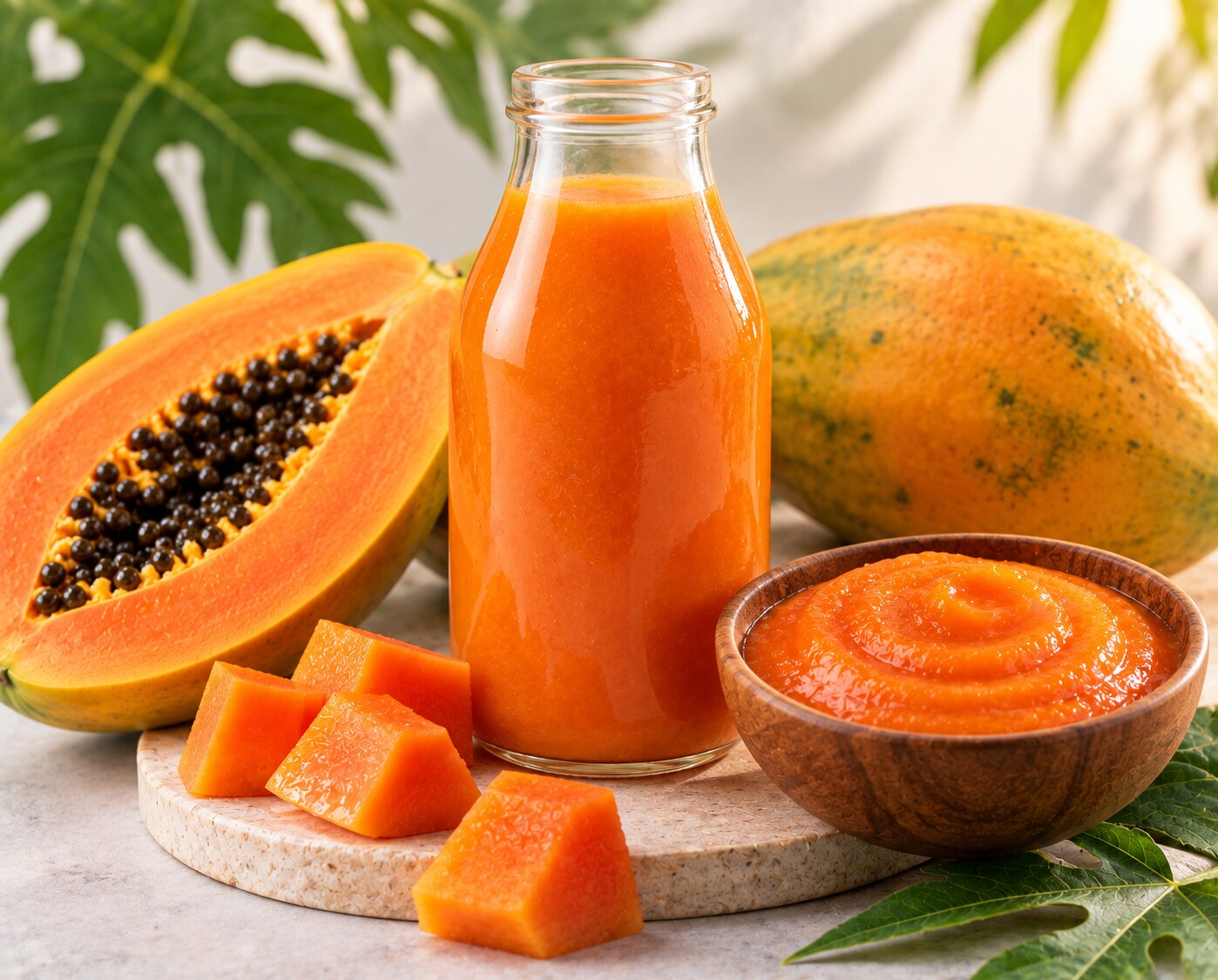
Papaya concentrate can support high-volume production when you formulate for its natural pulp, haze, viscosity, and variable acidity rather than treating it like a clarified juice concentrate. You will be able to judge the right beverage applications, calculate a workable starting formula, test process stability, and specify the evidence a supplier must provide before approval.
Key takeaways
- Use papaya concentrate in pulpy, hazy drinks rather than clear juice formulations.
- Calculate dosage from concentrate strength and target finished-fruit content.
- Test viscosity, separation, heat stability, and flavour after storage.
- Approve suppliers only after plant-scale trials and full batch documentation.
When papaya concentrate works at production scale
Papaya concentrate works at production scale in fruit drinks, nectars, smoothies, and blended beverages when the formulation is designed around its natural pulp, haze, viscosity, and relatively low acidity. Papaya concentrate industrial use is less suitable as a direct replacement for clarified apple, grape, or citrus juice concentrate.
| Beverage category | Production-scale fit | Form to specify |
|---|---|---|
| Fruit drinks and nectars | Strong fit as a sole or blended fruit base | Cloudy or pulpy; state target °Brix and viscosity |
| Smoothies | Strong fit where body and suspended fruit matter | Pulpy or cloudy, with sediment limits |
| Functional drinks | Fit when papaya is blended with higher-acid fruits or other ingredients | Clarified or cloudy, depending on mouthfeel and appearance |
| Dairy beverages | Fit only after protein, heat, and phase-stability trials | Fine-pulp or clarified; define particle size |
| Cocktail mixers | Fit when colour, haze, and settling are acceptable | Cloudy, pulpy, or clarified according to the serve |
| Clear juice-style drinks | Poor fit unless specially processed | Clarified concentrate with a defined haze limit |
Specify more than “papaya concentrate.” Name the physical form, aseptic or frozen supply, soluble-solids range, pulp or particle limit, colour range, and sedimentation tolerance. Crops and lots can shift aroma, colour, viscosity, and flavour intensity, so approve a retained reference sample and require a lot-specific certificate of analysis.
Check the finished drink’s legal designation—juice, juice from concentrate, nectar, or fruit drink—against its final recipe. Test pH after blending, because papaya concentrate’s pH does not establish the finished beverage’s acidity or process requirement.
How to calculate dosage, dilution, and finished-fruit content
Use measured soluble solids, not the word “concentrate,” to set dosage. For a mass-based formula:
1. Define the target fruit equivalent and its reference °Brix. For a 1,000 kg drink at 10% fruit equivalent and a 12°Bx reference, the target is 100 kg of 12°Bx juice equivalent.
2. Measure the supplier’s batch °Brix. If papaya concentrate tests at 30°Bx, calculate concentrate required as: 100 kg × 12 ÷ 30 = 40 kg.
3. Calculate dilution water by difference: finished batch mass minus concentrate, sugar, acids, stabilisers, and every other ingredient. Do not add water from a volume estimate; weigh it.
4. Recheck the blended drink’s °Brix, pH, titratable acidity, viscosity, and net batch mass. Correct the formula only after all ingredients are present.
One kilogram of 30°Bx concentrate supplies roughly the soluble solids of 2.5 kg at 12°Bx, before accounting for pulp, insoluble solids, density, added sugar, acids, or processing losses. That ratio estimates juice-equivalent solids; it does not prove that the final drink contains the same volume or sensory intensity as reconstituted juice.
For papaya concentrate for beverage manufacturers, specify whether “fruit content” means juice-equivalent solids, declared fruit percentage, or actual papaya ingredient mass. Confirm the definition against the finished product’s UK legal category, because the supplier’s technical description does not determine whether your label says juice, juice from concentrate, nectar, or fruit drink.
What happens during blending, heat treatment, and storage
Treat papaya concentrate as a process ingredient, not a fixed flavour dose. For papaya concentrate industrial use, blending can intensify sweetness, body, and orange colour while also increasing viscosity, pulp sediment, or phase separation between production lots.
1. Dilute a retained lot sample to the planned finished-fruit level, then blend it with the other juices, acids, stabilisers, and proteins. Measure viscosity, sediment, colour, and equilibrium pH after all ingredients are present; the concentrate’s pH does not predict the drink’s final pH.
Higher-acid fruit can sharpen flavour and improve colour balance, but pectin interactions can create haze or a settling layer.
2. Run the actual deaeration, homogenisation, pasteurisation, hot-fill, or aseptic process. Heat can strip fresh papaya aroma, darken colour, and create cooked notes, so judge the diluted beverage after processing rather than the concentrate in its drum. Control acidification against the finished beverage’s microbiological and preservative targets.
3. Hold packaged samples through the intended storage temperature and shelf life. Check for colour fading or browning, aroma loss, viscosity drift, serum separation, sediment compaction, and cap or pouch swelling. Record lot-specific results because crop and processing differences can change each outcome.
Papain and related proteolytic enzymes create a separate risk in milk, whey, collagen, and other protein drinks. Residual activity can break down proteins, changing haze, mouthfeel, and sedimentation; require an enzyme-activity check and a shelf-life challenge trial before approval.
How papaya concentrate compares with other fruit ingredients
A high-volume beverage benefits from concentrate when you need consistent fruit solids, pumpable bulk handling, and less storage volume than ready-to-use juice. Papaya concentrate for large beverage production is a weaker choice for a clear drink because its natural pulp, haze, viscosity, and sediment can defeat clarification targets.
| Option | Better choice when | Worse choice when |
|---|---|---|
| Papaya concentrate | You need scalable fruit character in nectar, smoothie, fruit drink, mixer, or blended beverage | The formula demands clear juice or a highly stable, bright colour |
| Papaya puree | You want fuller pulp, body, and fresh papaya impact | Pumps, heat exchangers, or fillers cannot handle higher viscosity |
| NFC juice | You need a closer-to-juice profile with simple dilution | Freight, tank capacity, and refrigerated handling outweigh flavour benefits |
| Fruit powder | You need low water activity, compact transport, or dry blending | Complete hydration, lump prevention, and uniform dispersion would slow production |
| Flavouring | You need aroma adjustment without materially increasing fruit solids | The label, nutrition claim, or finished flavour requires genuine papaya content |
Papaya concentrate for beverage manufacturers works best as one fruit component, paired with higher-acid or more flavour-stable juices when the recipe needs sharper flavour or better colour control. Compare suppliers using actual fruit solids, not the word “concentrate,” and test sediment, phase separation, and flavour after processing.
The concentrate’s form also affects the legal result: adding it does not automatically make a drink “juice from concentrate.” Check whether the finished formula qualifies as juice, nectar, or fruit drink under UK compositional and labelling rules.
The supplier and plant trial checks that determine suitability
Approve a source only after its concentrate passes a written specification and your own production trial. Brix alone cannot predict flavour, sediment, viscosity, or finished-drink stability.
1. Request lot-specific certificates of analysis for soluble solids, pH, titratable acidity, pulp or insoluble solids, viscosity, colour, flavour, microbiological limits, batch number, production date, and best-before date. Compare three lots with a retained reference sample and agreed acceptance ranges.
2. Confirm the commercial evidence: available annual volume, minimum order, aseptic bag or drum format, pallet configuration, storage temperature, shelf life, lead time, continuity plan, Incoterms, and export and import documents. A papaya concentrate UK supplier is suitable only if it can support your delivery schedule and traceability requirements.
3. Check regulatory evidence, including HACCP documentation, allergen and cross-contact statements, country-of-origin details, pesticide and contaminant declarations, and a product specification that identifies the concentrate as cloudy, pulpy, or clarified.
Confirm the finished recipe under the Fruit Juices and Fruit Nectars Regulations 2013 and UK labelling rules; “concentrate” on the supplier’s sheet does not decide whether your drink is legally juice, nectar, or a fruit drink.
4. Run a plant trial at production speed through blending, pasteurisation or hot filling, and storage. Measure finished-drink pH after all ingredients are added, final Brix, acidity, sediment, colour, viscosity, separation, flavour, and package performance.
For papaya concentrate for beverage manufacturers, approve the source only when the trial survives the intended shelf-life test without unacceptable settling or phase separation.
Zeus India Enterprise can be assessed against these same lot, documentation, and process-trial criteria rather than its location or product description alone.
Related product
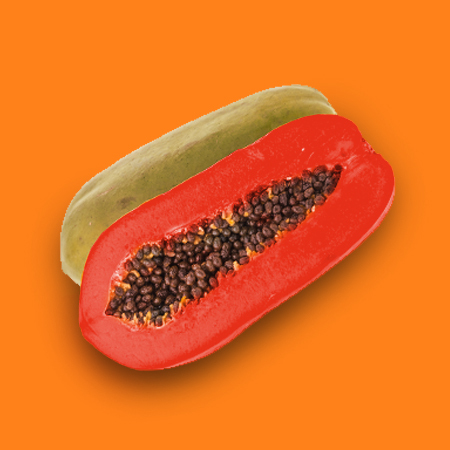 | Papaya Concentrate Zeus India is a trusted exporter and supplier of premium Papaya Concentrate in India, delivering high-quality fruit ingredients to the global food... View product → |
Frequently asked questions
When is papaya concentrate suitable for large beverage production?
It suits fruit drinks, nectars, smoothies, and blended beverages designed to retain papaya’s pulp, haze, viscosity, and relatively low acidity.
How do you calculate papaya concentrate dosage?
Use the concentrate’s declared soluble-solids content and your target finished-fruit content, then confirm the calculation through a pilot or plant trial.
What should you test during heat treatment and storage?
Check colour, flavour, viscosity, pulp distribution, separation, sediment, microbial stability, and package performance after processing and storage.
How should beverage manufacturers assess a papaya concentrate supplier?
Request the specification, batch traceability, microbiological results, allergen and food-safety documentation, export paperwork, and samples for a controlled plant trial.