

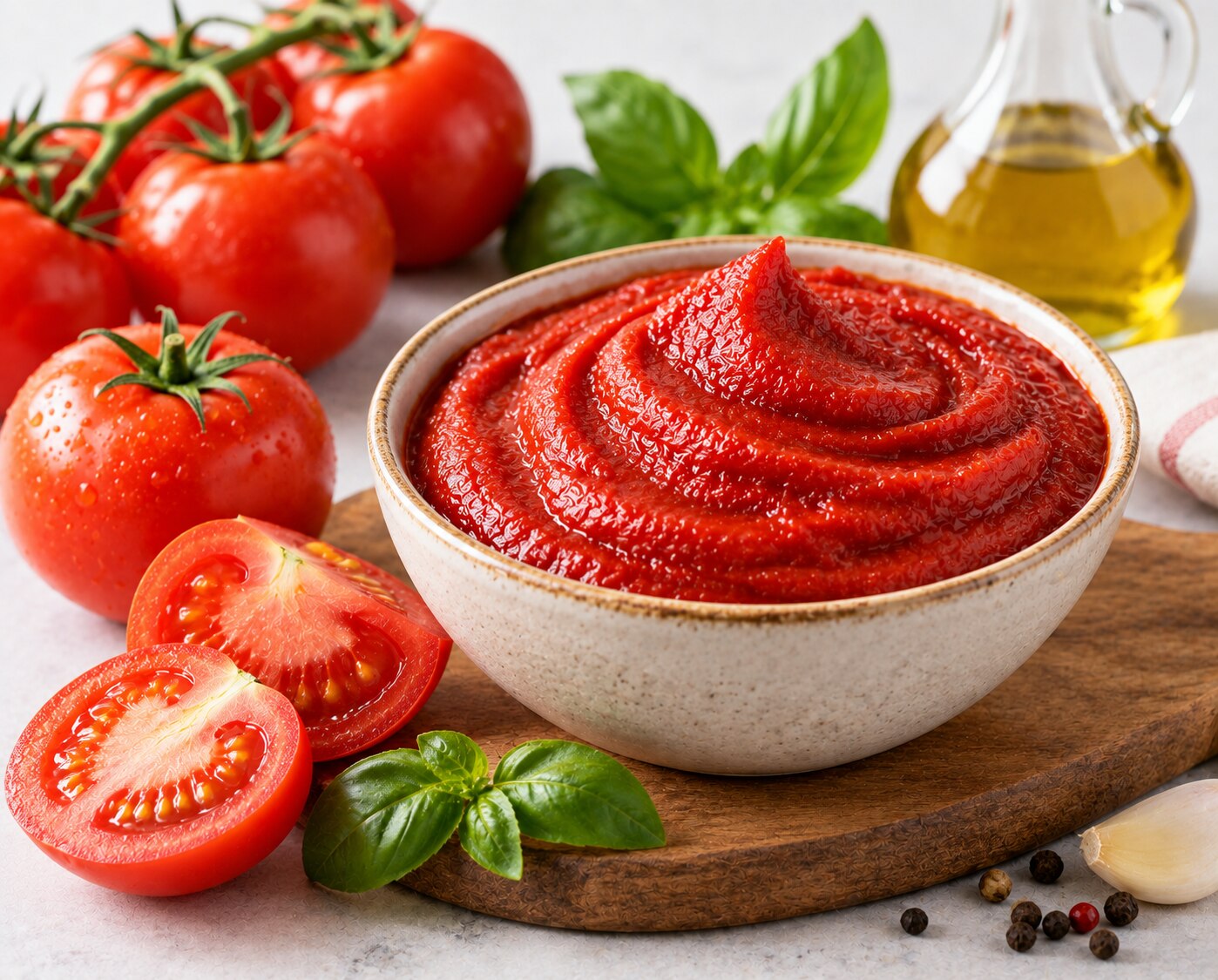
Tomato paste is the right ingredient when you need controlled tomato flavour and solids with less water, trimming, and seasonal variability than fresh fruit. By the end, you can match it to your product, calculate the required quantity, approve a batch, test its process performance, and compare suppliers on more than delivered price.
Key takeaways
- Match tomato paste to your finished product and required tomato solids.
- Approve batches using solids, colour, acidity, and microbiological data.
- Run a plant trial before replacing fresh tomatoes or other concentrates.
- Check receiving, storage, traceability, and supplier documents before buying in bulk.
Start with the product you are making, not the word “paste”
Ketchup, cooking sauces, soups, gravies, ready meals, snack seasonings, and marinades can use tomato paste when you need concentrated tomato solids, controlled water addition, and repeatable colour.
- Choose it for ketchup, pizza and pasta sauces, gravies, soups, and ready meals that need body without carrying excess water.
- Use it in snack seasonings and marinades when the formulation can disperse a thick ingredient or when you first dilute it.
- Avoid it when you need fresh tomato pieces, raw tomato aroma, or a loose pourable texture.
The buying question for tomato paste for processed food companies in Bengaluru is not simply whether the ingredient is thick.
Codex defines tomato paste as tomato concentrate with at least 24% natural soluble solids; 28°–30° Brix paste removes more water from your recipe than lower-Brix puree, but it can also demand more mixing and pumping power.
| Option | Water, flavour, and handling | Best fit |
|---|---|---|
| Fresh tomatoes | Highest water, fresh flavour, more sorting and processing labour | Products needing pieces or fresh notes |
| Puree | Lower concentration, easier dispersion, higher water load | Soups, sauces, and lighter formulations |
| Pulp | Tomato flesh and texture, with variable particles | Chunky sauces and ready meals |
| Paste or concentrate | Concentrated solids, cooked flavour, efficient storage; viscosity needs checking | Ketchup, sauces, gravies, soups, seasonings |
| Tomato powder | Low water and long storage potential, but dusting and rehydration affect flavour | Dry seasonings and mixes |
Aseptic paste is not your finished product’s safety treatment. Validate the final cooking, hot-fill, retort, or aseptic process with the chosen ingredient.
Set the solids specification and approve the batch with data
Specify tomato paste by natural soluble solids, not by the word “paste.” Codex sets tomato paste at a minimum of 24% natural soluble solids, so your purchase specification must state the target Brix, permitted range, and measurement method—such as refractometer soluble solids—because Brix alone does not prove tomato solids.
| Specification choice | Recipe effect | Purchasing decision |
|---|---|---|
| 24% Brix paste | More water enters per kilogram of paste | Use when the formula can tolerate extra cooking or dilution control |
| Higher-Brix paste | Less paste is needed for the same tomato-solids contribution | Compare cost per kilogram of tomato solids, not price per pack |
| Unstated “paste” grade | Yield and cooking load cannot be calculated reliably | Reject the specification until solids and method are defined |
Calculate usage from the target tomato solids: required paste weight equals required tomato-solids weight divided by the paste’s solids fraction. A 100 kg formula needing 12 kg of tomato solids requires 50 kg of 24% paste before accounting for process losses.
Approve each lot against a certificate of analysis and retained sample. Check:
- pH and titratable acidity
- Colour, viscosity or consistency, flavour, and salt
- Seeds, skin particles, foreign matter, and preservatives
- Aerobic plate count, yeast and mould, coliforms, and pathogens against your finished-product limits
- Pack integrity, lot traceability, and raw-tomato campaign reference
For an industrial tomato paste India purchase, require lot-level data rather than a catalogue average; crop and concentration runs can shift colour, acidity, viscosity, and flavour.
Run the paste through your actual process before committing
A paste that performs well after dilution in a beaker can still split, scorch, block a pump, or produce an underfilled pack. Qualify it in the recipe and on the equipment that will make the commercial product.
1. Dilute the paste from the supplier’s stated Brix to your target formulation, then compare the finished colour, pH, titratable acidity, flavour, viscosity, sediment, and tomato solids against your current ingredient. Record the water added and the resulting yield.
2. Run the trial through the planned cooking profile. Check dispersion, heat transfer, sticking, viscosity changes, and colour loss; concentrated paste can demand more shear and alter the residence time needed for a uniform sauce, soup, gravy, or marinade.
3. Test the actual filling route. Measure flow, fill-weight variation, nozzle or piston blockage, and seal cleanliness during hot filling or aseptic filling. For retort products, assess separation, scorching, pack deformation, and post-process viscosity after the scheduled time and temperature.
4. Freeze and thaw a sample if the product will be frozen, and test emulsified or particulate products after storage. Check oil separation, serum release, particle settling, and texture alongside the final flavour.
Aseptic paste protects the unopened ingredient, not the finished food. Validate your own cooking, hot-fill, retort, or aseptic process and confirm shelf stability through the packed product; a bench sample cannot prove either filling performance or ambient safety.
Control bulk receiving, storage, and supplier documentation
A damaged aseptic bag can erase the shelf-life advantage before production starts. Receive bulk tomato paste in Bengaluru against the purchase specification, not a catalogue description.
- Check bag-in-box liners for swelling, punctures, wet cartons, broken seals, and illegible lot codes; inspect drums for dents, rust, bulging, leaks, and tampered closures.
- Record supplier lot, pack number, quantity, vehicle number, arrival date, product temperature, warehouse temperature, and any heat exposure or delivery delay.
- Quarantine leaking, swollen, unlabelled, or temperature-abused packs until the supplier investigates. Store unopened packs in the conditions stated on the validated pack specification.
- After opening, use clean, sanitised equipment; protect the outlet from dust and contact, reseal only with an approved method, mark the opening time, and set a written use-by window. Aseptic packaging does not make an opened pack contamination-proof.
Request a lot-level certificate of analysis, traceability to the tomato campaign, retain-sample details, and a complaint-and-liability procedure. Zeus India Enterprise belongs on a comparison list only after it supplies these records for the exact pack and lot offered.
| Supplier comparison | Ask for | Flag |
|---|---|---|
| Specification | Brix, pH, acidity, colour, viscosity, salt, particles, microbiology | “Food-grade” only |
| Consistency | Multi-lot results and retains | One sample only |
| Pack format | Aseptic bag, drum size, seal design | Handling mismatch |
| Commercial terms | MOQ, lead time, delivered cost, continuity | Unclear replenishment |
| Delivery and export | Delivery window, invoice, packing list, COA, origin or health documents when required | Missing destination documents |
| Support | Trial guidance and technical response time | No process support |
Related product
 | Tomato Paste Zeus India is a trusted exporter and supplier of premium Tomato Paste in India, delivering high-quality tomato-based ingredients to the global food... View product → |
Make the Bengaluru go-or-no-go decision
Choose tomato paste when its higher solids reduce cooking time, water handling, and batch variability enough to outweigh harder dispersion and the purchase cost. For a 28°–30° Brix paste, calculate the required quantity from target tomato solids: paste quantity equals required tomato solids divided by paste solids.
Do not assume a lower-Brix puree gives the same yield.
Paste is the stronger option when your Bengaluru plant needs:
- Less water to evaporate from sauces, ketchup, soups, gravies, or ready meals.
- Fewer fresh-tomato receiving, sorting, washing, trimming, and spoilage steps.
- More compact storage and steadier production outside the fresh-tomato campaign.
- A specification that stays available through agreed minimum order quantity, lead time, and delivered-cost terms.
Fresh tomatoes or lower-concentration puree remain sensible when fresh flavour, pulp texture, short supply distance, or a low-solids recipe matters more than evaporation and storage efficiency. Powder suits applications that need very low water, but rehydration, flavour, colour, and dispersion require separate validation.
Before approving the switch, complete four checks:
- Compare final yield, cooking time, viscosity, pumping, colour, acidity, flavour, sediment, and filling performance in the finished process.
- Confirm unopened-pack shelf life, storage conditions, and continuity across production campaigns.
- Verify the applicable FSSAI standard, additives, contaminants, packaging, and labelling requirements.
- For exports, check destination-country residue limits, allergen declarations, testing, documents, and packaging rules. Use Codex as a benchmark, not as a replacement for Indian or destination-market review.
Frequently asked questions
Which processed foods can use industrial tomato paste?
Ketchup, cooking sauces, soups, gravies, ready meals, snack seasonings, and marinades can use tomato paste when concentrated tomato solids, controlled water addition, and repeatable colour fit the formula.
What data should you check before approving a tomato paste batch?
Set the required soluble-solids specification and review the supplier’s batch data for solids, colour, acidity, microbiological results, batch identification, and other agreed quality parameters.
Why should Bengaluru food companies run a process trial?
A plant trial shows how the paste behaves in your actual mixing, heating, filling, and storage process before you commit to bulk supply.
What should you verify when receiving bulk tomato paste?
Check container condition, seal integrity, lot or batch number, delivery temperature requirements, storage conditions, shelf life, traceability records, and the supplier’s accompanying documentation.
When is tomato paste the wrong choice?
Reject it when its solids, colour, flavour, acidity, texture, packaging, or process performance fails your product specification or raises handling and storage costs beyond the benefit of concentration.