
Dessert manufacturers need to know whether Totapuri puree will deliver the right flavour, acidity, colour and texture without creating extra work at the dosing line. By the end, you will be able to calculate a suitable inclusion rate, open and handle a drum safely, compare bulk formats and verify the lot documents before accepting delivery.
Key takeaways
- Balance Totapuri puree’s acidity before adjusting sweetness or fruit solids.
- Use sanitized equipment and controlled transfer temperatures when opening a puree drum.
- Check Brix, pH, acidity, colour, microbiology and packaging details on the COA.
- Choose drums for flexible batch production and larger systems for continuous dosing.
Why Totapuri works—and where it changes dessert formulation
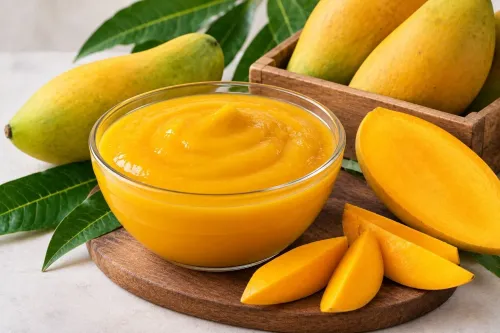
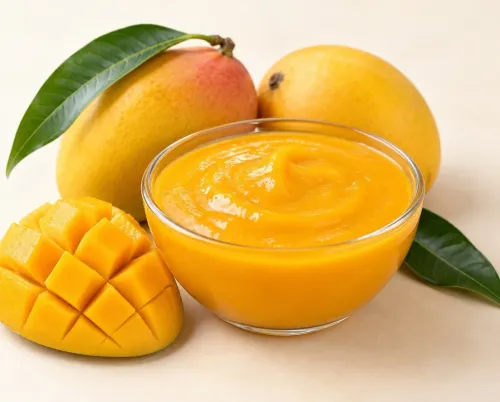
Totapuri works best when you want mango character with brightness, not maximum sweetness. Its aromatic, tangy flavour and acidity sharpen sorbet, gelato, yoghurt desserts, sauces and fruit toppings; its colour gives fillings and ripples visual impact.
Natural fibre adds body, while viscosity supports mousse and cheesecake filling but can make ice cream or sauce dosing heavier than expected.
| Option | Flavour and solids | Preservatives, storage and processing |
|---|---|---|
| aseptic Totapuri mango puree | Tangy, aromatic profile; puree-level soluble solids, with fibre and viscosity varying by lot | Often preservative-free; sterilised and filled into a pre-sterilised sealed bag; unopened storage follows the supplier’s validated ambient conditions |
| Alphonso puree | Sweeter, more floral and dessert-oriented; do not match it by weight without changing sugar and acid | Check the same lot controls; processing and storage depend on its pack |
| sweetened mango pulp | Mango flavour is combined with added sugar, so recipe sweetness and soluble solids rise | Read the sugar and preservative declaration; storage follows the pack specification |
| mango concentrate | Higher soluble solids and stronger fruit impact per kilogram; it is not a one-for-one puree replacement | Requires dilution and controlled reformulation |
| frozen puree | Fresh-like puree profile can vary after thawing; freezing affects warehouse and handling needs | Requires continuous frozen storage and thaw control |
| drum-packed non-aseptic pulp | Flavour and solids depend on the pack and preservation method | Requires the stated refrigerated or controlled storage and a validated thermal process |
Aseptic Totapuri mango puree cannot replace fresh mango pulp or sweeter Alphonso puree directly. Buy against lot-specific °Brix, pH, titratable acidity, colour, viscosity, fibre, microbiological limits and additive status; consistency matters more than the cultivar name.
How to formulate with puree instead of fresh mango
Do not replace fresh mango pulp kilogram for kilogram: puree can bring a different solids level, acidity, fibre content and viscosity. For mango puree for dessert manufacturing, measure °Brix or total soluble solids for the lot before changing sugar, water or fruit content.
1. Set the target inclusion and calculate the puree mass. For a 500 kg dessert batch at 12% puree inclusion, use 60 kg puree and formulate the remaining 440 kg around that addition. The 12% rate is a worked formulation example, not a universal dosage.
2. Calculate the puree’s contribution to total solids from its measured °Brix. Then adjust added sugar, water and any other fruit preparation so the finished dessert reaches its intended sweetness, yield and total-solids target. Treat the puree’s acidity as a measured input, not as a generic mango value.
3. Use acidity to balance yoghurt desserts, sauces and fruit toppings. A more acidic puree increases sourness and can reduce yoghurt protein stability, while sauces and toppings may need changes to sugar, acid and setting components for the intended taste and spread.
4. Use fibre and viscosity to set the stabiliser and water level. They affect aeration and firmness in mousse, sliceability in cheesecake filling, and body, overrun and freezing behaviour in ice cream, gelato and other frozen desserts.
5. Confirm the finished product’s pH, water activity, texture and heat treatment on the actual line. A puree specification cannot replace process validation.
How to open, transfer and dose a bulk puree drum
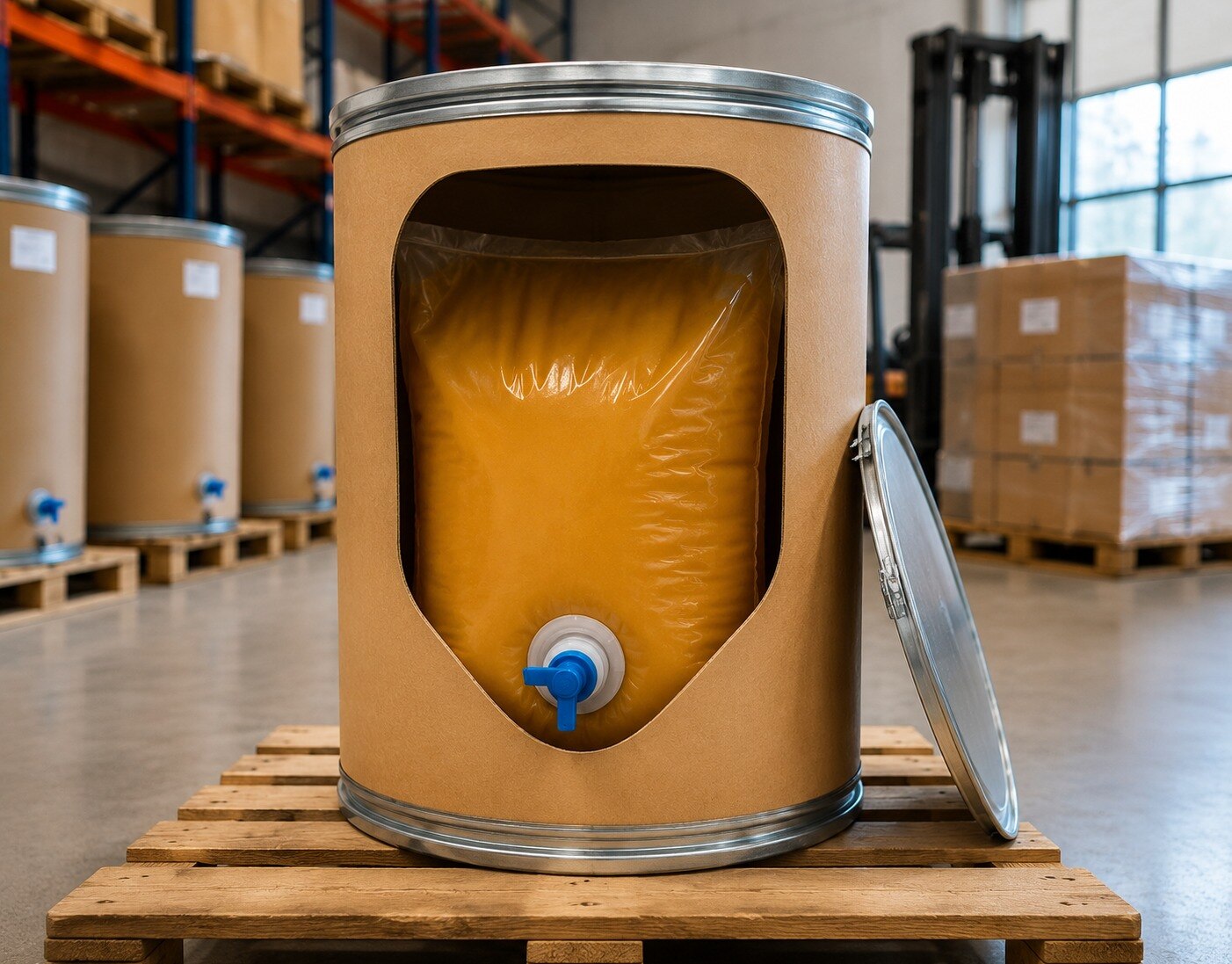
Treat Totapuri mango puree in aseptic bag in drum as a bulk processing ingredient, not a ready-to-use retail pouch. The drum supplies mechanical protection and handling support; the multilayer bag is the sterile barrier. An undamaged drum therefore does not prove that the product package is intact.
1. Receive the drum with trained handling staff, a pallet truck or forklift, and a clean, stable staging area. Check for forklift impact, sharp edges, dents, distortion and swelling. Reject or quarantine damage until the inner package is assessed.
2. Before opening, examine the liner, fitment, closure and seal. Look for punctures, abrasion, loose connections, leakage or product residue. Rough decanting or a hidden puncture can contaminate the puree even when the outer drum looks sound.
3. Clean and sanitise the transfer area, pump, hose, clamps and dispensing connection. Use food-contact equipment suitable for acidic puree, and keep the fitment protected from hands, dirty surfaces and splashback.
4. Secure the drum, expose the bag carefully and cut only the outer packaging or designated access material. Do not cut across the bag, fitment or closure. Connect the sanitised pump or dispensing assembly without touching the product-contact opening.
5. Transfer the puree hygienically into the dosing vessel or directly to the production line. Mix it before dosing if separation or settling is visible, then confirm the pump delivers a steady flow.
6. Label any remainder with the opening time and lot number. Refrigerate and protect it under the plant’s defined hygienic, refrigerated and validated post-opening procedure; aseptic packaging does not preserve sterility after opening.
What the specification sheet and certificate of analysis must prove
Approve a lot only when its documents prove both product conformity and plant usability. Request a specification sheet and certificate of analysis tied to the lot, not a generic mango puree sheet.
1. Require Brix or total soluble solids, pH, titratable acidity, viscosity, colour, flavour, pulp or fibre content, foreign-matter controls, and microbiological limits. State the test method, units, acceptance range, and result for that lot.
2. Record preservative status, allergen statement, country of origin, lot number, manufacture date, stated shelf life, remaining shelf life at delivery, and the lot-traceability path back to fruit, processing, filling, and release records.
3. Confirm net fill tolerance, drum dimensions, pallet pattern, storage temperature, maximum stacking height, minimum order quantity, and delivery conditions. Missing values can force relabelling, repacking, unsafe stacking, or warehouse delays before totapuri puree bulk packaging reaches production.
4. Ask whether the bag, fitment, and closure are qualified for acidic fruit, oxygen exposure, temperature range, and your filling or dispensing system. Food-contact suitability belongs to these components; the outer drum alone proves neither it nor package integrity.
5. Identify the process as aseptic or hot filled. Aseptic processing separately sterilises the product and package zones, while hot filling depends on product temperature and package sterilisation conditions; do not accept interchangeable storage or commissioning claims.
Use the same lot-specific checklist to evaluate Zeus India Enterprise: compare its evidence, tolerances, and traceability with competing suppliers rather than approving a product name alone.
Related product
 | Totapuri Mango Puree Zeus India is a trusted exporter and supplier of premium Totapuri Mango Puree in India, offering high-quality fruit-based ingredients for the global... View product → |
Which bulk format fits continuous dessert production?
For continuous dessert production, aseptic bag-in-drum usually suits high batch frequency because one bulk unit replaces many smaller containers. It reduces opening events, packaging waste and labour per kilogram, while unopened puree can remain at ambient temperature when the supplier’s validated storage conditions are followed.
| Option | Warehouse, storage and waste | Handling, equipment and dosing fit |
|---|---|---|
| Aseptic bag-in-drum | Compact per kilogram; no freezer before opening; least packaging waste among bulk choices | Needs forklift or drum lifter, safe decanting and a hygienic pump or transfer setup; strong fit for continuous dosing; MOQ may be higher |
| Aseptic carton | Easier to move manually and useful at lower volumes; more cartons and closures per kilogram | Fast to open, but carton collapse and fitment compatibility can limit automated dosing |
| Bag-in-box | Moderate footprint and waste; ambient storage depends on the validated pack | Suits intermediate throughput and pump transfer; less mechanical protection than a drum |
| Frozen drum | Requires freezer space, frozen inventory control and an unbroken cold chain; thawing consumes time and energy | Mechanical handling is required; dosing waits for controlled thawing, so scheduling is less flexible |
| Smaller pouch | Simple manual handling at low volume, but many opening and waste events | Labour-intensive for frequent batches; poor fit for continuous dosing unless a pouch-depacking system exists |
A drum is not a sterile barrier: the sealed multilayer bag is. Inspect and open it without damaging the fitment, then control the exposed puree under the plant’s refrigerated, hygienic post-opening procedure.
Choose by batch frequency, line design, storage capacity, equipment compatibility, MOQ and post-opening controls—not drum price alone.
Frequently asked questions
Why does Totapuri mango puree suit dessert production?
Totapuri provides aromatic mango flavour, bright acidity and strong colour for sorbet, gelato, yoghurt desserts, sauces and toppings.
How should you formulate desserts with Totapuri puree instead of fresh mango?
Account for the puree’s soluble solids, acidity, water content and flavour concentration rather than substituting it gram for gram for fresh mango.
How do you open and transfer puree from an aseptic bag in a drum?
Inspect the drum and seal, sanitise the connection point and transfer the puree through clean, suitable equipment using a controlled process.
What must a Totapuri mango puree specification sheet and COA include?
Check Brix, pH, titratable acidity, colour, viscosity or consistency, microbiological limits, allergens, batch identification, packaging and test results.
Which bulk packaging format suits continuous dessert production?
Aseptic bag-in-drum packaging suits controlled batch handling, while larger bulk systems suit operations with continuous pumping and regular consumption.