
Guava puree is practical when your product benefits from fruit pulp, aroma and body, but it creates technical work that clear juice and high-speed filling lines may not tolerate. By comparing applications, puree formats, specifications and process risks, you can decide whether it belongs in your London production plan and what to demand from a supplier.
Key takeaways
- Use guava puree when your product needs pulp, suspended solids and fuller mouthfeel.
- Choose white or pink puree according to colour, flavour and finished-product appearance.
- Compare puree, concentrate, preparation and flavouring against your target texture and label.
- Specify pack format, variety, Brix, microbiology, shelf life and delivery conditions before ordering.
When does guava puree work in juice production?
Guava puree works in juice production when the product is designed to carry pulp, not merely guava flavour. Aseptic bags or frozen bulk packs give London manufacturers a steadier year-round input than fragile, seasonal fresh fruit. The puree brings fuller mouthfeel, suspended solids and aroma, but also raises viscosity, sedimentation and filler loading.
Guava puree for juice production is not interchangeable with concentrate: dilute and standardise it with water, sugar or other fruit ingredients, then test the finished drink for sweetness, acidity, viscosity and microbial stability. A narrow-orifice filler may need a finer screen specification, while a high-pulp smoothie can accept more suspended material.
- Still juice and nectar: use puree for body and visible pulp, then control settling through homogenisation and continuous tank agitation.
- Juice blends: combine it with sharper or more acidic fruit to balance guava’s rounded sweetness and moderate acidity.
- Smoothies: retain more pulp for a dense texture, but confirm that the pump, pipework and filler can handle the load.
- Drinking yoghurt: standardise viscosity and stabilise the pulp so storage does not produce a watery top layer.
- Functional beverages: strain more aggressively when sediment or a gritty sensation conflicts with the intended clean finish.
For guava puree for juice and dessert manufacturers London buyers, the screen or sieve limit is critical: hard seed fragments and fibres that suit a spoonable product can block valves or make a beverage unpleasant. Confirm the agreed screen specification before production, and test each incoming lot for foreign material, colour and consistency.
Which guava puree suits desserts and finished product appearance?
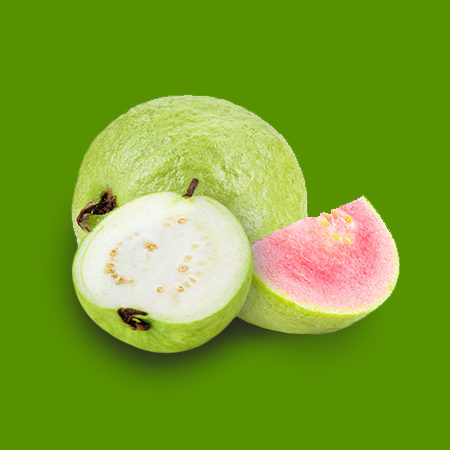
White guava puree is the safer choice for pale, clean-looking desserts; pink guava puree is better when colour and aroma should announce the fruit. Both work in guava puree for dessert manufacturing because retained pulp adds body to sorbets, ice creams, mousses, yoghurt preparations, fillings and fruit layers.
| Puree | Finished appearance and flavour | Best dessert fit |
|---|---|---|
| White guava | Cream, ivory or pale yellow; delicate aroma; leaves space for added colours and layered presentation | Cheesecakes, pale mousses, yoghurt desserts, white chocolate fillings and neutral sauces |
| Pink guava | Pink to red tone; stronger visual impact and more pronounced guava aroma | Sorbets, ice creams, jellies, fruit inserts, bakery fillings and brightly coloured sauces |
Do not buy on “white” or “pink” alone. Cultivar, ripeness and heat processing shift the final shade, so request a colour range, reference sample and aroma description; this protects visual consistency across batches.
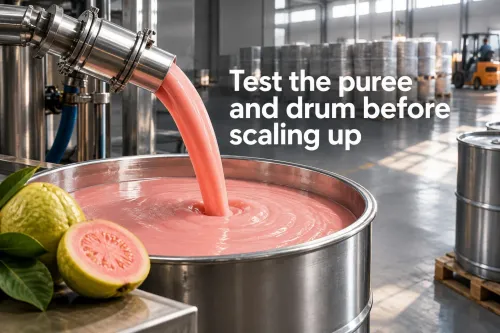
Pulp also changes texture. A coarse puree can leave seed fragments, fibre or a grainy perception, while insufficient homogenisation can cause settling in a fruit layer or sauce. Specify the sieve or screen size and test the puree in the finished recipe, not only in the drum.
For white pink guava puree supply into London, compare samples under the dessert’s actual lighting and storage conditions. A pink puree that looks attractive at filling may darken or separate during storage; a white puree may need fruit colour or a stronger flavour system to remain recognisable.
Should you buy puree, concentrate, preparation or flavouring?
Choose puree when the finished product needs guava body, pulp and natural fruit solids. Choose concentrate when shipping volume and dosing efficiency matter more than mouthfeel; it must be diluted and standardised, so it is not a direct substitute for puree.
Preparation suits a ready-formulated filling or dessert component, while flavouring supplies aroma with little colour, acidity or texture.
| Option | Main advantage | Operational trade-off |
|---|---|---|
| Puree | Full flavour, pulp and thicker mouthfeel | Needs straining, mixing or homogenisation; sediment and filling-line loading need control |
| Concentrate | Lower water volume and efficient dosing | Requires dilution and sweetness/acidity adjustment; gives less natural body |
| Preparation | Consistent fruit filling or dessert base | Recipe is less flexible and may include sugar, acid or stabilisers |
| Flavouring | Strong aroma at low dosage | Cannot replace guava solids, colour or texture |
For a bulk guava puree london order, compare landed cost rather than the quoted kilogram price: include bags or drums, pallet configuration, freight, customs, sampling, storage and packaging disposal. Aseptic supply fits a factory with limited freezer space because unopened bags travel and store at ambient temperature under the validated conditions.
After opening, refrigerate and use within the supplier’s stated period. Frozen packs suit factories with dependable freezer capacity but add frozen freight, thawing time and warehouse demand.
Chilled puree reduces thawing work but shortens the usable window and raises cold-chain risk. Ask Zeus India Enterprise to quote the same specification in aseptic and frozen formats so your production schedule, storage cost and waste risk are compared fairly.
Related product
 | White and Pink Guava Puree Zeus India is a trusted exporter and supplier of premium White Guava Puree and Pink Guava Puree in India, catering to the growing demands of the... View product → |
What should a London buyer specify before placing an order?
A bulk guava puree London quote is incomplete without a specification, import file and landed-cost calculation. Confirm whether the product is single-strength or concentrated, its soluble-solids range, pH or acidity range, sieve limit, microbiological limits, preservative status, packaging, storage temperature, shelf life, country of origin and lot coding.
Do not assume “100% fruit”, “natural” or “no added sugar” without written confirmation.
Ask the supplier for:
- The commodity classification and tariff code, commercial invoice, packing list, origin statement and any UK import documents required for the exact processed product; fresh-fruit phytosanitary rules do not automatically apply.
- Traceability records linking the lot to fruit origin, production date and batch-release results.
- The drum or bag-in-box size, pallet pattern, net weight, sampling arrangements and packaging-disposal responsibility.
- Freight, insurance, port, customs, storage and disposal charges, including whether transport is ambient or frozen. Aseptic and frozen prices are not comparable until these costs are included.
- A defined colour standard and screen result, not just the words “white” or “pink”.
| Offer | Specify before approval | Main comparison |
|---|---|---|
| White guava puree | Pale colour range, aroma intensity and particle limit | Suits light-coloured products where visual uniformity matters |
| Pink guava puree | Pink-to-red colour range, aroma intensity and particle limit | Suits products where stronger colour and guava identity are desirable |
Treat white pink guava puree supply as a colour-controlled ingredient, not a cultivar label alone: maturity and processing can change the finished shade.
How do you control guava puree failures during processing?
Control failures by standardising the incoming puree, matching it to your equipment, and validating the recipe on the actual production line.
1. Set acceptance limits for colour, Brix, acidity, viscosity, pulp, seed fragments and aroma. Compare every lot against an approved reference sample; otherwise colour variation can reach juice or dessert packs before anyone detects it.
2. Run a pre-production sample through the same pump, sieve, homogeniser and filler. Guava puree for juice production carries more suspended solids than concentrate, so excessive viscosity can overload dosing equipment, while inadequate straining leaves seeds and fibre in the finished drink.
3. Reduce separation and sediment by controlling particle size, stabiliser, homogenisation and tank agitation. Keep the puree moving during filling; a settled tank produces weak flavour at the start and heavy pulp at the end.
4. Limit oxidation by minimising headspace, air entrainment and unnecessary holding time. Use closed transfers and protect the puree from heat, because oxidation dulls colour and removes fresh guava aroma.
5. Keep unopened aseptic packs intact and follow the supplier’s storage instruction. After opening, refrigerate promptly, use clean equipment and define a short hold time; damaged seals, warm storage or slow use can permit fermentation and microbial growth.
6. For guava puree for dessert manufacturing, adjust stabilisation and homogenisation to prevent graininess in ice cream, sorbet, mousse or fruit layers. Check texture after freezing, thawing and storage, not only at mixing.
7. Taste the finished product after processing and shelf-life checks. Correct dilution, sugar, acidity and heat exposure before flavour loss becomes a customer complaint.
Frequently asked questions
When does guava puree work in juice production?
Guava puree suits juice products designed to carry pulp and suspended solids. It adds fuller mouthfeel and aroma but requires control of viscosity, sedimentation and filler loading.
Which guava puree suits desserts and finished product appearance?
Choose white or pink guava puree according to the dessert’s intended colour, flavour profile and visual finish. Confirm how the puree behaves after mixing, heating and storage.
Should you buy puree, concentrate, preparation or flavouring?
Buy puree when you need guava solids and natural fruit texture. Compare concentrate, preparation and flavouring when you need higher soluble solids, a controlled formulation or guava aroma without pulp.
What should a London buyer specify before placing an order?
Specify guava variety, colour, Brix, particle or pulp requirements, pack format, storage temperature, shelf life, microbiological limits, documentation and delivery conditions.
How do you control guava puree failures during processing?
Control puree failures by checking viscosity, sedimentation, thawing or aseptic handling, mixing order, heat treatment, filler capability and storage stability before full production.