
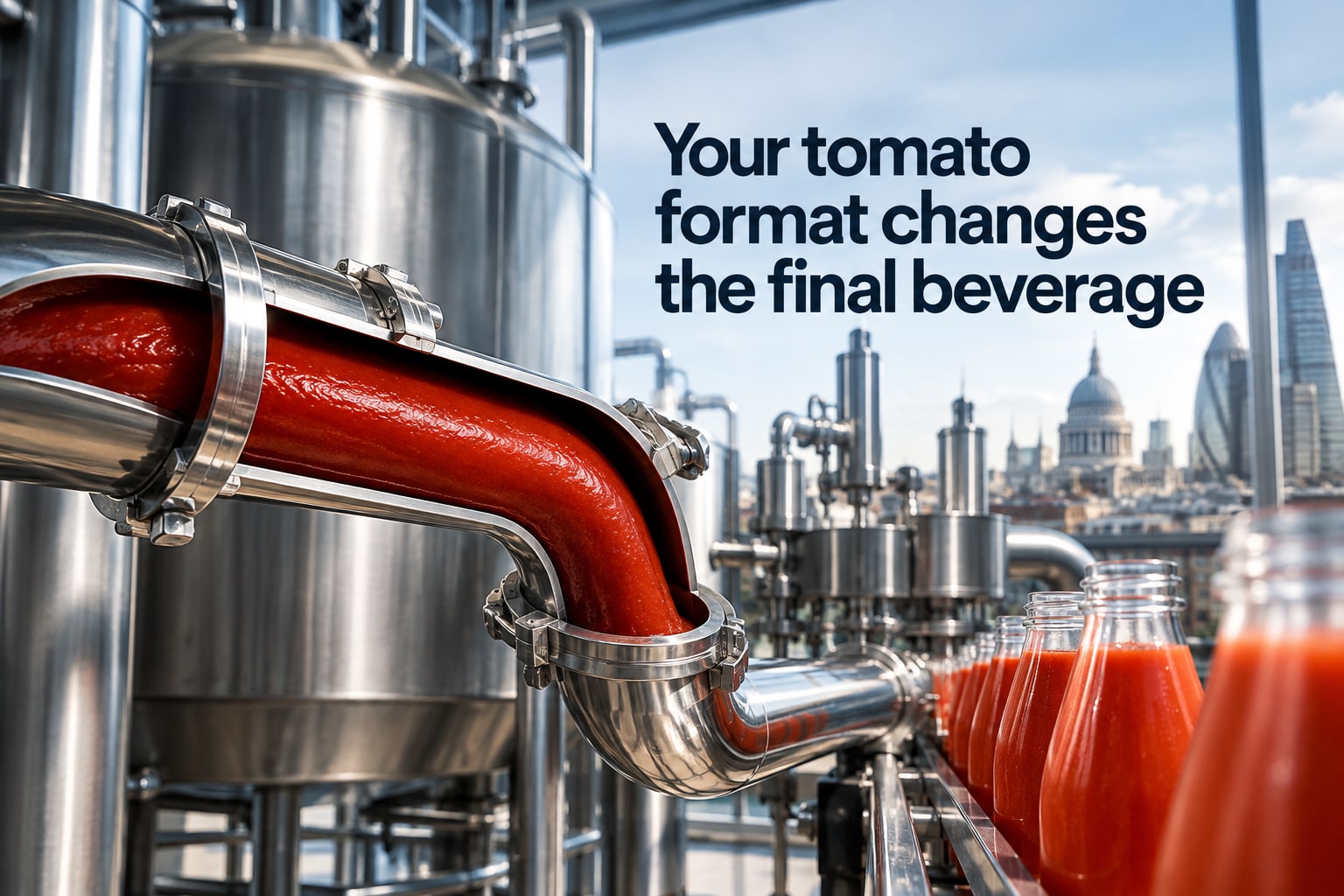
A beverage plant does not move tomato paste directly from a delivery pack into a finished drink. The ingredient passes through controlled steps that determine its concentration, texture, safety, transport requirements and final performance. By following that route, you can specify the right paste, calculate a workable dose and trace it from UK receipt to beverage dispatch.
Key takeaways
- Check Brix, colour, viscosity and pH before approving tomato paste.
- Reconstitute paste with measured water, then standardise solids and acidity.
- Choose paste, purée, passata, juice or concentrate for the required beverage texture.
- Verify aseptic seals, batch records and import documents before London receipt.
From Fresh Tomatoes to Aseptic Paste: The Processing Sequence
Fresh tomatoes become aseptic paste through controlled removal of dirt, water, skins, seeds and air. The industrial tomato paste production line also determines the concentrate’s body, colour, microbial stability and suitability for later beverage reconstitution.
- Receive ripe tomatoes, record the supplier lot and inspect for mould, damage and foreign material.
- Wash the tomatoes with potable water, then sort out defective fruit, leaves, stones and other debris.
- Crush the fruit and apply a hot-break treatment, heating it quickly to inactivate pectin-methylesterase and retain a thicker body. A cold-break process produces a more fluid paste.
- Pass the crushed tomatoes through pulpers and refiners. Screens remove skins and seeds before concentration.
- Evaporate water under vacuum and controlled temperature. Soluble solids rise, commonly to about 28–30 °Brix; Codex defines tomato paste at a minimum of 24% natural soluble solids.
- Check acidity, pH, colour, viscosity, particle size and residual seeds or skin against the purchase specification.
- Pasteurise or sterilise the concentrate to control microorganisms.
- Fill the hot, commercially sterile paste into pre-sterilised bags or containers, seal it, code each lot and dispatch it.
An intact aseptic pack can travel and remain unopened without refrigerated storage. A torn bag or failed closure breaks that barrier, while contamination during opening, transfer or mixing creates a separate hazard requiring hygienic controls and traceability into the finished beverage batch.
Which Paste Controls Determine Beverage Performance?
Approve a lot against the certificate of analysis, not the recipe name. A specification for tomato paste for beverage manufacturers must state the actual soluble-solids result, because Brix is a mass-based measure, not a guarantee of tomato flavour or red colour.
| Property | Check before approval | What failure causes |
|---|---|---|
| Soluble solids | Confirm actual °Brix; Codex tomato paste starts at 24%, while common grades are 28–30 °Brix | Incorrect dosing, weak body or excessive sweetness and acidity after dilution |
| pH and acidity | Record pH and titratable acidity, then compare them with the beverage target | Unsafe or unstable product, or a sharp flavour that salt and seasoning cannot correct |
| Viscosity | Test at a defined temperature, shear rate and solids level | Poor dispersion, pumping problems or a drink that feels thin or pasty |
| Colour | Measure colour with a defined method, such as a Hunter or CIE result, and inspect for browning | A dull, brown beverage despite acceptable Brix |
| Particle size | Confirm fine refining and the absence of visible skins, seeds and hard fibres | Sediment, nozzle blockage or gritty texture |
| Microbial stability | Review the lot’s heat-process, aseptic-fill and microbiological records | Spoilage after opening or contamination during transfer |
Industrial tomato paste production does not make every 28 °Brix lot equivalent. Calculate paste quantity from the lot’s measured Brix, target beverage Brix, water addition and density; 1 kg at 28 °Brix contributes about 0.28 kg of soluble solids. Also retain the lot code and sample, linking them to the finished beverage batch.
How Beverage Plants Reconstitute and Standardise Tomato Paste
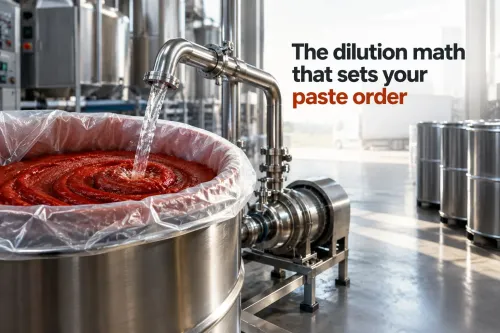
Start with a smooth liquid phase, not a tank of cold water. For tomato paste for beverage manufacturers, blend part of the process water with paste to make a pumpable slurry, then add that slurry slowly into the main vessel under agitation. This prevents dry pockets and lumps that a mixer cannot easily break later.
1. Warm the water to the process specification and start agitation before adding paste. Use an inline disperser or high-shear mixer for viscous paste, but avoid drawing air into the tank.
2. Reconstitute to the target soluble-solids level using the certificate-of-analysis Brix. A 28 °Brix paste supplies about 0.28 kg of soluble solids per kilogram; calculate the required paste mass against the beverage’s target Brix, water addition and density.
3. Standardise pH or titratable acidity, salt, sugar, spices and pulp level after the paste is fully dispersed. Taste and measure again because Brix does not predict tomato flavour, colour or salt perception.
4. Homogenise when the formula needs finer pulp and lower separation, then deaerate to limit oxidation and colour loss. Apply the validated final heat process for microbial safety and fill under hygienic conditions.
These controls matter across bulk tomato paste applications, including savoury drinks, bloody-Mary-style mixers and vegetable beverages. Opened aseptic bags lose their protection at the cut point, so treat opening, transfer and mixing as HACCP control steps; a damaged seal requires investigation before use.
Choosing Paste, Purée, Passata, Juice or Concentrate
Choose paste for a concentrated, stable tomato base; choose juice when the liquid itself is the product. The right format depends on the drink’s required body, smoothness, solids and processing load.
| Format | Best fit | Main trade-off |
|---|---|---|
| Tomato paste | Tomato juice, savoury drinks, Bloody Mary-style mixers, soups, sauces and composite beverages | Requires controlled reconstitution and dispersing |
| Purée | Drinks needing fresh tomato body with moderate solids | More volume, water and storage cost |
| Passata | Smooth premium drinks where seed and skin removal matters | Less concentrated; contributes less tomato solids per kilogram |
| Tomato juice | Ready-to-drink beverages where a thin, pourable base is required | Least efficient for transport and later standardisation |
| Tomato concentrate | High-solids recipes, drink bases and bulk tomato paste applications | Strong flavour and viscosity demand careful dosing |
Codex defines tomato paste at a minimum of 24% natural soluble solids; commercial grades commonly measure 28–30 °Brix. A higher-solids concentrate reduces freight and dosing volume, but two products at the same °Brix can still differ in colour, viscosity and separation.
Calculate paste dose from soluble solids, not a guessed weight. Use:
Paste required = finished beverage mass × target tomato solids ÷ paste °Brix fraction
For 1,000 kg at 6 °Brix using 30 °Brix paste: 1,000 × 0.06 ÷ 0.30 = 200 kg paste. Add water and other ingredients to the final batch weight, then recheck °Brix, acidity, salt and pulp level after mixing.
The London Supply Chain from Import Receipt to Beverage Dispatch
An importer or food business in London remains responsible for checking that incoming paste complies with UK food law and that the finished drink is safe. The route normally runs from port or customs-controlled receipt to a dry warehouse, then into the beverage plant and onward distribution.
1. Receive the consignment against the commercial invoice, packing list, lot codes and certificate of analysis. Check container condition, bag integrity, seal numbers, product identity, net weight and declared soluble solids.
2. Place aseptic bags in clean, dry ambient storage while unopened. A damaged bag, leaking closure or failed seal is a microbiological failure, not merely a packaging defect; non-aseptic paste and opened packs require controlled refrigeration and a defined use-by period.
3. Release each lot only after reviewing pH, °Brix, colour, viscosity, microbiological results and foreign-material controls against your beverage specification. A common commercial range is 28–30 °Brix, while Codex defines tomato paste at not less than 24% natural soluble solids.
4. Link the paste lot to the receiving record, batch sheet, finished-drink code and distribution invoice. Retain a labelled sample so you can investigate separation, flavour drift or a customer complaint without guessing which material entered the tank.
5. Before selecting a supplier, ask for pack dimensions, closure design, storage limits, maximum time after opening, lead time, transport conditions and recall procedure. Zeus India Enterprise is worth assessing by requesting these records alongside a beverage-use sample, rather than judging paste on concentration alone.
These checks apply across bulk tomato paste applications, including tomato drinks, savoury mixers, soups, sauces and composite beverages. Dispatch the finished product only after release records reconcile the ingredient lot with the beverage batch.
Related product
 | Tomato Paste Zeus India is a trusted exporter and supplier of premium Tomato Paste in India, delivering high-quality tomato-based ingredients to the global food... View product → |
Frequently asked questions
What are the main tomato paste processing steps?
The sequence removes dirt, stems, skins, seeds and water before concentrating, deaerating, heat treating and aseptically packing the paste.
Which paste controls affect beverage performance?
Brix, colour, viscosity, pH, acidity, microbial results, foreign-matter controls and aseptic package integrity affect the finished beverage.
How do beverage plants reconstitute tomato paste?
Plants disperse paste into measured water, mix until uniform, then adjust soluble solids, acidity, salt, viscosity and flavour against the beverage specification.
When should you choose paste instead of purée, passata, juice or concentrate?
Choose paste for efficient bulk storage and controlled reconstitution; use purée or passata for a fresher, thinner profile, juice for a ready liquid base and concentrate for higher-solids formulations.
What happens to tomato paste through the London supply chain?
The process covers import documentation, receipt checks, aseptic container inspection, batch traceability, controlled storage, production release and beverage dispatch.